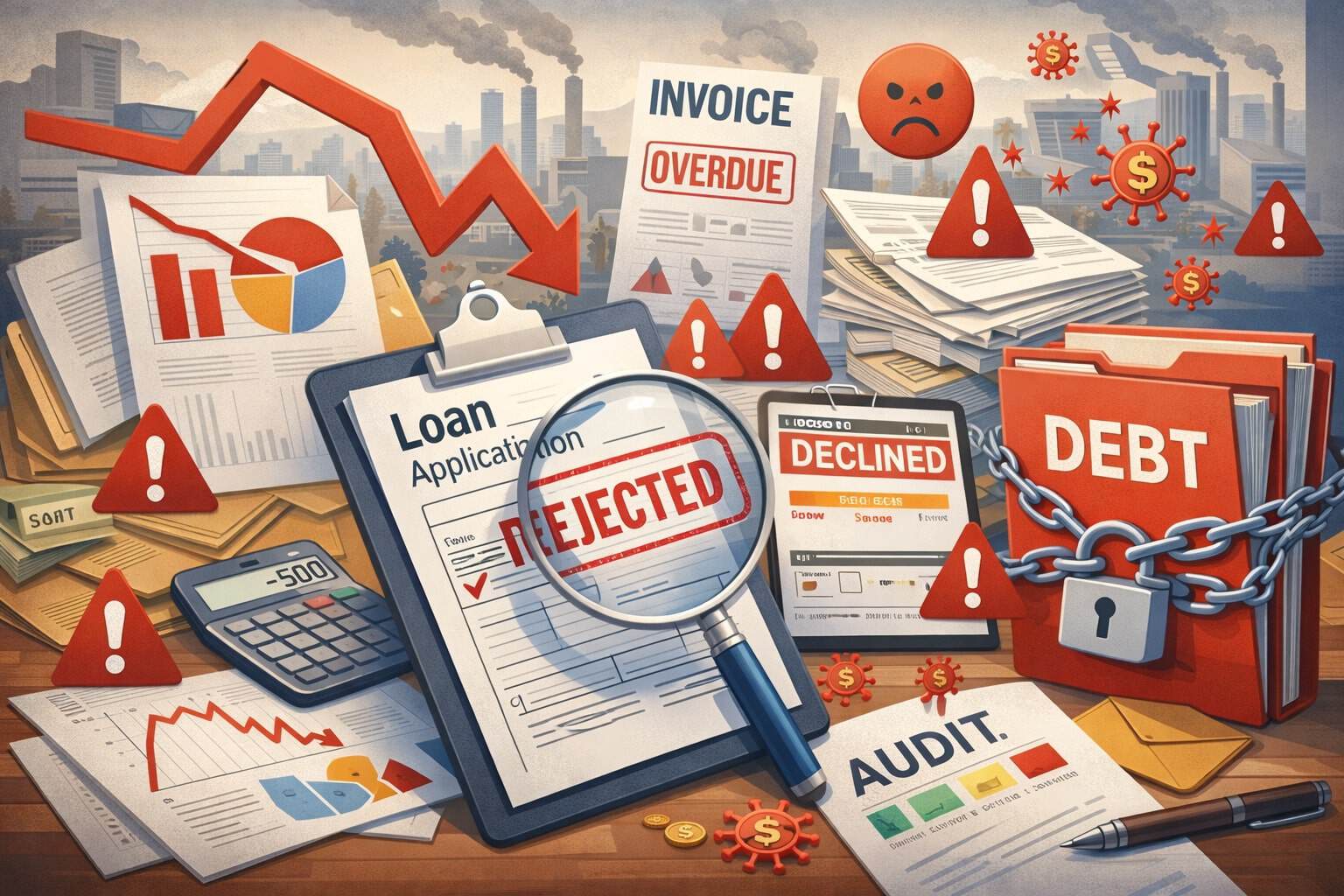
Financial Red Flags That Hurt Funding Approval
Getting funding isn’t just about having a “good idea.” Underwriters and credit teams look for proof that your business can repay, stay compliant, and withstand shocks.
The fastest way to lose an approval (or get worse terms) is to trigger financial red flags—patterns in your cash flow, records, tax posture, credit profile, and documentation that signal higher risk.
This guide breaks down the financial red flags that hurt funding approval, explains why each one matters, and shows how to fix them before you apply. You’ll also see how underwriting is evolving—especially as lenders rely more on bank-transaction data and cash-flow analytics.
How Funding Decisions Are Really Made (and Why “Red Flags” Matter)

Funding approval is usually a structured risk decision, not a vibe check. Most lenders—whether banks, credit unions, online lenders, or SBA-participating lenders—aim to answer three questions: Can you repay? Will you repay? Can we verify everything?
The “can you repay” part shows up in cash flow, profitability, and debt capacity. The “will you repay” part is influenced by payment history, credit behavior, and how you’ve handled past obligations. The “verify everything” part covers documentation quality, consistency, and compliance.
This is where financial red flags become decisive. Underwriting models and manual reviewers are trained to treat certain signals as predictors of charge-offs and defaults: unstable cash flow, unexplained deposits, irregular financial statements, tax liens, sudden debt spikes, or gaps between bank statements and your profit-and-loss report.
Many declines are not because the business is “bad,” but because the lender can’t confidently quantify risk, confirm income, or validate the story.
Another major shift: lenders are increasingly using cash-flow underwriting—bank transaction data and cash-flow variables—especially for small businesses and newer credit products. That means your day-to-day banking patterns can now create financial red flags even if your annual revenue looks strong on paper.
The practical takeaway is simple: you should treat funding approval like an audit of clarity, consistency, and capacity. If any part of your financial picture is confusing, inconsistent, or fragile, you create financial red flags. Fixing those issues can be the difference between approval and decline—or between average terms and excellent terms.
Bank, SBA, and Online Lenders: Same Goal, Different “Red Flag” Triggers
Different funding sources use different toolkits, but they’re often allergic to the same categories of financial red flags. Traditional lenders usually emphasize documented cash flow, conservative debt coverage, and clean documentation.
SBA-participating lenders commonly require strong evidence of ability to repay and tend to rely heavily on historical cash flow and required documentation for eligibility and use of proceeds.
Online lenders and fintech lenders may approve faster, but they often monitor bank-statement behavior more aggressively—because they can. Cash flow volatility, negative days, frequent overdrafts, or irregular deposits can become immediate financial red flags.
So even if you’re shopping multiple options, don’t assume “someone will say yes.” If the core financial red flags exist, you’ll either get declined everywhere—or approved only at expensive terms (high factor rates, short terms, aggressive covenants). The cheapest capital almost always goes to the businesses with the fewest financial red flags.
The Rise of Cash-Flow Underwriting (and What It Means for You)
Cash-flow underwriting is changing what “creditworthy” looks like. Instead of relying only on a credit score and tax returns, lenders increasingly analyze bank transactions to measure income stability, expense discipline, seasonality, and repayment capacity. Industry research and lender reports describe this shift as a meaningful evolution in credit decisioning.
That’s good news if your books are thin but your bank activity is strong. It’s bad news if your bank account is messy.
In a cash-flow underwriting world, financial red flags can include: too many cash deposits with unclear source, revenue concentration visible in deposits, irregular payroll patterns, repeated “low balance” stretches, or heavy reliance on merchant cash advances that drain daily cash.
This trend also creates a new reality: your “real” financial story is not only what you report in your P&L, but what your bank transactions prove. If those two stories don’t match, that mismatch itself becomes one of the biggest financial red flags.
Unstable Cash Flow and Weak Debt Coverage

If you want to predict a decline, start with repayment capacity. Lenders care less about how much revenue you generate and more about how reliably you generate free cash flow after expenses. A business can do seven figures in sales and still fail underwriting if cash flow is unpredictable or too thin to support debt payments.
One of the most common financial red flags is unstable monthly net cash flow. This shows up as revenue spikes followed by weak months, or steady sales paired with erratic expenses that eat margins.
Underwriters notice volatility because volatility increases default risk. If your revenue is seasonal, you need to show you understand seasonality and can manage through low periods.
A related financial red flag is weak “debt coverage”—your ability to pay loan obligations from operating cash flow. Many lenders use a debt service concept (often discussed as debt service coverage) and want to see breathing room.
When your coverage is tight, one bad month can put you behind. That’s why “barely enough” cash flow is often treated the same as “not enough.”
To reduce this category of financial red flags, you want to demonstrate repeatability: consistent deposits, predictable margins, and an operating cushion. You also want to align requested loan payments with your real cash cycle. A common mistake is applying for a payment size that fits your best month instead of your average month.
“Revenue Looks Great” but Cash Is Always Tight: The Working Capital Trap
A classic funding killer is strong sales paired with constant cash stress. Lenders see this pattern and flag it because it often signals: slow collections, poor inventory control, thin margins, or overspending. If you’re growing fast, it’s easy to create financial red flags by reinvesting every dollar while leaving no buffer for debt payments.
Underwriters often validate this in the bank statements. If you’re routinely dropping to low balances, bouncing payments, or relying on last-minute transfers, it suggests the business is operating without slack. In a cash-flow underwriting environment, those low-balance patterns become bright financial red flags.
The fix is to show controlled working capital: faster receivables, tighter payables strategy, inventory discipline, and a documented cash forecast. Even a simple 13-week cash flow forecast can help you explain dips and prove the business is managed proactively rather than reactively.
Too Much Existing Debt (and the MCA “Cash Flow Squeeze”)
Another major set of financial red flags comes from stacking obligations—especially short-term daily/weekly repayment products. If you already have multiple loans, lines, or merchant cash advances (MCAs), underwriters may worry you’re using new funding to plug holes rather than invest for return.
The danger isn’t only the total debt—it’s the payment structure. Daily withdrawals can crush liquidity and create a “silent default risk” even when sales are okay. Lenders will often see this in withdrawals on bank statements and treat it as a major financial red flag.
If you’re in this position, the best move is usually to restructure: consolidate into fewer obligations, extend term length, and reduce daily payment pressure. Your goal is to present a cleaner cash profile where the new loan improves stability instead of escalating risk.
Messy Financial Statements and Inconsistent Reporting

Strong numbers don’t help if lenders can’t trust them. Some of the most damaging financial red flags are documentation-based: inconsistent financial statements, mismatched totals, unexplained adjustments, or books that don’t reconcile to tax returns and bank activity.
Underwriters are trained to look for consistency across documents: P&L, balance sheet, tax returns, bank statements, and payment processing statements (if relevant).
If your P&L says one thing but your bank deposits say another, you create a credibility problem. Credibility problems are financial red flags because they can indicate errors, aggressive accounting, or misrepresentation.
Another frequent issue is “DIY bookkeeping” that lacks proper categorization. If expenses are lumped into vague buckets, or owners mix personal spending inside the business account, lenders have a harder time estimating true operating profit. The risk isn’t that you do it—it’s that it creates noise, and noise becomes financial red flags.
To fix this category, focus on three principles: reconcile monthly, standardize reporting, and be ready to explain anomalies in plain language. A clean, consistent financial package can sometimes offset weaker metrics because it reduces uncertainty.
The Tax Return vs. P&L Gap: Why Underwriters Get Suspicious
A large difference between your tax returns and your internal financial statements is one of the most common financial red flags. Tax returns often show lower profit due to write-offs, while internal statements may show higher profit.
Underwriters don’t automatically assume fraud, but they do assume risk: if the “real” profitability is unclear, repayment ability is unclear.
For many business loan programs, tax returns remain central documentation, and guidance around required documentation (including returns) is widely discussed in lending ecosystems and SBA-related lending workflows.
If your business legitimately has add-backs (one-time expenses, owner discretionary costs, non-cash depreciation), prepare a clear add-back schedule with brief explanations. The goal is to transform a financial red flag into a documented, reasonable adjustment that a lender can underwrite.
Thin or Missing Balance Sheet: The “Invisible Risk” Problem
Some owners focus only on profit and ignore the balance sheet. But lenders care about leverage, liquidity, and obligations—much of which lives on the balance sheet. Missing or unreliable balance sheets create financial red flags because the lender can’t confirm what you owe, what you own, or how stable your working capital really is.
Common balance-sheet financial red flags include negative equity, growing payables, ballooning credit card balances, and unexplained loans from owners. Even if your income statement looks decent, these signals can indicate stress.
A lender-friendly balance sheet doesn’t have to be perfect. It has to be accurate and explainable. If you have owner loans, document them. If you have stale AR, clean it up. If you have inventory, verify the valuation method and reconcile to reality.
High Leverage, Overextended Credit, and Utilization Spikes

Credit behavior is another area where financial red flags hurt funding approval. Lenders don’t just look at a score—they interpret patterns: utilization, recent inquiries, new tradelines, and payment history.
A business or owner with multiple new accounts in a short time can look like they’re “searching for cash,” which lenders interpret as distress.
High utilization is a classic financial red flag. If credit cards are near limits, it can signal dependence on revolving debt for payroll or basic expenses. Even if you pay on time, persistent high utilization suggests the business doesn’t generate enough free cash to operate comfortably.
Another financial red flag is a sudden spike in borrowing right before applying. Many owners do this to “bridge” a gap, but the lender sees it as a warning that cash is unstable. Some underwriting models penalize recent credit seeking because it correlates with default risk.
If you want to reduce these financial red flags, work backward from your application date: stabilize utilization, avoid unnecessary hard pulls, and show at least a few months of steady payment behavior. Lenders love boring, predictable credit profiles.
Personal Credit Spillover: When Owner Behavior Hurts Business Approval
Even for business funding, the owner’s credit behavior often matters—especially for small businesses, thin-file businesses, or personally guaranteed loans.
Underwriters view the owner as a secondary repayment source and a proxy for financial discipline. Missed payments, collections, or high personal utilization can become business funding financial red flags.
You don’t need perfect credit. You need a coherent story and a recent positive trend. If you had a rough period, you want to show recovery: balances declining, on-time streaks, and fewer derogatory events.
If your personal credit has issues, consider strengthening the business profile: more time in business, more cash reserves, cleaner financial statements, and stable bank activity. The objective is to ensure the decision isn’t forced to rely heavily on personal credit factors.
Too Many Payment Plans and “Hidden” Obligations
Underwriting also considers obligations that don’t always show up cleanly: payment plans with vendors, installment arrangements, or informal loans. When these are discovered late in the process, they become financial red flags because they signal incomplete disclosure.
Be proactive: list obligations in your debt schedule, match them to bank statement payments, and explain terms. Transparency reduces financial red flags more than people expect.
Tax Problems, Liens, and Government Collections
Tax issues are among the most damaging financial red flags because they imply both cash stress and compliance risk. If a business fell behind on taxes, a lender may assume future cash crunches could happen again. Tax debt can also create legal claims that complicate collateral and repayment priority.
A tax lien is especially serious in underwriting because it’s a public claim against assets and can restrict financing options. Many lenders will either decline or require the issue to be resolved before funding.
Consumer-education lenders and finance publications commonly highlight that some lenders may still approve but often with higher cost and tighter terms, reinforcing why this is a major financial red flag.
If you have tax issues, the best strategy is to address them head-on. Set up a formal resolution path and document it. Underwriters don’t just want to hear “we’re working on it.” They want proof: payment plans, compliance filings, and evidence you’re currently on ongoing obligations.
IRS Liens: Why They Scare Lenders (and What Helps)
When an IRS lien exists, lenders worry about repayment priority and reputational risk. Even when a lender is willing to consider funding, they often require steps that reduce the lien’s impact.
Some business finance guidance discusses options like IRS lien subordination or withdrawal processes (where available), which can improve lender comfort.
What helps most is structured resolution and current compliance. If you’re behind, catch up on filings. If you’re on a plan, show a history of on-time plan payments. If your accounting is messy, clean it so the lender can see you won’t repeat the problem.
The goal is to transform the tax problem from an uncontrolled financial red flag into a controlled, documented obligation.
Inconsistent Tax Filings, Late Returns, and “Missing Years”
Even without a lien, missing or late returns can become financial red flags. Underwriters interpret missing years as uncertainty. They also may suspect unreported income or unfiled liabilities.
If you’re applying for programs tied to government-backed lending ecosystems, documentation expectations can be strict, and lenders may seek historical returns and supporting documents.
If you’re behind, fix it before applying. If you can’t, be prepared for fewer options and higher costs. Funding markets price uncertainty, and missing tax documentation is uncertainty in its purest form.
Compliance and Transparency Gaps (KYC, Entity Details, Ownership)
Even if your finances are strong, compliance gaps can stop a deal. Lenders must follow “know your customer” (KYC) rules, verify business identity, and understand ownership/control. When entity documents are outdated or inconsistent, it creates financial red flags because it raises fraud and enforceability concerns.
Typical compliance-related financial red flags include: mismatched business addresses across filings, missing or expired IDs, inability to verify beneficial owners, irregular business registrations, and unclear signatory authority. These issues can delay funding or trigger a denial, even if cash flow supports repayment.
It’s also important to stay current on reporting and verification expectations. For example, beneficial ownership information (BOI) reporting requirements have been actively evolving, with major updates and legal developments affecting whether domestic companies must report and when.
Official and major-news coverage describes changing rules and enforcement posture, so lenders may still ask ownership questions even when a reporting obligation is paused or altered.
The practical point: treat ownership and entity documentation like part of your financial package. If your entity house is messy, lenders see it as operational risk—another form of financial red flags.
Ownership Confusion, Operating Agreements, and “Who Controls the Business?”
Lenders need to know who has authority to borrow and who benefits from the business. If your operating agreement is missing, outdated, or conflicts with filings, you create financial red flags that can halt underwriting.
Fixes include: updating operating agreements, ensuring EIN and registration data matches your real structure, documenting any ownership changes, and keeping signer authority documents ready.
If you’ve changed addresses or added partners, align every system: bank, tax filings, merchant processing, and state registrations. Consistency is the antidote to this category of financial red flags.
“Too Many Entities” and Intercompany Transfers
Multiple entities aren’t automatically bad. But unmanaged intercompany transfers become financial red flags because the lender can’t tell where profits actually live. If revenues flow into one account but expenses live in another, underwriting becomes harder.
If you operate multiple entities, prepare consolidated reporting and show clear transfer logic. Clean intercompany bookkeeping can turn an apparent financial red flag into an organized group structure.
Customer Concentration and Revenue Quality Risks
A business can look profitable while being dangerously fragile. One of the most underappreciated financial red flags is customer concentration—when too much revenue depends on a small number of customers, platforms, or contracts. If losing one relationship would materially reduce cash flow, the lender sees elevated risk.
Revenue quality also matters. Underwriters prefer revenue that is recurring, diversified, and contractually supported. If your revenue is one-time, promotion-driven, or dependent on a single marketplace policy, it can create financial red flags even when the numbers are large.
Customer concentration is easier to spot now because lenders can infer it from deposits (repeating large payments from the same source) or invoice patterns. In cash-flow underwriting models, this becomes a measurable risk factor rather than a subjective concern.
To reduce these financial red flags, build and document diversification: new customer acquisition channels, contract lengths, renewal rates, and pipeline strength. If concentration is unavoidable (common in certain B2B niches), the goal is to prove stability with long-term contracts, strong retention history, and contingency planning.
Platform Dependence: When a Policy Change Can Crush Cash Flow
If a platform controls your visibility, payments, or customer access, lenders may treat that dependency as a financial red flag. This includes scenarios like a single advertising channel, a single referral partner, or a single payment channel.
The fix is not always to abandon the platform. It’s to show redundancy: additional channels, direct customer relationships, email lists, and diversified payment acceptance. Underwriters like businesses that can survive a sudden platform change.
AR Quality: Slow-Paying Customers and “Paper Profits”
If your profit exists only on paper because receivables are slow, lenders will discount your earnings. Aged receivables, disputed invoices, and customer payment delays are financial red flags because they weaken real repayment capacity.
Bring an aging report. Show collection policies. Demonstrate improved days sales outstanding (DSO). These details help a lender view your AR as a reliable cash source rather than a financial red flag.
Inventory, Margin Pressure, and Bad Unit Economics
Another category of financial red flags is margin instability. If your gross margin is shrinking, inconsistent, or difficult to verify, lenders worry you can’t absorb shocks. A few common margin-related financial red flags include: rising cost of goods without price power, heavy discounting, high returns/chargebacks, and inventory shrinkage.
Inventory itself can be a financial red flag when it’s mismanaged. Too much inventory ties up cash. Too little inventory can limit sales and create revenue volatility. Old or obsolete inventory makes balance sheets unreliable. If your inventory valuation is unrealistic, lenders may treat your financial statements as inflated—again, financial red flags.
Underwriters want to see predictable unit economics: stable gross margin, controlled overhead, and clear paths to profitability. If you’re scaling, show that margin holds as volume grows. If your margins are thin, show operational discipline and strong cash management.
High Chargebacks, Refunds, and Disputes
For many businesses, a surge in disputes or refunds is one of the fastest-growing financial red flags. It signals either customer dissatisfaction, fulfillment issues, or risk of payment interruptions.
If chargebacks are elevated, document mitigation: updated fulfillment timelines, clearer policies, better customer support, fraud screening, and improved proof-of-delivery. A lender doesn’t need perfection—they need evidence that the trend is controlled.
Pricing Without Profit: Growth That Makes You Weaker
Some businesses grow revenue while losing money on each sale after true costs. Underwriters often spot this through margin compression and cash burn patterns. This is a brutal financial red flag because it suggests the business will need constant external capital to survive.
If this is you, focus on fixing pricing, reducing fulfillment costs, and narrowing product lines to profitable segments. Show a margin-improvement plan with real numbers and execution proof.
Banking Behavior and Account “Hygiene” Issues
Because of cash-flow underwriting, your bank statements are now a primary underwriting artifact. That means banking behavior can create financial red flags even if your financial statements look clean.
Repeated overdrafts, frequent negative balances, large unexplained cash deposits, constant balance hovering near zero, and irregular transfers can all trigger concern.
Some owners treat bank accounts like a pass-through: money in, money out, no reserve. Underwriters interpret that as fragility. If the account can’t maintain stability, it may not support a new loan payment.
Lenders also look for “source of funds” clarity. If deposits are inconsistent or unlabeled, it may raise compliance questions. This is especially true when deposits don’t align with invoicing or reported revenue.
Cash-flow underwriting research highlights that transaction-level variables can be meaningful in underwriting outcomes, which is why these patterns are increasingly important to fix.
Excessive Cash Deposits and Unclear Sources
Cash-heavy businesses aren’t automatically unfinanceable. But if deposits are frequent and poorly documented, it can become a financial red flag. Underwriters need to confirm revenue is legitimate and stable.
Best practice: deposit cash consistently, maintain daily sales logs, and reconcile cash deposits to POS reports or invoices. The more you can tie cash to verifiable business activity, the less it looks like a financial red flag.
“Too Many Transfers” and Owner Draw Chaos
If your account shows constant transfers between personal and business, the lender may struggle to measure real operating cash flow. Mixed accounts create financial red flags because they blur the business’s true performance.
Fix it with separation: dedicated business accounts, consistent owner pay strategy, and clear bookkeeping categories. Even two months of cleaner behavior before applying can materially reduce financial red flags.
Documentation, Legal, and Operational Red Flags That Look Financial
Some funding declines are blamed on “financials” when the real issue is operational readiness. Missing licenses, expired registrations, unclear contracts, unresolved lawsuits, or insurance gaps can indirectly become financial red flags because they threaten continuity.
From an underwriter’s viewpoint, anything that could interrupt revenue or create sudden expenses is a financial risk. That’s why legal disputes or regulatory penalties can stop funding. Even a small lawsuit can become a financial red flag if it indicates potential judgments or cash drain.
Operational clarity matters too. If you can’t explain your business model, customer acquisition, or expense drivers, the lender assumes poor management. Poor management is one of the most predictive financial red flags.
Prepare a lender-ready file: entity documents, IDs, bank statements, financials, tax documents, insurance proofs, major contracts, and a clean narrative of what you’re funding and why. The smoother you make verification, the fewer financial red flags you trigger.
Unclear Use of Funds: “Working Capital” Isn’t a Plan
Saying “working capital” is normal, but vague. If you can’t show where money goes and how it produces repayment capacity, the lender may see it as a financial red flag—especially if your recent cash flow is thin.
A strong request ties funds to outcomes: inventory that turns in 30–45 days, equipment that increases capacity, marketing with measured CAC and payback, or refinancing that lowers payment pressure. A clear plan reduces financial red flags because it gives the lender a rational repayment story.
Rapid Business Changes Without Documentation
Sudden changes—new ownership, new location, new industry focus, major staff reduction—can become financial red flags if they aren’t documented and explained. Underwriters prefer stability.
If change is positive (expansion, acquisition, new contract), bring proof. If change is corrective (closing an unprofitable location), show improved numbers after the change. The message should be: “Yes, we changed—and here’s the data showing the business is stronger now.”
How to Fix Financial Red Flags Before You Apply
The fastest way to improve approval odds is to run a “pre-underwriting” process on yourself. You’re trying to remove uncertainty. Most financial red flags are fixable—or at least explainable—if you prepare early.
Start with a 90-day cleanup plan:
- Banking cleanup: eliminate overdrafts, stabilize balances, reduce chaotic transfers, and document cash deposits.
- Bookkeeping cleanup: reconcile monthly, correct categorization, and ensure P&L matches bank reality.
- Debt cleanup: reduce high utilization, avoid new inquiries, and restructure short-term obligations that crush cash flow.
- Tax cleanup: get current on filings, document payment plans, and resolve liens if possible.
- Documentation cleanup: update entity docs, ensure signer authority, and compile a lender-ready package.
Then build a funding narrative: what you’re funding, how it increases cash flow (or reduces risk), and why the payment fits your real cash cycle. If you can tell that story with supporting documents, many financial red flags lose power.
Finally, choose the right product for your profile. A mismatch between product and cash cycle creates unnecessary financial red flags. If your revenue is seasonal, you need a structure that respects seasonality.
If you’re scaling, you need term length that prevents cash starvation. Funding is not only “can you qualify”—it’s “can this structure succeed without creating new financial red flags?”
The “Explainability File”: Turn Concerns Into Confidence
Underwriters don’t hate problems. They hate surprises. Create a one-page explanation file for any historical issues: a past dip in revenue, a tax hiccup, a one-time expense, a dispute. Attach proof and show resolution.
This transforms a perceived financial red flag into a managed event. Lenders fund businesses that manage reality well—not businesses that pretend reality never happens.
Future Predictions: How Underwriting Will Evolve Next
Underwriting is moving toward deeper, faster verification. The direction is clear: more bank-transaction analysis, more automated validation, and more continuous monitoring. Cash-flow underwriting research and industry papers describe this as a major force shaping lending decisioning.
Here’s what that likely means for the next phase of funding:
- Bank statements become even more important. Financial red flags will increasingly be transaction-level patterns, not just annual totals.
- Speed will reward clean data. Businesses with consistent accounts and organized documentation will get faster approvals and better terms.
- Compliance expectations stay dynamic. Entity transparency and ownership verification will remain in focus, especially as rules and enforcement approaches change over time.
- Risk-based pricing becomes sharper. Instead of “approve/decline,” more lenders will offer tiered offers—better terms for fewer financial red flags, tougher terms for more red flags.
The best way to prepare is to run your business as if underwriting is continuous: clean books, clean banking, disciplined debt, and proactive compliance. In a world where data moves faster, the businesses with the fewest financial red flags will win cheaper capital—and win it more often.
FAQs
Q.1: What are the biggest financial red flags that hurt funding approval the fastest?
Answer: The fastest “deal killers” are the financial red flags that combine repayment risk with verification risk. At the top of the list are unstable cash flow, weak ability to cover loan payments, and messy documentation.
If your bank statements show repeated overdrafts or low-balance stress, underwriters may assume the business can’t absorb a new payment. If your financial statements don’t match bank deposits, the mismatch becomes a credibility red flag.
If tax issues exist—especially liens—many lenders will either decline or demand resolution first because tax problems can signal both cash stress and legal priority issues.
Another major accelerant is excessive existing short-term debt. When daily or weekly withdrawals already strain the account, any new obligation looks dangerous.
Finally, compliance gaps—unclear ownership, missing entity documents, inconsistent addresses—can stop approvals even when numbers are strong, because lenders must verify identity and authority. The overall pattern is this: the biggest financial red flags are the ones that make repayment uncertain and make the story hard to verify.
Q.2: Can I still get approved if I have financial red flags?
Answer: Yes, but outcomes depend on which financial red flags you have and whether they’re improving. Lenders are typically more flexible with explainable, corrected issues than with ongoing instability. If you can document resolution and show recent stability, many underwriters will reconsider.
Where you’ll see the biggest difference is pricing and structure. With financial red flags, you may still get approved but at higher cost, shorter terms, or with added requirements (more documentation, stronger reserves, or a lower loan amount).
Cash-flow underwriting also means that fixing bank behavior for even 60–90 days can change your outcome, because lenders may measure recent transaction-level stability and use it in decisioning.
Q.3: How far back do lenders look when evaluating financial red flags?
Answer: It varies by lender and product, but most decisions blend historical documentation (like tax returns and annual financials) with recent performance (bank statements and current year-to-date results).
Many underwriting approaches rely heavily on recent bank activity because it reflects current reality, especially when cash-flow underwriting is used.
From a practical standpoint, you should assume lenders will look at: recent months of bank statements, year-to-date financials, and prior-year documentation for context. That means you can often improve outcomes by cleaning up the most recent period.
Reducing overdrafts, stabilizing deposits, and aligning bookkeeping with bank activity can remove major financial red flags quickly. However, serious issues like liens, judgments, and chronic losses usually require longer-term fixes or structured resolution.
Q.4: What’s the best way to reduce financial red flags before applying?
Answer: The best approach is a short, disciplined “pre-underwriting” phase. First, stabilize cash flow: build a buffer, reduce payment pressure, and smooth volatility. Second, clean documentation: reconcile books monthly, ensure P&L and bank activity tell the same story, and prepare explanations for anomalies.
Third, resolve compliance and tax issues: get current on filings and document any payment plans. Tax liens are particularly important to address because they can drastically reduce options or worsen terms.
Finally, present a clear funding narrative: exact use of proceeds, expected ROI or risk reduction, and why the payment fits your cash cycle. Underwriters are more comfortable approving when the request looks planned rather than urgent.
In other words, the best way to reduce financial red flags is to replace uncertainty with evidence: stable recent performance, consistent records, and a clear plan.
Conclusion
Funding approval is a confidence decision—and financial red flags are confidence killers. The most common financial red flags that hurt funding approval include unstable cash flow, weak debt coverage, inconsistent financial statements, high leverage and utilization, tax issues (especially liens), compliance gaps, customer concentration, margin pressure, and messy banking behavior.
As underwriting shifts toward cash-flow analytics, transaction-level patterns are becoming even more influential in approvals and pricing.
The good news is that most financial red flags can be reduced with preparation: stabilize banking, reconcile books, clarify taxes, document ownership, and present a lender-ready narrative.
If you treat your application like an audit of clarity and repayment capacity, you dramatically increase approval odds and improve terms. The businesses that win the best funding are rarely the ones with “perfect” stories—they’re the ones with clean, consistent, verifiable stories and the fewest financial red flags.