Term Loans vs Business Lines of Credit: The Complete Guide for Small Businesses
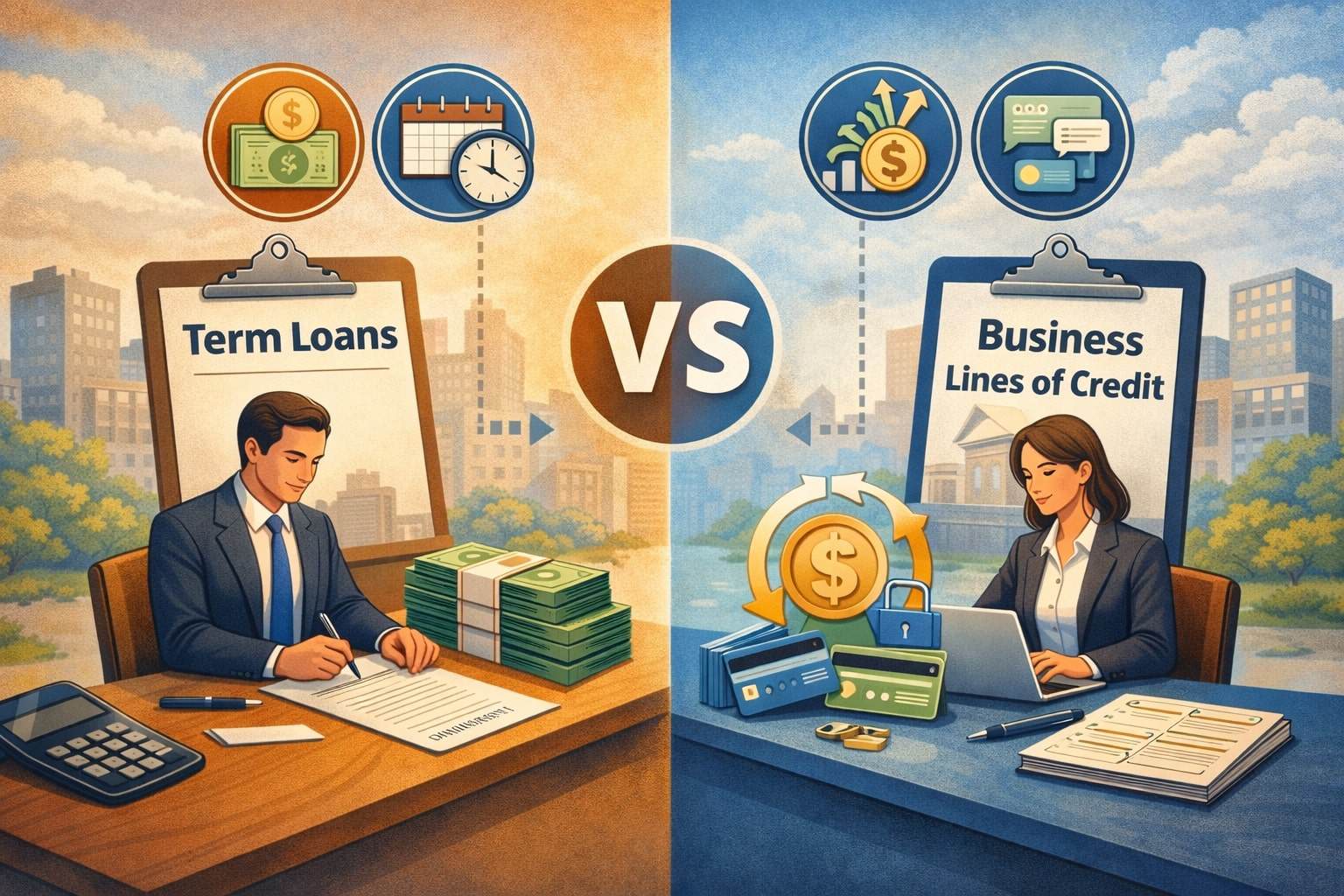
Choosing between term loans vs business lines of credit can shape your cash flow, risk level, and growth speed for years. Both products are designed to fund business needs, but they behave very differently once the money hits your account.
A term loan is usually a one-time lump sum repaid on a fixed schedule. A business line of credit is typically a revolving pool of funds you can draw from, repay, and reuse.
In practice, the best option depends on what you’re buying, how predictable your revenue is, and how quickly you need funds. If you’re making a large purchase with a clear payoff—equipment, a build-out, a vehicle, or expansion inventory—term loans often fit.
If you need flexible working capital—covering payroll gaps, seasonal swings, short-term inventory, or unexpected expenses—lines of credit can be ideal.
This guide breaks down term loans vs business lines of credit with real-world decision logic, cost factors, approval standards, and future trends. You’ll also learn how to prepare your application, avoid common traps, and match funding to the way your business actually operates.
Understanding the Core Difference in Term Loans vs Business Lines of Credit
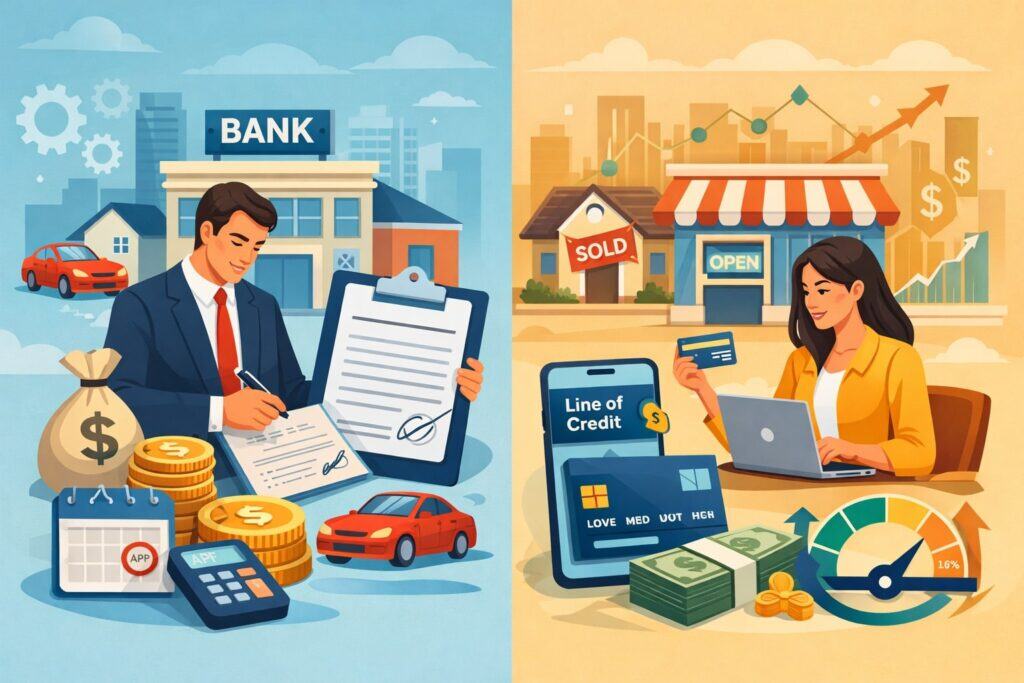
At the simplest level, term loans vs business lines of credit is a choice between structured borrowing and flexible borrowing. A term loan provides a defined amount upfront, then you repay that amount (plus interest) over a set period—often in monthly payments.
This structure is powerful for long-term planning because you know your payment and payoff date. Many businesses like term loans for predictable budgeting and major investments.
A business line of credit works more like a reusable funding reserve. You’re approved up to a limit, and you only pay interest on what you actually draw. When you repay, your available credit typically replenishes, which makes it useful for recurring cash needs. This flexibility is the main reason lines of credit are often considered the “working capital tool.”
In term loans vs business lines of credit, the “right” choice usually comes down to matching the loan structure to the business need. A long-lived asset (like equipment) usually pairs better with longer repayment. A short-lived need (like bridging receivables) often pairs better with revolving access.
Another key difference is how lenders evaluate risk. Term loans are often underwritten around the stability of cash flow over time and the value of assets or business performance.
Lines of credit focus heavily on ongoing cash flow patterns, liquidity, and the likelihood you’ll draw repeatedly. If your revenue is uneven, you may still qualify for either—but pricing and limits can change.
How Term Loans Work in Term Loans vs Business Lines of Credit Decisions
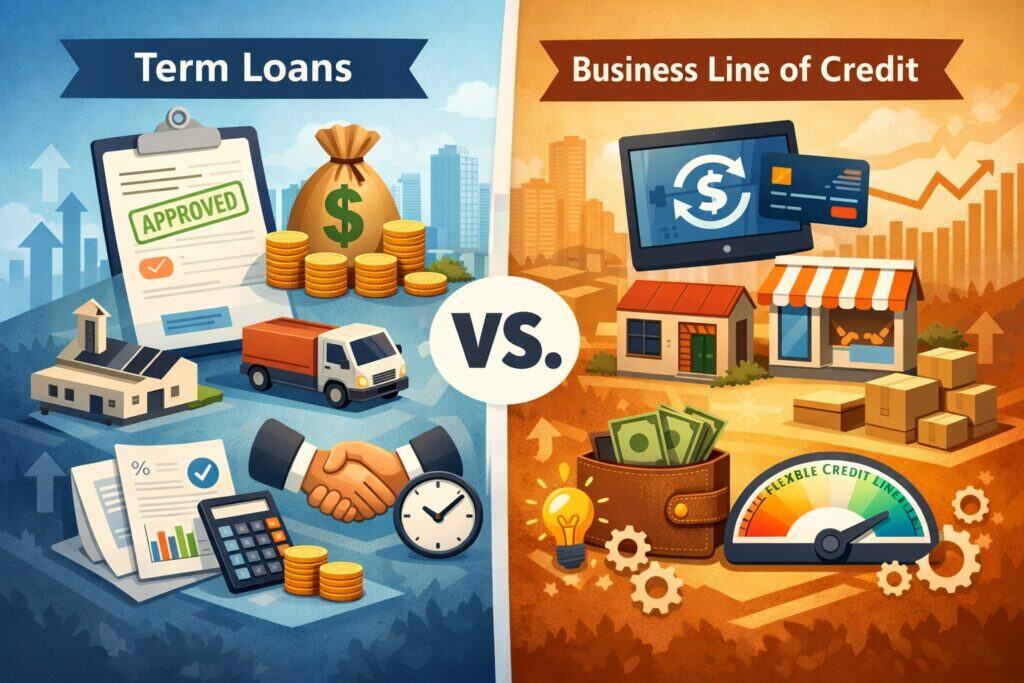
In term loans vs business lines of credit, term loans are the “installment” option. You receive a lump sum and repay it in equal payments (or a defined schedule) over a fixed term, such as 1–10 years, sometimes longer depending on the loan type and what you’re financing.
Interest may be fixed or variable, and you may see origination fees or closing costs depending on the lender.
Term loans are best when you can clearly connect the funds to a durable business benefit. For example, a remodel that increases capacity, a new machine that increases output, or a bulk inventory purchase that improves margins.
The structure supports investments that generate returns over time, because you’re spreading repayment across the period you’ll benefit from the purchase.
Another reason term loans are popular in term loans vs business lines of credit comparisons is payment consistency. Many business owners prefer knowing exactly what leaves their account each month. That stability can be calming, especially when you’re scaling operations, hiring, or expanding locations.
However, term loans can be less forgiving if your needs change. You can’t “undraw” funds you already received, and if you pay off early, some products include prepayment penalties.
Also, if you borrow too much, you’re stuck with the payment regardless of seasonality. That’s why aligning loan size and term length with realistic cash flow is crucial.
Traditional Bank Term Loans
Traditional bank term loans tend to be the most cost-effective option in term loans vs business lines of credit—but also among the strictest to qualify for. Banks often want strong credit, consistent revenues, healthy cash flow coverage, and a clear use of funds.
Documentation is usually extensive: business financial statements, tax returns, bank statements, debt schedules, and sometimes projections.
The upside is that bank term loans can provide competitive rates and longer terms, especially for established companies. Many banks prefer loans backed by collateral—equipment, vehicles, real estate, or sometimes business assets. Collateral can reduce risk and improve pricing, but it also increases what’s at stake if the business struggles.
Approval timelines vary, and the process can feel slower than online lenders. But for businesses with stable operations, a bank term loan can be a strong anchor in your financing mix. In term loans vs business lines of credit, bank term loans shine when you’re funding an expansion with a clear ROI and you can handle a structured underwriting process.
From a strategy standpoint, bank term loans often work best when paired with a smaller line of credit for short-term needs. That combination prevents using long-term debt for short-term cash gaps, which can stress your finances.
Government-Backed and Similar Programs for Term Loans
When business owners compare term loans vs business lines of credit, they often overlook government-backed term loan programs and similar structures that can improve affordability and access.
These loans may offer longer repayment periods, potentially lower pricing, and underwriting that considers broader business context—not just collateral strength. They typically require strong documentation and patience, but they can be an excellent fit for major projects.
Many of these programs prioritize job creation, community development, or support for small and mid-sized businesses that may not qualify for conventional bank terms. They can be used for equipment, working capital, real estate, or refinancing—depending on the program.
The biggest benefit in term loans vs business lines of credit terms is that these loans can extend your repayment timeline, reducing monthly payment pressure. That can free up working capital for hiring, marketing, and inventory.
The tradeoff is complexity. You may need detailed projections, a business plan narrative, and strict use-of-funds tracking. If you need money quickly, a revolving line may be faster. But if you’re building something substantial—like a second location or a major equipment purchase—this category can be worth the effort.
Online and Alternative Term Loans
Online term loans have grown because businesses want speed and convenience. In term loans vs business lines of credit, online term loans can be attractive when a business needs a lump sum quickly and can tolerate a higher cost in exchange for rapid funding.
These products often come with shorter repayment periods, and some use weekly or even daily payments.
Underwriting may rely more on bank statement analysis, recent revenue, payment processing history, and cash flow patterns rather than strictly on tax-return profitability. This can help businesses that are growing fast or have non-traditional profiles. But pricing can be higher, and fees can significantly affect the true cost of capital.
When comparing term loans vs business lines of credit, online term loans sometimes blur into “short-term financing.” If the term is short and payments are frequent, the cash flow impact can be intense.
That doesn’t mean they’re bad—it means you must model repayment realistically. Many owners accept the tradeoff because quick capital helps them seize opportunities: buying discounted inventory, launching a marketing campaign, or covering an urgent operational expense.
A smart approach is to treat online term loans as a tactical tool and avoid stacking multiple loans with overlapping payments. If the business need is recurring, a line of credit may reduce the risk of repeated borrowing cycles.
How Business Lines of Credit Work in Term Loans vs Business Lines of Credit Choices
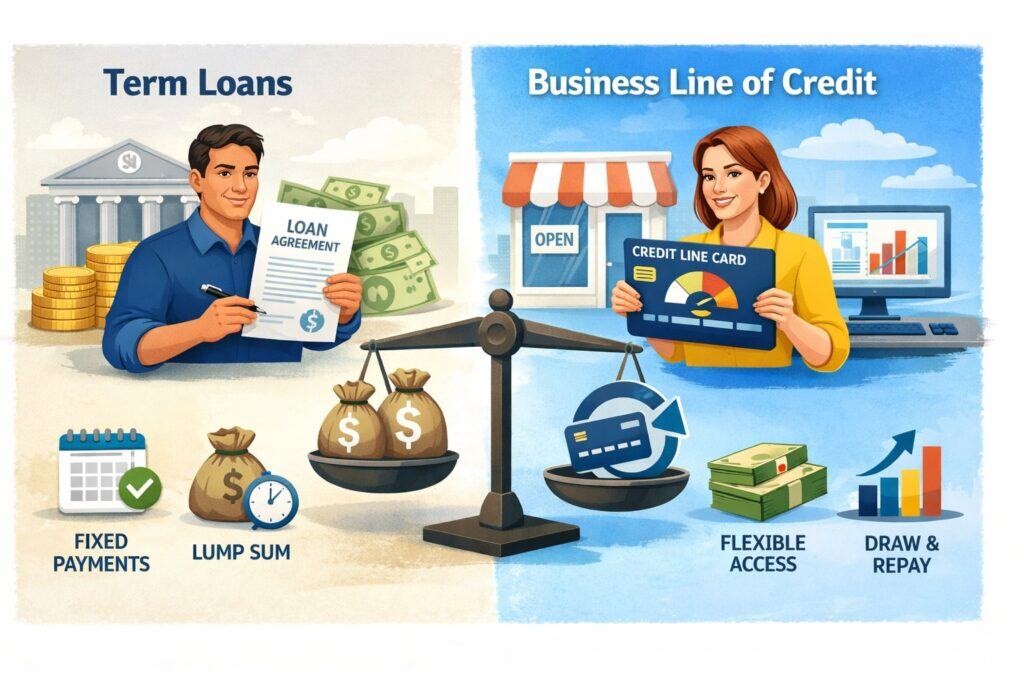
A business line of credit is designed for flexibility. In term loans vs business lines of credit, lines are usually the better fit when the timing and size of expenses are uncertain, or when you want funding “on standby.”
You’re approved for a credit limit—say $25,000 or $250,000—and you draw only what you need. Interest typically accrues on the outstanding balance, not the full limit.
Most lines are revolving, meaning as you repay principal, your available credit returns. This is helpful for seasonal businesses, businesses with long receivable cycles, or businesses that want to smooth out cash flow without repeatedly applying for new loans.
In term loans vs business lines of credit, lines are also often used as a defensive tool. A line can act like an emergency fund for the business—covering unexpected equipment repairs, supplier issues, or short-term drops in revenue.
The psychological benefit is real: access to capital reduces stress and helps you negotiate from a position of strength.
However, lines of credit can have their own rules: annual renewal, periodic reviews, minimum draw requirements, inactivity fees, or covenants. Some lenders can reduce limits during downturns, especially if cash flow weakens. That’s why it’s important to understand how the lender can adjust the line over time.
Secured vs Unsecured Lines of Credit
In term loans vs business lines of credit, secured lines are backed by collateral, while unsecured lines rely more on cash flow and credit strength. Secured lines often offer higher limits and better pricing because the lender has a claim on assets if repayment fails. Collateral might include receivables, inventory, equipment, or sometimes other business assets.
Unsecured lines are simpler in concept—no pledged collateral—but they usually require stronger credit and may come with lower limits or higher rates. Unsecured options can be appealing for service businesses that don’t carry much inventory or hard assets. They can also be useful when the business owner wants to avoid pledging critical assets.
In terms of strategy, secured lines can be powerful for businesses with strong receivables cycles. Some lenders structure lines around accounts receivable quality, which can align the credit limit with real operating activity. For businesses with stable billing and reliable payers, this can reduce financing friction.
When comparing term loans vs business lines of credit, remember that “secured” doesn’t automatically mean “better.” The right choice depends on how comfortable you are pledging assets and whether the improved pricing outweighs the increased risk exposure.
Revolving Lines vs Non-Revolving Structures
Most people think of lines as revolving, but some lenders offer non-revolving or limited-reuse credit structures. In term loans vs business lines of credit, a revolving line is typically the most flexible: you can borrow, repay, and borrow again repeatedly. This can match ongoing working capital needs, especially in retail, wholesale, and seasonal services.
Non-revolving structures may resemble a line at first—access up to a limit—but once you repay, the amount may not be available again unless the lender renews or re-approves the facility. These can be used as transitional products or for businesses that need short-term funding but don’t want an open-ended revolving obligation.
A common decision mistake in term loans vs business lines of credit is assuming every “line” behaves the same. The operational details matter: draw fees, repayment rules, how quickly availability replenishes, and whether the lender can pause draws during reviews.
For example, some lines require minimum monthly payments that include principal, which steadily reduces the balance. Others are interest-only during a draw period. Some reset payment schedules with each draw, while others keep the same timeline. These mechanics affect cash flow more than most business owners expect.
The best approach is to treat the line like a product with terms—not just a limit. Ask how repayment works after each draw, how renewals are handled, and what triggers limit changes.
Cost, Interest, and True Pricing in Term Loans vs Business Lines of Credit
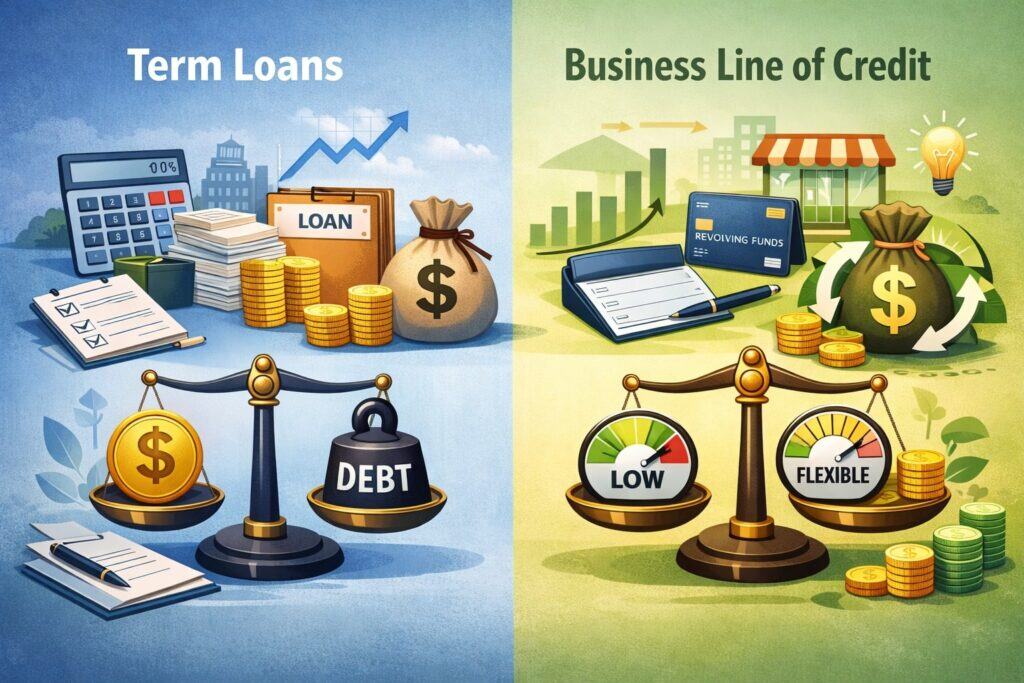
Cost is one of the biggest decision points in term loans vs business lines of credit, but “cheaper” isn’t always obvious. Term loans may look straightforward: interest rate + term + payment schedule.
Lines of credit may look cheaper because you pay interest only on what you draw. Yet the real cost depends on fees, utilization patterns, and how long you carry balances.
Term loans can be cost-effective when you actually need the full lump sum and will deploy it immediately into something productive. If you borrow $150,000 to buy equipment and you put that equipment to work right away, a term loan’s interest is the cost of financing a productive asset.
Lines of credit can be cost-effective when you borrow smaller amounts intermittently. If you only need $20,000 for 45 days to bridge receivables, paying interest for 45 days can be far cheaper than carrying a fixed term loan payment for years.
But in term loans vs business lines of credit, lines can become expensive if you keep them maxed out long-term. A line is often designed as short-term working capital, not a permanent loan. If you keep a line drawn continuously, you may face renewal risk and pricing that doesn’t reward long-term balances.
Also, lenders may charge annual fees, draw fees, maintenance fees, or penalties for inactivity. Those costs can matter even when you don’t use the line. So it’s essential to calculate the “all-in” cost, not just the advertised rate.
Understanding Interest Structures and Payment Mechanics
In term loans vs business lines of credit, interest structure changes your monthly reality. Term loans often have amortizing payments—each payment includes interest and principal.
Early in the schedule, interest is a bigger portion. Later, the principal dominates. That predictability can help planning. Lines of credit often require interest-only payments on the outstanding balance during a draw period, though some require principal repayment as well.
Interest-only sounds easier, but it can create a trap: the balance doesn’t decrease unless you intentionally pay down principal. Many businesses accidentally “park” debt on a line because the minimum payment feels manageable.
Another critical detail is variable vs fixed pricing. Many lines are variable, tied to an index plus a margin. That means your cost can rise when rates rise. Some term loans are fixed, locking in predictable payments.
When evaluating term loans vs business lines of credit, consider how sensitive your business is to payment increases.
Payment frequency matters too. Some alternative products collect weekly or daily, which can strain cash flow even if the total cost seems acceptable. A business with uneven weekly revenue can feel pressure from frequent repayments, even when monthly totals are fine.
To make a smart decision, model best-case and worst-case scenarios: how payments look during slow months, what happens if customers pay late, and how quickly you can pay down a line after a big draw.
Fees, APR, and Comparing Offers Correctly
Comparing offers is where term loans vs business lines of credit decisions often go wrong. Many businesses compare only the headline interest rate. But fees can change the effective cost significantly.
Common term loan fees include origination fees, underwriting fees, documentation fees, and sometimes prepayment penalties. Lines of credit may include annual fees, draw fees, renewal fees, collateral monitoring fees, or inactivity fees. Some lenders also charge for wire transfers or expedited processing.
The right way to compare term loans vs business lines of credit is to calculate the total cost for how you will actually use the money. For a term loan, estimate total interest plus fees over the planned payoff period.
For a line, estimate interest for your expected utilization pattern plus all ongoing fees. If you plan to carry a balance long-term, compute the cost over that timeline.
Also pay attention to repayment rules. A line with “balloon” terms or required paydown periods can force you to repay at inconvenient times. A term loan with strict covenants can restrict flexibility. The cheapest product on paper is not always the lowest-risk product in real life.
If you’re not sure, ask lenders for a clear amortization schedule (for term loans) and a sample draw-and-repay scenario (for lines). That clarity turns confusing marketing into usable numbers.
Qualification and Underwriting in Term Loans vs Business Lines of Credit
Approval standards matter because they shape what products you can realistically access. In term loans vs business lines of credit, lenders evaluate your business through a mix of credit strength, cash flow, time in business, revenue consistency, and sometimes collateral. The stronger your profile, the more likely you are to get favorable rates and terms.
Term loans often require evidence that your business can sustain fixed payments over the full term. Lenders may look at debt-service coverage, profitability, and stability. If your business is newer or margins are thin, lenders may shorten the term, reduce the amount, or require collateral.
Lines of credit often place heavier emphasis on cash flow cycles and liquidity. Lenders want to see that you can draw and repay responsibly. If your deposits are consistent and you have predictable receivables, you may be a strong candidate—even if your profit margins fluctuate.
For businesses operating in regulated or higher-risk industries, underwriting can be more nuanced. Lenders may add restrictions based on chargeback risk, inventory types, or compliance requirements. In some cases, specialized lenders can be a better fit than general lenders.
When comparing term loans vs business lines of credit, think of underwriting as matching lender risk tolerance to your business model. Your job is to present clean financials and a credible story for repayment.
Credit, Cash Flow, Collateral, and Time in Business
In term loans vs business lines of credit, four factors consistently drive approvals: credit profile, cash flow, collateral, and operating history. Strong personal and business credit can unlock better pricing, but many lenders weigh cash flow even more heavily. They want evidence that your business generates enough free cash to support repayment comfortably.
Collateral can strengthen applications, especially for term loans. Equipment, vehicles, and real estate can provide lenders with security. Lines of credit may be secured by receivables or general business assets, depending on structure. Collateral can improve limits and pricing, but you should evaluate the risk of pledging assets essential to operations.
Time in business influences perceived stability. Newer businesses may still qualify, but often with smaller amounts and higher costs. If your business is young but growing quickly, lenders may rely on bank statements and recent performance rather than long-term tax records.
Cash flow quality matters, too. Consistent deposits and controlled expenses signal operational discipline. In term loans vs business lines of credit, lenders often prefer “clean” cash flow—fewer overdrafts, fewer negative days, and predictable expense patterns.
If your business has seasonality, that’s not automatically negative. The key is explaining it and showing how financing fits the cycle. A well-structured line of credit can be perfect for seasonal cash flow—if you can demonstrate a clear paydown pattern.
Documentation, Timing, and What Lenders Verify
Many businesses underestimate documentation demands in term loans vs business lines of credit. Typical requirements include bank statements, tax returns, financial statements (profit and loss, balance sheet), a debt schedule, and sometimes accounts receivable aging reports. Some lenders also request invoices, contracts, or proof of business ownership.
Timing matters because some products are faster than others. Online products may be funded quickly with bank statement analysis. Traditional institutions may take longer due to deeper verification. In either case, lenders will validate identity, business registration, and sometimes confirm revenue through bank data or payment processing statements.
In term loans vs business lines of credit, a common friction point is mismatched financial records. If your tax returns show low profit while bank statements show high deposits, lenders may ask for explanations—like high cost of goods, reinvestment, or owner draws. Clean bookkeeping reduces delays and improves credibility.
Lenders also verify existing debt obligations. If you have multiple loans with frequent payments, that can reduce your capacity for new debt. It doesn’t automatically disqualify you, but it can change the structure you’re offered.
If your business operates in multiple states, sells online, or handles large-ticket transactions, lenders may check chargeback patterns and customer dispute history. Having clear policies and stable payment performance can strengthen your application.
Use Cases and Best Scenarios in Term Loans vs Business Lines of Credit
Use case is where term loans vs business lines of credit becomes practical. The best financing choice is the one that matches the lifespan of what you’re funding and the predictability of the return.
Term loans are typically best for large, planned investments. Think equipment, vehicles, build-outs, expansion projects, refinancing higher-cost debt, or buying a business. These are initiatives where you want a stable payment and a repayment term aligned to the asset’s useful life.
Lines of credit are typically best for recurring working capital needs. They shine when you don’t know the exact amount or timing of expenses: inventory restocks, seasonal labor, supplier delays, marketing bursts, or bridging receivables. Many businesses use a line as a cash flow buffer and rely on it during tight cycles.
In term loans vs business lines of credit, consider whether the expense is a one-time event or a repeating pattern. If it’s repeating, a line is often more efficient. If it’s one-time with long-term benefit, a term loan may reduce long-term cost and risk.
Also consider how the financing affects decision-making. With a term loan, you may be tempted to spend the lump sum quickly. With a line, you may be tempted to draw repeatedly without paying down. Good financing supports good behavior, not bad habits.
Working Capital, Growth, Seasonal Operations, and Emergencies
Working capital is the most common reason businesses evaluate term loans vs business lines of credit. A line of credit is usually built for this purpose because it adjusts to your needs. If you need to cover payroll while waiting on invoices, a line can be a clean solution—especially if you repay when customers pay.
For growth, it depends on the type of growth. If you’re expanding into a new location or buying revenue-generating equipment, term loans often fit because the benefit lasts years. If growth means ramping inventory and marketing campaigns with uncertain timing, lines can offer safer flexibility.
Seasonal operations are a classic line-of-credit scenario. Many businesses have predictable high and low periods. A line can fund inventory and staffing for the peak, then be paid down after sales come in. In term loans vs business lines of credit, this pattern—borrow, generate revenue, repay—is exactly what revolving credit is designed for.
Emergencies are where a line becomes a safety net. Equipment failures, unexpected repairs, supplier issues, or sudden demand spikes can break a business that lacks liquidity.
Having a line in place before you need it can protect your operations and reduce stress. The best time to apply is often when your financials are strongest, not when you’re already in a crunch.
Inventory, Equipment, Renovations, and Long-Term Projects
If you’re funding inventory, the decision in term loans vs business lines of credit depends on inventory turnover. Fast-turn inventory often pairs well with a line because you can borrow, sell, and repay quickly.
Slow-turn inventory may be better suited for a term loan or specialized inventory financing, because the repayment timeline should match the sales cycle.
Equipment purchases are often a term-loan scenario because the asset lasts multiple years and can generate revenue over that time. Many businesses prefer aligning payments with the equipment’s useful life. If the equipment improves productivity, the incremental profit can help cover the payment.
Renovations and build-outs also lean toward term loans because they’re long-lived investments. A planned remodel with a clear scope is easier to finance with a lump sum. A line may still be used, but it can introduce renewal risk if the project runs longer than expected.
Long-term projects—like expansion, acquisitions, or major technology upgrades—often require stable funding. In term loans vs business lines of credit, term loans reduce uncertainty because you’re not dependent on a lender renewing your line in the middle of a project.
A practical strategy is “term loan for the big fixed project, line for the flexible overages.” That structure prevents using a revolving product for a long-term asset while preserving agility for unexpected costs.
Risks and Pitfalls in Term Loans vs Business Lines of Credit
Every financing choice carries risk, and term loans vs business lines of credit is no exception. The most common risk with term loans is committing to a fixed payment that your cash flow can’t sustain during slower periods.
Businesses often underestimate seasonality, market shifts, or operational disruptions. A term loan can become a strain if revenue dips and the payment remains unchanged.
For lines of credit, the biggest risk is “permanent debt.” Because minimum payments can be low, businesses sometimes keep balances outstanding indefinitely. That can create dependency and reduce resilience. If a lender reduces your limit or declines renewal, you may face a sudden liquidity crisis.
Another risk in term loans vs business lines of credit is misusing the product. Using a term loan for short-term working capital can leave you paying interest for years on expenses that were consumed quickly. Using a line for a long-term asset can put you at renewal risk and expose you to rate fluctuations.
There’s also operational risk: borrowing can mask underlying issues like low margins, pricing problems, or poor collections. Financing should support a healthy business model, not patch a broken one indefinitely.
Overborrowing, Covenants, and Payment Shock
Overborrowing is a common mistake in term loans vs business lines of credit decisions. With term loans, overborrowing often happens because the lump sum feels like a cushion. But every extra dollar increases monthly obligations. If you borrow more than you can deploy efficiently, you pay for idle capital.
Covenants—rules in loan agreements—can limit flexibility. Some loans require maintaining certain financial ratios or restricting additional debt. If your business violates covenants, lenders may increase oversight or demand corrective action. Not every loan has strict covenants, but it’s important to read the agreement carefully.
Payment shock can happen with variable-rate products or short-term repayment structures. A line of credit may have a variable rate that rises, increasing monthly payments. A short-term loan may have frequent payments that feel manageable until cash flow tightens.
In term loans vs business lines of credit, the best defense is planning. Stress-test your repayment under conservative assumptions: slower sales, late-paying customers, higher costs, or a temporary downturn. If the loan only works in best-case conditions, it’s not a safe structure.
Also, keep an eye on how debt affects your ability to invest elsewhere. Excessive payments can reduce marketing spend, limit hiring, and prevent inventory growth—ironically slowing the growth the loan was meant to support.
Managing Draws, Renewals, and Dependency on a Line of Credit
A line of credit can be a powerful tool, but in term loans vs business lines of credit, it’s also easier to misuse. The draw-and-repay cycle should be intentional. Ideally, you draw for a specific need and repay from a specific source—customer payments, seasonal sales, or receivable collections.
Renewal risk is real. Many lines are reviewed annually or periodically. If the lender sees declining revenue, higher expenses, or increased debt, they may reduce the limit or refuse to renew. That can be painful if your business has come to rely on the line as permanent working capital.
To avoid dependency, build a paydown rhythm into your operations. Some businesses plan to reduce the line balance to near zero during stronger months. This demonstrates healthy usage and can improve your renewal outcomes.
In term loans vs business lines of credit, also watch for “limit creep.” If your limit increases, it can be tempting to treat it as extra income. It’s not. It’s borrowed money that must be repaid. Use increases strategically—only if they support profitable growth or stabilize cash flow responsibly.
A good practice is to maintain a separate internal cash reserve even if you have a line. The line is access to lender capital; your reserve is access to your own capital. Together, they create real resilience.
A Practical Decision Framework for Term Loans vs Business Lines of Credit
If you want a clean decision process, term loans vs business lines of credit can be reduced to a few key questions.
- First: Is the expense a one-time investment or a repeating operating need? One-time investments usually favor term loans. Repeating needs usually favor lines.
- Second: How long will it take for the investment to pay back? If the benefit unfolds over years, longer repayment is safer. If the payoff is within weeks or a few months, revolving credit may be more efficient.
- Third: How predictable is your revenue? Predictable revenue supports fixed payments. Volatile revenue often benefits from flexible borrowing—assuming you can manage paydowns responsibly.
- Fourth: Do you need certainty or flexibility? Term loans provide certainty. Lines provide flexibility. In term loans vs business lines of credit, neither is universally better; it depends on the operational reality of your business.
- Finally: What’s the risk if the lender changes terms? A term loan generally won’t change once funded. A line can be adjusted or not renewed. If the financing is mission-critical, that renewal risk matters.
Checklist and Scenario-Based Comparisons
A fast checklist for term loans vs business lines of credit looks like this:
- If you need a lump sum for a defined purchase with a long useful life, lean term loan.
- If you need on-demand funding for short-term needs, lean line of credit.
- If you prefer predictable payments, lean term loan.
- If you prefer flexible access and paying interest only on usage, lean line.
- If you’re worried about renewal or limit reductions, lean term loan for essential projects.
- If you want a financial safety net, lean line—set up before you’re desperate.
Scenario examples help clarify term loans vs business lines of credit:
- A contractor buying a $90,000 piece of equipment that will generate revenue for years often benefits from a term loan that matches the equipment life.
- A retailer managing holiday inventory ramps often benefits from a line of credit to buy inventory and pay it down after sales.
- A service business with long invoice cycles often benefits from a line to bridge receivables.
- A growing business opening a second location often benefits from a term loan for build-out plus a line for early operating volatility.
The most practical approach is matching the financing timeline to the business timeline. That’s the heart of making term loans vs business lines of credit decisions without guesswork.
When Using Both Makes Sense
Many successful businesses don’t choose only one. In term loans vs business lines of credit, using both can create a balanced capital structure. The term loan funds long-term investments with predictable payments, while the line handles short-term working capital swings.
This combination prevents “mismatched financing,” like using a line for a multi-year asset or using a term loan for short-lived operating expenses. It also reduces stress: the line provides a buffer, and the term loan provides stable funding for strategic moves.
A common structure is: term loan for equipment or expansion + line for inventory cycles and emergencies. The term loan builds productive capacity; the line protects liquidity. This is especially useful for businesses with growth plans and seasonal variability.
However, using both only works if you manage debt capacity carefully. Two facilities mean two sets of obligations. In term loans vs business lines of credit, the risk is overleveraging—taking on a term loan payment while keeping the line perpetually drawn.
To make the “both” strategy safe, set internal rules. For example: keep line utilization below a target percentage, pay down the line during peak months, and avoid drawing the line for non-essential spending. These habits make lenders more comfortable, which can help with renewals and future borrowing.
How to Prepare and Apply Successfully in Term Loans vs Business Lines of Credit
Preparation can improve approvals and reduce cost, which is why it’s a key part of term loans vs business lines of credit planning. Start by cleaning up bookkeeping. Lenders like clear financial statements, accurate categorization, and consistent reporting. Messy books slow underwriting and can make your business look riskier than it is.
Next, organize documentation: recent bank statements, tax returns, profit and loss statements, balance sheets, and a list of existing debts. If you’re applying for a line tied to receivables, prepare receivables aging reports and customer concentration details.
Also prepare your “use of funds” narrative. In term loans vs business lines of credit, lenders want to know what you’ll do with the money and how it supports repayment. “Working capital” is acceptable, but specific is better: payroll bridging, inventory purchases, marketing campaigns, equipment purchase, or expansion costs.
Finally, review your credit profile. Correct errors, reduce revolving utilization if possible, and avoid major credit changes right before applying. Small improvements can influence pricing.
Improving Approval Odds and Getting Better Terms
To win in term loans vs business lines of credit, focus on reducing perceived risk. Show stable deposits, minimize overdrafts, and avoid large unexplained cash withdrawals. Lenders interpret these patterns as signals about business discipline.
Strengthen your cash flow story. If revenue is seasonal, explain the cycle and show historical patterns. If margins are improving, show why. If a large expense lowered profits temporarily, document it. The goal is to make underwriting easy and logical.
Collateral can help for term loans, but only pledge what you can afford to risk. A secured structure may reduce cost, but it increases consequences if things go wrong. If you’re considering secured options, understand what the lender can claim in default.
For lines of credit, demonstrate paydown ability. In term loans vs business lines of credit, lenders like lines that “breathe”—drawn and repaid regularly. If your bank statements show strong inflows after receivables pay, highlight that pattern.
Negotiation matters too. Ask about fees, renewal conditions, rate structure, prepayment penalties, and covenant requirements. Many businesses accept the first offer without comparing. Even one alternative quote can improve your leverage.
Avoiding Common Application Mistakes
Application mistakes in term loans vs business lines of credit often come from inconsistency. If your application numbers don’t match tax returns or bank statements, it triggers delays and skepticism. Be accurate, and if there are differences, explain them proactively.
Another mistake is choosing the wrong product for the need. If you apply for a term loan but your need is short-term and uncertain, you may get denied or offered unfavorable terms. If you apply for a line but the lender sees a long-term project, they may worry about permanent utilization.
Also avoid stacking debt without a plan. Multiple short-term obligations can harm cash flow and reduce eligibility for better products later. In term loans vs business lines of credit, lenders evaluate total monthly obligations, not just the new loan.
Don’t ignore “fine print” risks. For lines, check whether the lender can freeze draws, reduce limits, or require periodic paydowns. For term loans, check prepayment rules, collateral requirements, and default triggers.
A final mistake is waiting until crisis mode. The best approvals often happen when revenue is strong and your books look healthy. If you need emergency funding, you can still apply—but your options may be more expensive.
Future Predictions: Where Term Loans vs Business Lines of Credit Are Headed
The landscape for term loans vs business lines of credit continues to evolve. Over the next few years, expect more underwriting driven by real-time business data—bank feeds, accounting platforms, and payment performance. This can speed approvals and allow credit limits to adjust more dynamically based on business health.
We’re also likely to see more “embedded lending,” where financing is offered inside software platforms businesses already use—accounting, invoicing, payroll, e-commerce, and industry-specific tools. That convenience can reduce friction, but it also means businesses must compare costs carefully because offers can be presented as “simple” while fees are embedded.
Rate environments will continue to influence product choices. When rates are volatile, fixed-rate term loans may become more attractive for budgeting. Lines of credit may remain variable more often, which can increase payment uncertainty.
In term loans vs business lines of credit, future best practice may involve mixing fixed and flexible products to balance certainty and agility.
Risk management trends also matter. Lenders may continue tightening standards around customer disputes, fraud risk, and operational volatility. Businesses with strong documentation, clean financials, and consistent payment patterns will likely be rewarded with better pricing and higher limits.
Technology-Driven Underwriting and Faster Access to Capital
Technology is reshaping term loans vs business lines of credit underwriting. Automated analysis can evaluate cash flow patterns faster than traditional methods, which reduces time-to-funding.
For businesses, this means preparation becomes even more important—because real-time data will reflect operational discipline immediately.
We’ll likely see more “cash flow underwriting” replacing pure credit-score gatekeeping. That can help growing businesses that reinvest profits or have non-traditional profiles. But it can also penalize businesses with messy banking behavior—frequent overdrafts, inconsistent deposits, or unclear expense patterns.
Another trend is dynamic credit limits on lines of credit. Instead of a static limit for a year, some lenders may adjust limits based on monthly performance. In term loans vs business lines of credit, this makes lines more responsive but also introduces uncertainty.
The upside is potentially higher access during growth. The downside is the possibility of limit reductions during temporary downturns.
For term loans, technology may improve refinancing and restructuring options. Businesses may be able to renegotiate terms more easily, especially if performance improves. That could reduce the fear of being “stuck” with a loan that no longer matches the business.
What Smart Borrowers Should Do Now
To stay ahead in term loans vs business lines of credit, focus on operational fundamentals that algorithms and underwriters both reward: consistent deposits, clean bookkeeping, stable margins, and predictable paydown patterns.
Build your financing stack intentionally. Use term loans for long-term investments and lines for short-term working capital—then set internal rules for utilization and paydown. This structure is likely to remain effective even as underwriting changes.
Also, diversify lender relationships when possible. If you rely on a single line of credit and that lender reduces the limit, your operations can be exposed. A combination of cash reserves, diversified funding options, and strong financial reporting can reduce that risk.
Finally, keep a forward-looking cash flow forecast. It doesn’t need to be perfect—just realistic. In term loans vs business lines of credit, the businesses that win are the ones that borrow with a plan, not the ones that borrow in reaction to surprises.
FAQs
Q.1: Which is better for working capital: term loans vs business lines of credit?
Answer: For most working capital needs, term loans vs business lines of credit tends to favor a business line of credit—because working capital is usually flexible and recurring.
Working capital isn’t one single expense; it’s the ongoing gap between when you pay expenses and when you collect revenue. A line is designed for that gap because you can draw what you need, when you need it, and repay when cash comes in.
That said, term loans can be used for working capital if the need is tied to a specific growth initiative with predictable returns.
For example, hiring a sales team or launching a defined expansion project might justify a lump sum, especially if you can model how new revenue will cover payments. The risk is that term loan payments are fixed even if the working capital need disappears or revenue arrives slower than planned.
In term loans vs business lines of credit, the best working capital approach is usually: a line for day-to-day flexibility plus disciplined paydowns. If you find yourself carrying a line balance permanently, it may be a sign that you need a different structure—like refinancing part of that balance into a term loan for stability.
Q.2: Are business lines of credit harder to qualify for than term loans?
Answer: In term loans vs business lines of credit, qualification difficulty depends on the lender and your business profile. Lines of credit often require confidence in ongoing cash flow management.
Lenders want to see that your business can draw and repay repeatedly without stress. That may mean consistent deposits, stable expense control, and a credible repayment rhythm.
Term loans may be easier for a single purpose—especially if the loan is tied to a purchase with collateral. For example, financing equipment can be more straightforward because the lender can secure the asset. But term loans still require evidence you can handle fixed payments over time.
If your business has strong, steady cash flow but uncertain expense timing, a line may be a natural fit. If your business has collateral and a defined purchase, a term loan may be more accessible. In practice, many businesses qualify for both but get better pricing in one category.
The best move in term loans vs business lines of credit is to apply for the product that matches your use case, because lenders respond better when the financing structure aligns with the business need.
Q.3: Can I use a business line of credit like a long-term loan?
Answer: You can, but in term loans vs business lines of credit, it’s often not the safest approach. A line of credit is typically built for short-to-medium-term borrowing cycles.
If you keep it drawn for years, you may face renewal risk, variable rate increases, and potential limit reductions. Your business becomes dependent on a lender’s continued willingness to maintain the facility.
That doesn’t mean long-term line usage is always wrong. Some businesses maintain steady utilization when the line is structured appropriately and the lender relationship is strong. But it’s usually wise to plan periodic paydowns and keep a buffer.
If the balance is truly long-term—funding a durable asset or permanent working capital—refinancing part of the balance into a term loan can reduce uncertainty.
In term loans vs business lines of credit, a useful rule is: if the money will be “in the business” for years, consider term debt. If it will be “in and out” with business cycles, consider a line. This reduces the risk of being forced to repay during a downturn.
Q.4: What credit score do I need for term loans vs business lines of credit?
Answer: Credit expectations vary widely, so there isn’t a single universal cutoff in term loans vs business lines of credit. Many lenders evaluate both personal and business credit, but they also look at cash flow, time in business, and revenue stability.
Stronger credit generally improves pricing and approval odds, but cash flow can outweigh score in many modern underwriting models.
Term loans from traditional institutions often prefer stronger credit profiles, especially for larger amounts or longer terms. Lines of credit may also prefer strong credit, but some lenders focus more on real-time cash flow behavior.
If your bank statements show consistent deposits and healthy balances, you may qualify for a line even if your credit isn’t perfect—though cost may be higher.
The smartest step in term loans vs business lines of credit is to strengthen what you can control: reduce credit utilization, pay on time, correct reporting errors, and keep business finances clean. Even modest improvements can translate into better terms and lower long-term costs.
Q.5: How do I decide the right amount to borrow?
Answer: Borrowing the right amount is a core success factor in term loans vs business lines of credit. For a term loan, start with a precise budget for the project and include a buffer for realistic overruns—then ensure the payment fits conservative cash flow. Avoid borrowing extra “just in case” unless you’re confident you’ll deploy it into profitable use.
For a line of credit, base the limit on your cash conversion cycle: how much you need to cover expenses while waiting for revenue to arrive. If you have seasonal spikes, estimate peak working capital needs, not average needs. But don’t treat the line as spending money—treat it as a tool to smooth timing gaps.
A safe method in term loans vs business lines of credit is to run a downside scenario: assume slower collections, lower sales, and higher costs. If you can still manage payments and paydowns in that scenario, the amount is likely reasonable. If you can’t, reduce the amount or choose a different structure.
Conclusion
The smartest choice in term loans vs business lines of credit comes from aligning financing structure with business reality. Term loans are built for large, defined investments with long-term payoff—offering predictable payments and stable funding.
Business lines of credit are built for flexible, recurring working capital needs—offering on-demand access and interest costs tied to usage.
If your need is a one-time project with years of benefit, a term loan usually fits. If your need is cyclical, uncertain, or tied to cash flow timing, a line of credit often fits. Many businesses ultimately use both: term debt for strategic assets and a revolving line for operational flexibility.
Whatever you choose, model the cash flow impact, compare all-in costs (not just rates), and avoid mismatching short-term needs with long-term debt—or long-term assets with short-term credit.
When you make the decision with intention, term loans vs business lines of credit stops being confusing and becomes a powerful tool for sustainable growth.