
Loan Application Tips That Improve Approval
Getting approved for a loan is rarely about one single “magic” factor. It’s the total picture your application paints—your credit behavior, your income story, your monthly obligations, your documentation quality, and how well the loan you request matches what lenders are comfortable funding.
This guide is written for borrowers applying for common consumer loans (personal loans, auto loans, mortgages, and small-business-style “personal” underwriting for self-employed applicants).
It focuses on practical loan application tips that improve approval odds, reduce delays, and help you qualify for better terms. I’ll also cover what’s changing in underwriting, including newer credit scoring models, cash-flow review, and where approvals may head next.
Throughout the article, you’ll see the phrase loan application tips used intentionally. If you’re serious about approval, treat these as a checklist—not “nice-to-haves.”
How Lenders Decide: The Approval Formula You Can Actually Influence
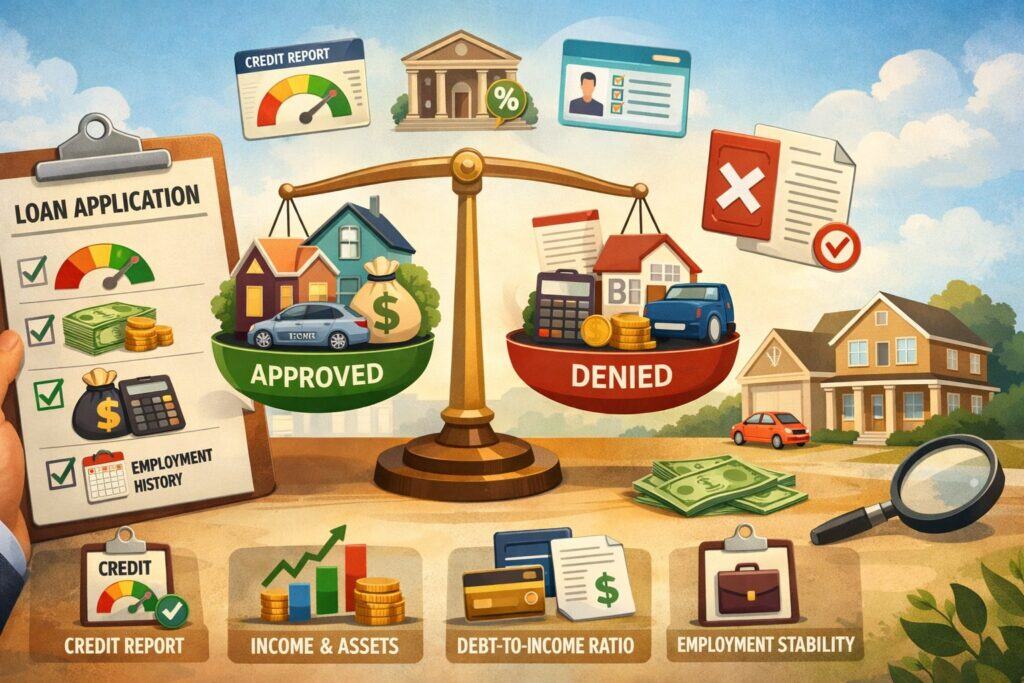
Many people assume loan approvals are mysterious. In reality, most lenders are applying some version of the same framework: they want to know you will repay, that you can repay, and that the loan fits their risk rules. The fastest way to improve your odds is to structure your application so it clearly answers those questions.
A practical way to think about underwriting is “risk signals.” Lenders look for signals that reduce uncertainty: stable income, manageable monthly obligations, consistent credit management, and clean documentation.
On the flip side, they also look for signals that increase uncertainty: frequent job changes, late payments, maxed-out cards, vague income proof, or requesting an amount that doesn’t match your profile. Good loan application tips focus on turning uncertainty into clarity.
Also, approval is not only about credit score. Your debt-to-income (DTI), cash reserves, recent credit behavior, and the accuracy of your application matter just as much. Two applicants with the same score can get different decisions because one looks stable and organized, while the other looks risky or inconsistent.
Finally, understand that underwriting isn’t only “you vs. a score.” It’s also “you vs. the lender’s current appetite.” Lenders tighten or loosen rules depending on economic conditions, delinquency trends, and internal targets.
That’s why applying with the right lender and the right loan type is one of the most overlooked loan application tips that improve approval.
The “5 Cs” of Credit: Make Your Application Strong in Every Category
Most underwriting still maps back to five categories: Character, Capacity, Capital, Collateral, and Conditions. You don’t need to memorize them—you need to shape your application so each one looks strong.
Character is your track record: on-time payments, low delinquencies, and responsible use of credit. Your credit report is the evidence here. Capacity is whether your income supports your payment after monthly obligations.
This is where DTI, job stability, and income documentation matter. Capital refers to savings and reserves—money you have after closing, or the cushion that proves you can handle surprises.
Collateral applies when the loan is secured (vehicle or home): lenders care about asset value and how easily it can be recovered if something goes wrong. Conditions include the loan purpose, term length, interest rate environment, and the lender’s current policies.
The best loan application tips don’t focus on one “score hack.” They strengthen multiple Cs at once. For example, paying down revolving balances improves Character (better utilization), Capacity (lower minimum payments), and Capital (if you also build reserves after payoff).
Choosing a shorter term can improve Capacity in a different way—some lenders see shorter terms as lower risk even if the payment is higher, because total exposure is lower.
If you want better approval odds, your goal is simple: reduce uncertainty and increase verifiable stability across the 5 Cs. Everything else in this article supports that goal.
Build a Credit Profile That Underwriters Trust

A credit score is only one summary of your credit behavior. Underwriters often look deeper: utilization trends, account age, inquiry patterns, and whether your recent behavior matches “financial stability.” Your mission is to align your credit profile with what lenders interpret as low-risk.
Start with the basics: consistent on-time payments, low utilization, and no surprises. But also focus on the “recentness factor.” If you had late payments three years ago but have been perfect since, that’s a better story than a high score with chaotic recent activity.
Many loan application tips fail because they ignore timing—improvements need time to show up in lender models.
Another overlooked factor is how you use revolving credit. Lenders like to see you can use credit without relying on it. That means keeping balances low relative to limits and avoiding patterns that look like “living on credit.”
If you’re applying for a major loan, even small behavior changes in the last 30–90 days can change how your application looks.
Also, be careful with “credit repair” shortcuts. Opening multiple accounts quickly, disputing legitimate items aggressively, or using gimmicks can backfire by triggering underwriting questions. The best loan application tips are boring and consistent—because boring is what lenders call “predictable.”
Clean Up Your Credit Reports the Right Way (Without Triggering Delays)
Before you apply, pull your credit reports and check for errors that could hurt approvals: wrong balances, incorrect late payments, duplicate accounts, or outdated negative items that should have aged off. Even one reporting mistake can raise your DTI or lower your score enough to change an approval decision.
If you find an error, dispute it with the credit bureau and, when appropriate, the furnisher (the company reporting it). Keep records.
If you’re close to applying, time matters: disputes can take weeks, and some lenders may pause underwriting if they see active disputes, especially on major loans. One of the most practical loan application tips is to start report cleanup well before you need financing.
Next, focus on revolving utilization. Many borrowers don’t realize utilization can be measured both per-card and overall. If one card is maxed while others are low, you may still look risky. A smart tactic is to pay down the highest-utilization card first. If you can, pay balances before the statement closing date so the lower balance is what gets reported.
Finally, avoid stacking credit inquiries. Multiple inquiries in a short window can signal financial stress. When you do rate shopping (especially for auto or mortgage), do it in a tight time frame so it’s more likely to be treated as a single shopping event by scoring models. This is one of those loan application tips that improves approval while also protecting your pricing.
Lower Your Debt-to-Income Ratio Without Wrecking Your Cash Flow

DTI is a core approval driver because it directly predicts repayment capacity. It’s typically calculated as your monthly debt obligations divided by your monthly gross income. Even if you have a strong score, a high DTI can cause denials, smaller approvals, or higher rates.
The key is to lower DTI in a way lenders recognize. Some borrowers pay off debts that don’t meaningfully change their monthly obligations. Instead, prioritize debts with the largest monthly payments relative to the remaining balance.
For example, paying off a small loan with a big monthly payment can improve DTI more than paying down a large balance that barely changes the payment.
Also, think about timing. Paying off a debt today might not reflect on your credit report for 30–45 days. If your lender verifies debts through both reports and statements, you may need proof of payoff.
One of the most effective loan application tips is to keep payoff confirmation letters and updated statements ready so underwriting can immediately credit the change.
DTI isn’t the only “capacity” metric. Some lenders evaluate residual income—what’s left after debts and living expenses. That means you can improve approval odds by not only reducing debts but also showing stable income and reserves. Underwriters want to see you won’t be stretched thin.
Smart Paydown Strategy: Target the Debts Underwriters Care About Most
Not all debts are viewed equally. Revolving credit (credit cards) often hurts approvals more than installment debt because it can expand and because high utilization signals stress. Paying down credit cards can improve both your score and your DTI picture, especially if your minimum payments drop.
Start with a simple prioritization plan:
- High utilization revolving accounts (especially any above 50% of the limit).
- Installment loans with high monthly payments compared to balance.
- Any debt with recent late payments (bring current immediately).
Then, freeze new debt activity. One of the most important loan application tips is: do not finance furniture, open store cards, or take “buy now pay later” plans during the weeks leading up to your application. Even if you can afford it, it changes your liabilities and can force the lender to re-run numbers.
If you must keep balances (for cash management), aim to report utilization below common risk thresholds. Many borrowers target under 30%, but lower is often better, especially if you’re applying for a large loan.
Also, avoid “zeroing out” all cards if you’re trying to maximize scoring—some profiles score well with one small balance reporting and the rest at zero, but don’t overthink it. Consistency and low risk signals beat micro-optimizations.
Prove Stable Income and Employment Like an Underwriter

Income isn’t just a number. It’s a story: source, stability, and likelihood it continues. Underwriters love predictable income because it reduces default risk. If you want approval, your job is to present income in a way that is easy to verify and hard to doubt.
If you’re a W-2 employee, stability usually means consistent employment and consistent pay. If you recently changed jobs, that doesn’t automatically mean denial, but you should be prepared to explain the transition—especially if it’s a different industry, variable pay, or probationary period.
Strong loan application tips here include providing offer letters, recent pay stubs showing regular hours, and clear explanations for any gaps.
If you’re self-employed, the game changes. Lenders typically want to see longer consistency, usually through tax returns and financial statements. They care about net income, not gross deposits.
If your business income is rising, document that with year-to-date profit and loss statements, bank statements, and contracts or invoices. The goal is to show income is real, recurring, and sustainable.
Also, avoid making big changes right before applying—like switching from salary to commission, changing industries, or moving to a new business entity structure—unless you’re ready for extra documentation. The cleanest approvals come when income looks stable over time.
Self-Employed and Gig Income: Make It “Underwritable” With Documentation
For variable income, you win approvals by making income look consistent and well-documented. Underwriters may average your income over time, discount it for volatility, or exclude it if it can’t be verified.
That’s why one of the best loan application tips for self-employed borrowers is to build a tidy income package before the lender asks.
A strong package often includes: two years of tax returns, year-to-date profit and loss statement, business bank statements, and proof your business is active (licenses, website, contracts, invoices).
If you take owner draws, clearly show how draws map to cash flow. If your income is seasonal, explain the cycle and show reserves.
Be careful with deductions. Deductions can reduce taxable income, which can reduce what the lender counts. This isn’t “bad,” but it’s reality. If your taxable income is low due to legitimate deductions, you may need a lender that is comfortable with bank-statement or cash-flow-based underwriting.
Cash-flow underwriting is becoming more common, with regulators and industry research discussing how deposit account data can help measure income and expenses more accurately. That means clean, consistent deposits and stable expense patterns may help more borrowers in the future—but today, documentation still drives decisions.
Create a Documentation Package That Prevents Denials and Delays
A surprising number of loan denials happen for “non-financial” reasons: missing documents, inconsistent details, unverifiable information, or last-minute changes the lender can’t reconcile. The best loan application tips include being organized before you apply.
Think like an underwriter: they need to verify identity, income, assets, employment, and debts. If any part of that verification is messy, they may either deny or ask for more conditions. Every extra condition increases the chance something goes wrong—especially if you’re on a deadline.
A good rule is: if you write a number on the application, you should be able to prove it with a document. That includes your address history, employment dates, income amounts, and debt obligations. Even small inconsistencies—like a job start date that doesn’t match HR records—can trigger re-verification.
Also, avoid “over-documenting” with irrelevant files. Send clean, readable PDFs with clear file names. Don’t submit blurry photos of pay stubs. Don’t crop statements. Underwriters want full statements including your name, account number (partially masked is fine), and date range.
Documentation quality is one of the highest-leverage loan application tips because it improves approval odds without requiring months of credit rebuilding.
The Pre-Application Checklist Most Borrowers Skip (But Lenders Notice)
Before you submit, assemble a simple, lender-ready file set:
- Government-issued ID (unexpired).
- Proof of address (utility bill or statement if required).
- Recent pay stubs (usually last 30 days).
- W-2s (often last two years) or tax returns (self-employed).
- Bank statements (commonly last 2–3 months).
- Proof of any large deposits (gift letters, sale receipts, transfers).
- Debt statements if you paid something off recently.
- Insurance proof for secured loans (auto or property).
Now do a consistency check. Does your stated income match pay stubs? Do deposits match stated income? Do your job dates match HR records? Do you have unexplained cash deposits? These issues don’t always cause denials, but they cause delays and conditions. And conditions sometimes become denials.
If you anticipate a “question mark,” write a short letter of explanation in advance. For example: a one-time medical issue that caused late payments, a job change for a higher salary, or a temporary dip in income that has recovered.
This is one of those loan application tips that improves approval because it prevents an underwriter from assuming the worst.
Finally, keep your finances “quiet” while applying. Avoid large transfers, new credit, and unusual spending. Underwriters love normal.
Choose the Right Loan Type and Lender for Your Profile
A major reason borrowers get denied is they apply for the wrong product or the wrong lender. Different lenders have different risk tolerances. A community-based lender may prioritize relationship banking and stable income.
An online lender may prioritize credit model signals and cash flow. A specialized program may accept lower scores but require more documentation.
The most overlooked loan application tips are about fit: matching your application to the lender that is most likely to approve you. If your profile has a specific weakness—thin credit file, self-employed income, recent job change—choose a lender known to handle that scenario.
Also, pick a loan structure that supports approval. Shorter terms, lower amounts, and secured options can reduce lender risk. Even if you plan to refinance later, getting approved now can be your immediate goal.
For example, offering collateral (when possible and appropriate) can shift a borderline application into an approval because it reduces loss risk.
If you’re applying for a mortgage-related loan, be aware that credit scoring and eligibility frameworks are evolving. The housing finance system has approved newer credit score models for enterprise use, and broader adoption may affect how borrowers are evaluated over time.
Rate Shopping Without Damaging Your Approval Odds
People often fear shopping lenders because of credit inquiries. The real risk isn’t shopping—it’s shopping poorly. Spread-out inquiries over months can look like repeated credit seeking. Tight, organized shopping looks like a single event.
For auto and mortgage borrowing, credit scoring systems often treat multiple inquiries within a shopping window as one “shopping” event, though the exact window can vary by model and lender interpretation. That means one of the best loan application tips is to do your comparison shopping within a short, intentional period.
Also, prequalification tools can help you estimate eligibility with less impact, depending on whether the lender uses a soft or hard pull. Still, treat prequalification as an estimate, not a guarantee. Underwriting can change the outcome when documents are verified.
When comparing offers, don’t only look at the interest rate. Compare APR, fees, prepayment penalties, term length, and whether the lender is likely to re-verify conditions. A “slightly higher rate but smoother approval” can be better than chasing the lowest rate and risking denial.
Apply Strategically: Timing and Behavior That Underwriters Reward
Your behavior right before and during the application window matters more than most people realize. Underwriters heavily weigh recent activity because it indicates current risk. If your last 60 days show stability, you look safer.
Start by selecting your application date with intention. Ideally, apply after your credit report reflects improvements: paid-down balances, fewer recent inquiries, and stable account management. If you just paid off a card yesterday but it hasn’t been reported, you might not get credit for it unless you provide updated statements.
Also, keep employment stable during underwriting. Even a positive job change can slow approvals because it triggers re-verification. If you must change jobs, expect to provide extra documents and possibly wait until you have at least one or two pay stubs in the new role.
Another key loan application tip is to keep your bank accounts clean and explainable. Large unexplained deposits can trigger extra conditions. If you sold something, keep the bill of sale. If you received help from family, keep documentation and follow lender rules.
Finally, make the requested loan amount realistic. Requesting the maximum can look aggressive. Sometimes requesting slightly less increases approval odds and can still meet your goals. You can often build a relationship and request more later.
Avoid These “Approval Killers” in the 30 Days Before You Apply
If you want immediate improvements, focus on what not to do. These mistakes cause avoidable denials:
- Opening new credit (cards, financing offers, store accounts).
- Running up balances even if you pay them later.
- Missing or late payments (even one can change underwriting).
- Large unverified deposits or cash deposits without paper trails.
- Changing jobs or becoming self-employed without planning.
- Applying to many lenders over a long time rather than in a tight window.
Each of these creates questions. Underwriters don’t like questions because questions require conditions, and conditions create friction. The most effective loan application tips are often about reducing friction.
If you already made one of these mistakes, don’t panic. You can recover by documenting, waiting for the next reporting cycle, and stabilizing activity. But if you haven’t applied yet, prevention is the easier path.
Strengthen Your Application Narrative With “Compensating Factors”
Sometimes you have a weakness: a lower score, thin credit file, recent hardship, or higher DTI. Approval is still possible if you add compensating factors—evidence that reduces lender risk despite the weakness.
Compensating factors include strong cash reserves, stable long-term employment, low housing payment relative to income, a meaningful down payment (for secured loans), or a co-applicant with strong credit. Even a short letter of explanation can help if it clarifies a past issue and demonstrates that the problem is resolved.
One of the most underused loan application tips is proactively explaining anomalies. Underwriters see patterns all day. If they see something unusual—like a short delinquency cluster two years ago—they will assume risk unless you provide context. A professional, factual explanation can shift the interpretation from “ongoing risk” to “resolved event.”
Also, choose a loan purpose that makes sense. Lenders often assess purpose risk. Consolidating high-interest debt can look responsible if it reduces payments and improves DTI. Funding a vague purpose can look riskier. Be honest and consistent. Inconsistent answers across documents can trigger verification problems.
Finally, don’t underestimate references and relationship factors when available. Some lenders value existing customer history. If you have a long-standing account with clean deposits and stable balances, use that relationship—it can be a real approval advantage.
Co-Applicants and Co-Signers: Use Them Strategically (Not Desperately)
Adding a co-applicant or co-signer can significantly improve approval odds because it adds income, credit strength, or both. But it should be done thoughtfully. A co-signer is taking responsibility for the loan if you don’t pay, and lenders will underwrite them too.
If you use a co-applicant, ensure their profile is clean: low DTI, stable employment, strong payment history. A weak co-signer can actually hurt approval if it adds complexity without improving the overall risk picture.
A smart loan application tip is to decide early whether you will apply solo or jointly. Switching mid-process can slow underwriting because the lender has to restart parts of verification. It can also trigger new disclosures and timelines.
Also, communicate expectations clearly. If your goal is to refinance into your name only later, plan for that: build your credit, lower DTI, and keep perfect payment history. Many borrowers successfully use a co-signer as a stepping stone—but only if they treat the initial loan as a credit-building project.
What to Do After You Apply: Protect the Decision Until Funding
Many borrowers “mess up” after submission. They assume approval is locked, but lenders often do last-minute verification. If anything changes—credit, employment, bank balances—the lender may reassess.
First, respond fast to document requests. Underwriters often have time-bound conditions. Delays can cause rate locks to expire (for some loan types) or require updated documents, which can restart verification.
Second, don’t change your financial profile. Avoid new purchases on credit, avoid moving money around unnecessarily, and avoid opening new accounts. Keep payroll deposits consistent. Keep balances stable. These are practical loan application tips that protect your approval after you’ve done the hard work.
Third, read the final terms. Ensure the payment matches what you expected. Confirm there are no unexpected fees. If something changes, ask questions before signing. Sometimes a lender will adjust pricing based on verified income or DTI. You want to understand why.
Finally, if you’re denied, don’t treat it as the end. Ask for the adverse action reason. Often it’s a specific fix: too many recent inquiries, insufficient income documentation, high utilization, or DTI. Turn the denial into a plan. The best borrowers use denials as data.
If You Get Denied: A Step-by-Step Recovery Plan That Works
A denial is usually solvable. Start by identifying the exact reason(s). Lenders are typically required to provide a reason for adverse action on consumer credit decisions. Then match the fix to the reason:
- High utilization or score-related denial: pay down balances, wait for reporting, avoid new inquiries.
- High DTI denial: pay off or refinance high-payment debts; increase verifiable income (not side cash).
- Insufficient income documentation: provide clearer records; switch to a lender that supports your income type.
- Short employment history: wait until you have more tenure or provide stronger proof of stability.
- Thin credit file: add a secured card, keep utilization low, build 6–12 months of history.
One powerful loan application tip is to reapply only after a measurable change. Reapplying immediately without changing the underlying weakness usually creates more inquiries and makes approval harder.
Also consider lender fit. A denial at one lender doesn’t mean denial everywhere. Different lenders weigh factors differently, and some are more flexible for certain profiles (self-employed, thin file, etc.). Be strategic, not reactive.
Future Predictions: How Loan Approvals Are Changing in the Next Few Years
Underwriting is evolving. While traditional credit reports and scores remain central, there is growing momentum toward using cash-flow data (bank transaction history), machine learning models, and “trended” credit data to improve risk prediction and expand access for borrowers whose credit files don’t tell the full story.
One major trend is newer credit scoring models. In mortgage-related lending, newer score models have been validated and approved for enterprise use, with implementation milestones continuing to develop.
Separately, FICO has promoted adoption of its newer trended-score model in certain mortgage segments through early adopter programs. In parallel, VantageScore has also pushed increased adoption and usage of its newer model, highlighting growth and the use of trended/alternative data.
What does this mean for borrowers? The “game” may shift from a static snapshot to a more behavioral view: how your balances trend over time, how stable your deposits are, and whether your cash flow supports the payment.
That’s why modern loan application tips increasingly include “stability over time” strategies—consistent deposits, fewer overdrafts, smoother spending patterns, and avoiding sharp balance spikes.
Another area of uncertainty has been medical debt reporting and underwriting. The regulatory landscape has seen proposals and final rules, along with legal challenges that can change what lenders can consider and what appears on reports.
Because these rules can shift, the safest borrower strategy is to focus on controllables: timely payments, low revolving utilization, and clean documentation—loan application tips that remain valuable regardless of policy changes.
How to “Future-Proof” Your Approval Odds as Underwriting Gets Smarter
To stay ahead, treat your finances like they might be evaluated with more data, not less. Even if your current lender uses traditional methods, your next lender may use transaction data or advanced scoring. Future-proof loan application tips include:
- Keep revolving balances consistently low, not just “paid down at the last minute.”
- Maintain stable deposits and minimize irregular cash activity that’s hard to verify.
- Avoid frequent overdrafts and repeated NSF events—they signal cash-flow stress.
- Document income clearly, especially if it’s variable (contracts, invoices, statements).
- Build real reserves—savings still matters in every underwriting model.
These strategies align with both traditional underwriting and emerging cash-flow-based approaches. If more lenders lean into cash flow underwriting (especially for consumers with nontraditional income), clean bank behavior becomes even more important.
FAQs
Q.1: What are the fastest loan application tips to improve approval in 30 days?
Answer: In a 30-day window, focus on changes that lenders can see quickly. The highest-impact loan application tips usually involve reducing revolving utilization, preventing new negative events, and improving documentation quality.
Start by paying down credit card balances—especially any card above 50% utilization. If possible, pay before the statement closes so lower balances report sooner. Next, stop applying for new credit.
Avoid new cards, financing offers, and BNPL plans. Even if you’re approved, the inquiry and new account can lower your score and raise underwriting questions.
Then, stabilize your bank behavior. Avoid overdrafts, keep balances steady, and don’t make large unexplained deposits. If you must move money, keep a paper trail.
Finally, assemble your document package early: pay stubs, bank statements, tax returns (if applicable), and payoff letters for any debt you’ve cleared. Many approvals are delayed or denied because income can’t be verified cleanly.
If you can only do three things: lower utilization, pause new credit, and get your documents organized. Those are the best rapid loan application tips for approval improvement.
Q.2: Do loan application tips change depending on the type of loan (personal, auto, mortgage)?
Answer: Yes—some loan application tips are universal, but each loan type has different risk priorities. For personal loans, lenders often focus heavily on credit profile, DTI, and recent inquiry behavior.
For auto loans, collateral matters more, and lenders may approve more readily if the vehicle value supports the loan structure. For mortgages, documentation depth and underwriting rules are typically stricter, with more verification steps.
However, the overlap is big: stable income, manageable monthly obligations, and clean credit behavior matter everywhere. What changes is how strict the thresholds are and how much documentation is required.
Another difference is rate shopping. Auto and mortgage borrowers often shop with multiple lenders; doing it within a tight window is a smart tactic. With personal loans, shopping can still help, but the underwriting may react more to repeated applications over time.
So the best approach is: follow universal loan application tips (credit, DTI, documentation, stability), then tailor your lender selection and documentation to the loan type you’re pursuing.
Q.3: Can I get approved with a fair credit score if I follow the right loan application tips?
Answer: Often, yes—especially if you strengthen other parts of the application. A fair score doesn’t automatically mean denial; it means the lender will look for compensating factors. That’s where loan application tips become powerful.
If your score is fair, prioritize these: lower utilization, show stable income, reduce DTI, and build reserves. Also choose a lender and product that matches your profile.
Some lenders specialize in near-prime borrowers, and secured options can reduce risk for the lender. If you have a strong down payment (secured loans) or a co-applicant with strong credit, approval odds can improve significantly.
Documentation is also critical. Fair-score borrowers can get denied if income is messy or unverifiable. Present clean pay stubs, stable deposits, and consistent employment history. If you have past negatives, include a brief explanation showing the issue was temporary and resolved.
The best loan application tips for fair credit borrowers are about reducing uncertainty: make the lender confident the payment is affordable and that your recent behavior is stable.
Q.4: Should I pay off all my credit cards before applying, or keep small balances?
Answer: This is a common question, and the best answer is: keep utilization low and your profile stable. From an approval perspective, the most effective loan application tips emphasize low revolving utilization and predictable behavior.
Many borrowers aim to have most cards report a zero balance and one card report a small balance. That can sometimes be scoring-friendly, but approval isn’t only about score—it’s about risk signals. Underwriters want to see you’re not dependent on revolving credit and that you have room in your budget.
If paying everything to zero would drain your cash reserves, that can backfire. Reserves matter, especially for larger loans. A smarter approach is to reduce high utilization first, keep balances low, and preserve enough savings to look financially stable.
Also consider timing: if you pay a card today but it doesn’t report for weeks, your credit report may still show the older balance. If you’re applying soon, request an updated statement showing the lower balance.
So, the best loan application tips here are: reduce utilization meaningfully, avoid large swings, and keep enough reserves to show financial cushion.
Q.5: What loan application tips help if I’m self-employed or have irregular income?
Answer: If you’re self-employed, approval hinges on verifiable, consistent income—so your primary job is to make income “underwritable.” The best loan application tips include building a clear documentation package and choosing lenders that understand variable income.
Start with your tax returns and profit-and-loss statement. Many lenders use taxable income, not gross revenue. If deductions lower taxable income, you may need a lender that evaluates bank statements or cash flow more directly. Keep business bank accounts clean and separate from personal spending as much as possible.
Next, show consistency: recurring clients, steady deposits, and predictable expense patterns. Provide invoices, contracts, and proof your business is active. If your income is seasonal, explain the cycle and show reserves to cover low months.
Finally, reduce other risk signals: keep utilization low, avoid new credit, and don’t create unexplained transfers between accounts. Cash-flow-focused underwriting is gaining attention and may expand options over time, but strong documentation still wins approvals today.
Conclusion
If you want better approval odds, the goal is not to “game” the system. The goal is to present a profile that looks stable, verifiable, and affordable. The most effective loan application tips are the ones that reduce uncertainty for the lender:
- Keep credit behavior consistent and utilization low.
- Lower DTI with targeted paydowns that change monthly obligations.
- Prove stable income with clean, complete documentation.
- Choose the right lender and loan structure for your profile.
- Apply in a tight, strategic window and keep finances quiet until funding.
Underwriting is evolving toward more behavioral and cash-flow-aware evaluation, and newer credit scoring models continue to reshape parts of the lending landscape. But even as tools change, the fundamentals remain: stability, affordability, and clarity.