Federal Grants for Small Businesses (2026 Updated Guide)
“Federal grants for small businesses” can be a game-changing source of non-dilutive funding, but only when you understand what federal grants are designed to do (and what they don’t do). A grant is not a blank check for “business growth.”
It’s a structured award tied to a public purpose—research, job creation, energy efficiency, exporting, resilience, training, or ecosystem-building—and it comes with compliance rules, reporting, and sometimes audits under the Uniform Guidance (2 CFR Part 200).
From an operator’s perspective: the fastest way to win federal grants for small businesses is to stop hunting for “free money” and start aligning your business model with a specific federal outcome. A robotics startup may fit SBIR/STTR.
A rural manufacturer installing solar may fit USDA REAP. A community incubator building a startup pipeline may fit EDA Build to Scale. Each path has different expectations, timelines, and scoring logic.
This guide breaks down federal grants for small businesses in plain English, using industry terminology, real-world examples, and the governing rules you’ll be held to—so you can apply efficiently, stay compliant, and increase your probability of award.
What “Federal Grants for Small Businesses” Really Means (and the Most Common Misunderstanding)
The biggest misconception about federal grants for small businesses is that they work like startup capital. In practice, federal grants are programmatic: they fund activities that help an agency achieve a mission objective—innovation, public health, energy resilience, workforce development, regional growth, or community services.
That’s why many everyday business needs (inventory, marketing expansion, general payroll, opening a second location) usually don’t qualify.
A clear example comes from the Small Business Administration’s own guidance: the SBA generally does not provide grants to start or expand a business.
Instead, its grant activity is limited and often routed to nonprofits, educational institutions, and resource partners—plus research-oriented programs like SBIR/STTR. If you approach federal grants for small businesses assuming the SBA is your “grant bank,” you’ll waste weeks chasing the wrong path.
So what does count as federal grants for small businesses? Think of three “lanes”:
- Innovation & R&D grants (SBIR/STTR and agency R&D programs)
- Project-based grants tied to sector outcomes (energy upgrades, manufacturing, supply chain resilience, export growth, etc.)
- Ecosystem or community grants where small businesses benefit indirectly (accelerators, training programs, procurement readiness)
Your job is to match your business to the lane, then write an application that reads like a measurable implementation plan—not a pitch deck.
Eligibility Basics: “Small Business” Definitions, Size Standards, and Why NAICS Matters
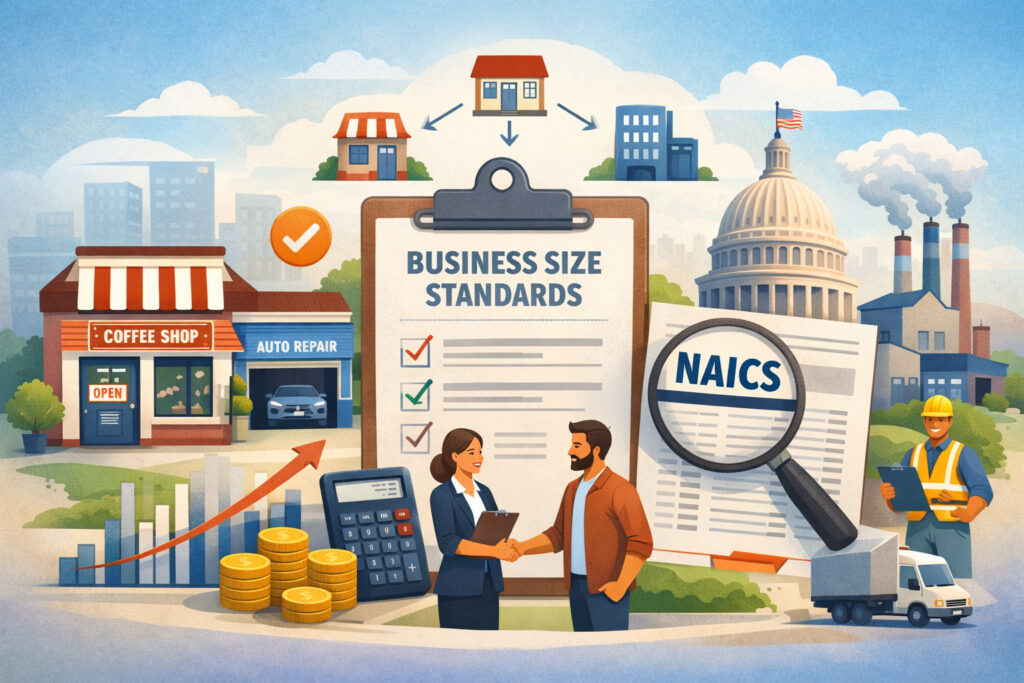
Before you invest time in federal grants for small businesses, confirm that you meet the program’s eligibility definition—because “small business” is not a vibe; it’s a legal and regulatory status.
Many federal programs rely on SBA size standards, which are typically based on NAICS codes and measured using annual receipts or employee counts (depending on industry). The SBA maintains a table of size standards and a Size Standards Tool to help businesses determine whether they qualify for “small” under the relevant NAICS classification.
Why this matters operationally:
- Your NAICS influences eligibility, set-aside rules, and sometimes the scoring model.
- Some programs require that the applicant be a for-profit small business; others allow nonprofits, universities, or state/local entities.
- Many research-heavy federal grants for small businesses (like SBIR/STTR) require specific ownership/control rules and place-of-performance requirements.
Real-world example:
A 40-person IoT company building grid-monitoring sensors might be “small” under a manufacturing NAICS but not under another classification. If the application uses the wrong NAICS or fails to document size properly, your proposal can be rejected as non-responsive before it’s ever scored.
Treat eligibility as a pre-flight checklist item: confirm NAICS, size standard, ownership/control, and any geographic/sector constraints—then build everything else on top of that foundation.
Where to Find Legit Federal Grants for Small Businesses (and How to Avoid Dead Ends)
If you want legitimate federal grants for small businesses, your primary discovery hub is Grants.gov. Most competitive discretionary grants are posted there as Notices of Funding Opportunity (NOFOs).
Many agencies also maintain specialized portals (for example, SBIR/STTR topic pages), but Grants.gov remains the backbone search engine for federal grant opportunities.
A practical search workflow:
- Search Grants.gov using keywords tied to outcomes (e.g., “energy efficiency,” “manufacturing extension,” “cybersecurity,” “workforce training”), not generic terms like “small business funding.”
- Filter by agency and eligibility category.
- Read the NOFO like a compliance document: eligibility, required forms, cost share, deadlines, attachments, formatting rules, and scoring criteria.
Also, don’t confuse federal contracting with federal grants for small businesses. Contracts are procurements (the government buys something). Grants are assistance (the government funds something for public benefit). You may need both strategies, but the paperwork, evaluation, and deliverables differ.
One more important point: federal grants for small businesses are a magnet for scams. Legit opportunities do not require you to pay someone “to unlock funds,” pay for “guaranteed approval,” or pay fees to use official systems. Grants.gov explicitly warns about grant-related scams and the kinds of messages that should trigger immediate skepticism.
The Required Setup: SAM.gov, UEI, Grants.gov Workspace, and Why Registration Timing Can Make or Break You
A surprisingly common reason small businesses miss federal grant deadlines is not writing quality—but registration delays.
To apply for many federal grants for small businesses, you must register your entity in SAM.gov (System for Award Management). During entity registration, SAM assigns a Unique Entity ID (UEI). Without an active registration and UEI, you may not be able to submit at all—or you may be deemed ineligible.
SAM.gov explains that registration is required to apply for federal assistance and that a UEI is assigned as part of registration.
Grants.gov’s applicant registration guidance reinforces this flow: SAM registration is required, you obtain a UEI through SAM, and SAM registration must be renewed annually.
Operational tips (that experienced grant teams use):
- Treat SAM.gov as a recurring compliance task, not a one-time setup.
- Keep your legal name, address, and taxpayer info consistent across SAM, banking, and grant forms.
- Assign internal ownership: one person responsible for SAM renewals, one person responsible for Grants.gov role management.
- Don’t wait until the last week before a deadline to create accounts and request roles.
If you’re serious about federal grants for small businesses, your internal process should treat registrations like the foundation—because they are.
Understanding NOFOs Like an Expert: How Federal Agencies Structure Requirements (and How You Should Respond)
A Notice of Funding Opportunity is the blueprint for how you win federal grants for small businesses. Most applicants skim; experienced applicants map every requirement to a response artifact.
The federal government standardizes NOFO expectations under the Uniform Guidance framework, including Appendix I to 2 CFR Part 200, which lays out what agencies include and how NOFOs should be written (including plain language expectations and accessibility considerations).
When you read a NOFO, build a compliance matrix:
- Eligibility (entity type, size, geographic constraints)
- Required forms (often SF-424 family)
- Narrative sections and page limits
- Budget structure and allowable costs
- Cost share/match rules (if any)
- Evaluation criteria and scoring weights
- Attachments (letters of support, resumes, work plans, technical volume, etc.)
- Submission mechanics and timestamps
Then write your proposal so a reviewer can “check the box” quickly:
- Use the NOFO’s headings and language.
- Provide measurable milestones, responsible parties, and verification methods.
- Show that your business can execute: staffing plan, subcontractor plan, risk plan, and procurement approach.
This is where many federal grants for small businesses are won: not by sounding inspiring, but by being easy to score.
The Compliance Rules You’re Signing Up For: Uniform Guidance (2 CFR Part 200) in Plain English
Federal grants for small businesses come with rules—especially once you accept an award. The primary framework is 2 CFR Part 200, also known as the Uniform Administrative Requirements, Cost Principles, and Audit Requirements for Federal Awards.
The eCFR version is updated regularly and governs how recipients manage funds, document costs, procure vendors, and report performance.
What this means in real operations:
- Allowable costs: You can’t bill the grant for costs that are unallowable or not properly documented.
- Timekeeping: If you charge labor, you need reliable time-and-effort documentation practices.
- Procurement: You may need competitive procurement processes for vendor selection, even as a small business.
- Records: You must retain records and be able to substantiate every dollar claimed.
- Subawards vs contracts: There’s a compliance difference between paying a subrecipient (subaward) and buying a service (contract).
- Reporting: Expect performance reports, financial reports, and sometimes site visits.
If your accounting is informal today, federal grants for small businesses will force a maturity leap. The good news: once you build a compliant system, you can reuse it across programs, making future applications easier and reducing audit risk.
SBIR/STTR: The Most Direct Federal Grants for Small Businesses (Non-Dilutive R&D Funding)
If you want federal grants for small businesses that go directly to for-profit companies, SBIR and STTR are among the most important pathways. These programs fund innovation, meet federal R&D needs, and push commercialization.
The central SBIR.gov site explains that SBIR/STTR funds a portfolio of startups and small businesses to stimulate innovation and transition R&D into impact. NIH’s “America’s Seed Fund” overview breaks down SBIR vs STTR, eligibility, phases, and the program basics.
How it typically works (high level):
- Phase I: Feasibility / proof of concept
- Phase II: Development and validation
- Phase III: Commercialization (often non-SBIR funding sources)
Real-world example:
A health tech startup creates an AI-assisted imaging workflow for early detection. A Phase I award funds feasibility and pilot data generation. A Phase II award funds integration testing, regulatory planning, and expanded validation. The business uses the results to pursue enterprise customers or follow-on funding—without giving up equity.
NSF’s SBIR/STTR solicitation language emphasizes non-dilutive support for use-inspired R&D and commercial outcomes.
If your product roadmap includes technical risk and you can articulate measurable R&D milestones, SBIR/STTR can be one of the best-aligned federal grants for small businesses available.
Energy, Sustainability, and Cost-Saving Projects: USDA REAP and Similar Programs
Not every business fits R&D grants. Some of the most practical federal grants for small businesses fund real assets—especially energy efficiency and renewable energy projects.
A flagship example is USDA Rural Development’s Rural Energy for America Program (REAP), which supports rural small business owners and agricultural producers making energy efficiency improvements or renewable energy investments.
USDA has highlighted significant REAP funding to help reduce energy costs and strengthen resilience, including funding tied to major federal policy initiatives.
Real-world example:
A rural cold-storage business upgrades compressors and adds rooftop solar. REAP can offset a portion of project costs, improving cash flow and reducing operating expenses. The proposal wins when it quantifies energy savings, shows vendor quotes, documents rural eligibility, and lays out a clear installation timeline.
Practical advice for project-style federal grants for small businesses:
- Build a “grant-ready” project packet: utility bills, energy audits (if required), engineering scope, quotes, and permits.
- Treat it like a finance deal: show payback period, operating cost reductions, and implementation risk controls.
- Expect documentation and reimbursement mechanics; don’t assume instant cash.
Also be aware: program funding and disbursement timing can be influenced by policy shifts, legal actions, or administrative changes. That uncertainty is not a reason to avoid federal grants for small businesses—but it is a reason to plan cash flow carefully and read award terms closely.
Department and Agency Grants: How to Choose the Right “Sponsor” for Your Business Model
A common mistake is applying to the first grant you find. The winning approach is to pick agencies whose missions naturally align with your outcomes.
Examples of agency alignment:
- Energy-related innovation: DOE funding opportunity announcements and DOE SBIR/STTR programs support R&D and commercialization tied to energy priorities.
- Regional entrepreneurship ecosystems: EDA’s Build to Scale supports organizations that strengthen entrepreneurial ecosystems and technology-driven business growth. Small businesses often benefit through the programs funded, even when they are not the direct grantee.
- Health and biomedical innovation: NIH SBIR/STTR and related pathways are designed for health innovation commercialization.
How to choose:
- Start from your deliverable: what will exist at the end (prototype, validated process, trained workforce, deployed project)?
- Match the deliverable to the agency mission language.
- Then match the agency’s typical award structure to your capacity (duration, reporting complexity, cost share).
When you align properly, federal grants for small businesses stop feeling like a lottery and start feeling like a pipeline.
Building a High-Scoring Application: The “Reviewer Brain” Strategy That Wins Federal Grants
Federal grants for small businesses are competitive, so your writing must be optimized for reviewers—not just stakeholders inside your company.
Use this structure in most narratives:
- Need statement: define the problem using credible framing and who it affects.
- Objectives: 2–5 measurable outcomes with target metrics.
- Approach / work plan: tasks, timeline, milestones, and success criteria.
- Evidence: prior results, pilots, customer discovery, prototypes, partnerships.
- Team: who is accountable, why they’re qualified, staffing coverage.
- Evaluation: how you’ll measure outcomes and report.
- Sustainability: how results continue after the grant ends.
Make it easy to score:
- Mirror NOFO headings.
- Put key metrics near the top of sections.
- Use short paragraphs and clear transitions.
- Avoid hype words; use verifiable claims.
Real-world example:
Two applicants propose “cybersecurity support for local manufacturers.” One writes a generic narrative about importance. The other provides a 12-month implementation plan, tool stack, baseline risk assessments, monthly deliverables, measurable reduction targets, and a reporting template. Reviewers almost always score the second higher—because it’s executable.
This is how experienced teams win federal grants for small businesses: they reduce reviewer uncertainty.
Budgeting Like a Grant-Pro: Allowable Costs, Matching Funds, and Documentation Practices
The budget is where many federal grants for small businesses get weakened. Reviewers don’t just assess numbers—they assess whether you understand compliance and execution.
First, ground your budget approach in Uniform Guidance principles: costs must be necessary, reasonable, and allocable to the award, and you must retain documentation to support charges.
Key budgeting components:
- Direct labor: tie roles to tasks, show hours and rates.
- Fringe benefits: document the basis (actual or approved rate).
- Equipment: justify why needed, how used, and whether procurement rules apply.
- Travel: tie to project activities, keep it modest.
- Contractors/consultants: define scope and deliverables, not vague “support.”
- Indirect costs: follow the program’s indirect cost policy; if you have a negotiated rate, use it. If not, follow allowable options in the award terms.
Cost share/match (if required) is not “free money.” It’s a commitment with documentation requirements. If your match is in-kind, document how you value it. If it’s cash, show where it comes from.
Winning federal grants for small businesses often comes down to budgets that look like operational plans, not wish lists.
Fraud and Scam Protection: How to Tell Real Federal Grants from Expensive Lies
Because “federal grants for small businesses” is a high-intent search phrase, scammers aggressively target business owners. The safest baseline rule: you should not have to pay to apply through official systems.
Grants.gov publishes guidance on grant-related scams and red flags, including unsolicited outreach promising “free money” or claiming you’ve already been approved.
HHS also warns it is illegal for scammers to ask you to pay to apply or to increase your odds of award. The FTC’s consumer guidance is blunt: offers of “free money from government grants” are scams and should be reported.
Legit process indicators:
- The opportunity is listed on Grants.gov (or a verified agency portal).
- The NOFO has an assistance listing number and clear eligibility rules.
- The submission happens through official portals, not via random email attachments.
- There is no “processing fee” to apply.
You can absolutely hire help (grant writers, compliance consultants), but payment should be for professional services—not for “access” to funds. Protecting your business from scams is part of responsible grant seeking.
Future Outlook: Where Federal Grants for Small Businesses Are Headed Next (2026–2028)
Federal grant priorities shift, but the direction of travel is visible in the programs agencies emphasize and the kinds of NOFOs appearing across sectors.
Here’s what is likely to grow for federal grants for small businesses over the next few years:
- Commercialization-heavy innovation grants: agencies increasingly want measurable deployment outcomes, not just research activity (especially in applied energy and critical tech).
- Domestic production and supply chain resilience: manufacturing modernization, regional clusters, and supplier development will remain high-interest themes.
- Energy efficiency, electrification, and resilience: project-based funding tied to lowering operational costs and improving grid resilience should remain active, with evolving eligibility and documentation requirements (especially in rural and underserved regions).
- Stronger disclosure and risk management for sensitive technologies and R&D collaborations (especially in innovation programs).
Also expect continued tightening around compliance expectations: clearer NOFO structures, stronger data requirements, and more scrutiny on documentation—consistent with agencies using Uniform Guidance and NOFO standards to drive consistency.
The practical implication: build a repeatable internal grants capability now—registrations, budgeting discipline, reporting workflows—so you can respond quickly as new federal grants for small businesses open.
FAQs
Q.1: Are federal grants for small businesses available to start a business?
Answer: Sometimes, but it’s not the norm. Most federal grants for small businesses are designed for research, implementation projects, or mission outcomes—not general business launch expenses.
The SBA specifically clarifies that it generally does not provide grants to start or expand a business, which is why many “startup grant” searches end in frustration.
Q.2: What’s the first step to apply for federal grants for small businesses?
Answer: Get grant-ready operationally: register in SAM.gov, obtain your UEI, and set up Grants.gov access. SAM.gov states that registration is needed to apply for federal assistance and that UEI assignment happens during registration. Grants.gov outlines applicant registration steps and notes SAM registration renewal requirements.
Q.3: Are SBIR/STTR awards considered federal grants for small businesses?
Answer: Yes—SBIR/STTR are among the best-known federal grants for small businesses focused on innovation and commercialization. SBIR.gov and NIH describe how the programs fund small businesses to stimulate innovation and move R&D toward impact.
Q.4: How competitive are federal grants for small businesses?
Answer: Very competitive in many categories. The most reliable way to compete is to align tightly with the NOFO, use measurable outcomes, build a credible work plan, and submit a compliant budget and documentation set. Treat the application like an execution plan that reduces reviewer uncertainty.
Q.5: How do I avoid scams when searching for federal grants for small businesses?
Answer: Use official portals (Grants.gov and agency sites) and ignore unsolicited messages promising guaranteed awards. Grants.gov and HHS publish scam warnings and red flags, and the FTC warns that “free money” grant offers are scams.
Q.6: What are the biggest compliance obligations after winning federal grants for small businesses?
Answer: Expect requirements around allowable costs, documentation, reporting, and procurement practices. The Uniform Guidance (2 CFR Part 200) is the core framework for administrative requirements, cost principles, and audit expectations.
Conclusion
Federal grants for small businesses are real, powerful, and achievable—but they reward discipline more than optimism.
The businesses that consistently win are the ones that treat grants as a professional function: registrations kept current, eligibility validated, NOFOs mapped into compliance checklists, budgets built from execution logic, and reporting systems ready before the award arrives.
If you remember one principle, make it this: federal grants for small businesses fund outcomes, not ambition. When your application reads like a measurable implementation plan that advances an agency mission—and your back office can document every dollar—you shift from “grant hunting” to building a sustainable funding pipeline.