
How to Fund an Online Business
Starting an online business can look inexpensive from the outside, but most digital businesses still need money to launch, operate, and grow.
To fund an online business successfully, owners need to understand their startup expenses, cash flow needs, revenue model, marketing budget, payment processing costs, software subscriptions, inventory requirements, and the time it may take before sales become consistent.
An online business may not need a storefront, but it may still require website development, branding, platform tools, fulfillment systems, customer support, content creation, contractors, advertising, and working capital.
An eCommerce seller may need inventory and shipping supplies. A SaaS founder may need technical talent and product development funds. A creator may need equipment, editing tools, and marketing support. A consultant may need a website, lead generation systems, and professional services.
The best way to approach online business funding is not to chase the fastest money available. It is to understand what the money will be used for, how repayment or ownership tradeoffs will work, and whether the funding option fits the business model.
Some online businesses can grow through bootstrapping and business credit cards. Others may need startup business loans, microloans, crowdfunding, inventory financing, a business line of credit, angel investors, or venture capital.
This guide explains how funding an online business works, how to estimate online business startup costs, which funding options may fit different business models, what lenders and investors may review, and how to prepare before applying for online business financing.
What It Means to Fund an Online Business
To fund an online business means to secure the money needed to launch, operate, stabilize, or grow a business that primarily sells, markets, delivers, or manages products and services through digital channels.
Online business funding can support many different needs, including startup expenses, website development, software subscriptions, online sales tools, payment processing setup, inventory costs, advertising, customer acquisition, content production, contractor support, product development, and working capital.
Funding needs vary widely because online businesses are not all the same. An eCommerce store may need cash for inventory, packaging, fulfillment, returns, and seasonal demand. A digital product business may need funds for course production, design, content creation, software tools, and audience building.
A SaaS business may require a longer runway because product development, technical support, and subscription growth can take time. A service provider may have lower startup costs but still needs marketing spend, bookkeeping, proposal tools, and reliable cash flow between client payments.
Funding can also serve different stages of growth. At launch, money may go toward business formation, branding, website setup, and initial marketing. During early sales, funding may help cover operating expenses while revenue is still inconsistent.
Once the business has traction, growth capital may support inventory expansion, hiring, paid advertising, technology upgrades, customer support, and larger sales channels.
Online business financing should always connect to a clear purpose. Borrowing without a plan can create pressure before the business has reliable revenue. Taking investor money too early can reduce ownership before the business model is proven.
Using personal funds without boundaries can blur finances and make bookkeeping harder. The goal is sustainable financing that supports the business without creating unnecessary risk.
How to Estimate Online Business Startup Costs

Estimating online business startup costs is one of the most important steps before seeking funding. Many first-time owners underestimate early costs because they focus only on building a website or listing products online.
In reality, startup expenses often include business setup, branding, product sourcing, legal documents, payment tools, software subscriptions, launch marketing, shipping systems, content production, and emergency cash reserves.
A good funding estimate should include both one-time startup costs and ongoing monthly costs. One-time costs help the business get ready to launch. Monthly costs keep the business running after launch.
Both matter because many online businesses do not generate steady revenue immediately. Even if the business gets early sales, cash may be tied up in inventory, advertising, refunds, platform fees, contractor invoices, or delayed payouts.
Owners should also estimate customer acquisition cost. This means the average amount spent to gain a customer through advertising, content marketing, partnerships, affiliate marketing, search visibility, email campaigns, or social media. If a business spends heavily on marketing before understanding profit margins, it can grow revenue while still losing money.
A startup cost estimate should include a reserve for unexpected expenses. Online businesses may face website repairs, payment holds, chargebacks, product returns, shipping increases, software upgrades, or supplier delays. A small reserve can prevent short-term problems from becoming major cash flow issues.
| Cost Category | Examples | Why It Matters |
| Setup costs | Formation, licenses, professional services | Creates a legal and operational foundation |
| Website costs | Domain, hosting, design, development | Builds the main sales or lead generation channel |
| Software costs | Email tools, accounting, project management, analytics | Supports daily operations and reporting |
| Product costs | Inventory, prototypes, packaging, samples | Helps prepare products for launch |
| Marketing costs | Ads, content, design, influencer outreach | Drives traffic and customer acquisition |
| Operations costs | Fulfillment, shipping tools, support systems | Keeps orders and customers managed |
| Cash reserve | Emergency funds, refund cushion, slow-month buffer | Protects cash flow during uncertainty |
One-Time Startup Costs
One-time startup costs are the expenses needed to prepare the online business for launch. These may include business formation, brand design, website buildout, legal templates, product photography, initial product inventory, equipment, launch content, and early advertising.
Some businesses may also need professional services, such as help from a bookkeeper, designer, developer, attorney, or tax professional.
For an eCommerce business, one-time costs may include product samples, supplier deposits, packaging design, shipping materials, product pages, photos, and launch inventory.
For a SaaS startup, early costs may include product design, software development, testing, security tools, user interface work, and technical infrastructure. For a creator business, costs may include cameras, microphones, editing tools, lighting, graphic design, and a website or landing page.
Launch marketing is also a common one-time or early-stage expense. Many businesses need an initial advertising budget, email list setup, content calendar, landing page copy, search optimization, and social media assets. Even businesses that rely on organic marketing usually need time, tools, and content production resources before results appear.
Ongoing Monthly Costs
Ongoing monthly costs are recurring expenses that continue after launch. These may include hosting, software subscriptions, email tools, bookkeeping, advertising, platform fees, contractor support, customer support tools, inventory replenishment, shipping software, payment processing costs, analytics tools, and content production.
These recurring costs matter because they affect cash flow. A business may make sales but still struggle if monthly expenses rise faster than revenue. For example, an online store may have strong sales but need to reorder inventory before customers finish paying.
A subscription business may have recurring revenue but also recurring costs for hosting, customer support, development, and churn reduction. A digital service business may have clients but still experience delays between invoice submission and payment.
Online business owners should estimate at least several months of operating expenses before deciding how much funding to seek. This helps prevent a common mistake: raising or borrowing enough money to launch, but not enough to keep the business operating while sales stabilize.
A simple monthly cost estimate should include fixed costs, variable costs, and growth costs. Fixed costs stay relatively stable, such as software or hosting. Variable costs rise with sales, such as shipping, payment processing, and fulfillment. Growth costs include advertising, contractors, and inventory expansion.
Best Funding Options for Online Businesses

There is no single best funding option for every online business. The right choice depends on business stage, revenue history, credit score, cash flow, collateral, profit margins, growth goals, and risk tolerance.
Some owners want to avoid debt and keep full control. Others are comfortable borrowing if repayment terms are manageable. High-growth founders may consider investor funding if the business can scale quickly.
Online business funding can come from personal resources, loans, credit cards, grants, crowdfunding, investors, revenue-based financing, invoice financing, inventory financing, equipment financing, or alternative funding sources. Each option has benefits and drawbacks. The key is matching the funding source to the purpose.
For example, using a short-term credit card for a large inventory purchase can be risky if sales are slower than expected. A business line of credit may be better for recurring cash flow gaps.
Crowdfunding may fit a product launch with a strong audience, but it requires marketing effort. Venture capital may fit a scalable SaaS startup, but it is usually not appropriate for a small online store with modest growth goals.
Bootstrapping and Personal Savings
Bootstrapping means funding an online business with personal savings, early revenue, or careful reinvestment instead of outside financing. Many online businesses begin this way because startup costs can be lower than physical businesses.
A consultant may launch with a website, email tools, and a small marketing budget. A digital product creator may start with content tools and a simple sales page. A small eCommerce seller may begin with limited inventory and reinvest profits into larger orders.
The main benefit of bootstrapping is control. The owner does not have to make loan payments, give up equity, or answer to investors. This can be helpful when the business model is still being tested. Bootstrapping also encourages discipline because every dollar must be connected to a clear purpose.
The drawback is slower growth. Limited funds may restrict advertising, product development, inventory, or hiring. Personal savings also create personal risk. Owners should avoid draining emergency funds or mixing personal and business expenses without records.
Before bootstrapping, prepare a budget, open a business bank account, track expenses, and set a personal limit on how much money you are willing to invest.
Friends and Family Funding
Friends and family funding can help an online business get started when traditional lenders are not yet available. This funding may come as a loan, gift, or small investment. It may support website development, inventory, product testing, branding, launch marketing, or early operating expenses.
The benefit is accessibility. People close to the owner may believe in the idea before the business has revenue history or a business credit profile. This can be useful for first-time owners, creators, consultants, or small online store owners who need modest startup funding.
The risk is personal. Money can damage relationships if expectations are unclear. A casual agreement can create confusion about repayment terms, ownership, timelines, or decision-making. For that reason, friends and family funding should be documented carefully.
Owners should clearly state whether the money is a loan, investment, or gift. If it is a loan, include repayment terms. If it is an investment, explain ownership rights and risks. Nobody should be pressured to provide money they cannot afford to lose.
Business Credit Cards
Business credit cards can be useful for online business financing when used carefully. They may help cover smaller recurring expenses such as software subscriptions, advertising tests, website tools, shipping supplies, content production, and professional services. They may also help separate personal and business spending, which can support cleaner bookkeeping.
The main benefit is flexibility. A business credit card can provide quick access to funds without applying for a larger loan. It may also be easier to use for small purchases that do not justify a formal loan. Some cards may offer rewards, but rewards should never be the main reason to take on debt.
The drawback is cost. If balances are not paid on time, interest can become expensive. Credit cards can also tempt owners to spend more than the business can repay. This is especially risky when paid advertising or inventory purchases do not produce expected revenue.
Business credit cards may fit online businesses with small recurring expenses and a realistic repayment plan. They are less suitable for large long-term funding needs unless the owner has a clear path to pay the balance quickly.
Startup Business Loans
Startup business loans may help newer online businesses cover launch costs, early operating expenses, technology, marketing, equipment, or working capital.
These loans can come from financial institutions, community lenders, or online financing providers. Approval may depend on personal credit score, business plan, available collateral, owner experience, cash flow, and projected revenue.
The benefit of startup business loans is that they can provide a larger funding amount than personal savings or credit cards. They may be useful for an online store that needs inventory, a digital service business that needs hiring support, or a SaaS founder who needs development funds.
The challenge is qualification. New businesses often have limited revenue history, which can make lender review more difficult. Some lenders may require a personal guarantee, collateral, strong personal credit, or detailed financial projections. Repayment begins whether or not sales grow as expected.
Before applying, owners should prepare a business plan, startup cost estimate, revenue model, cash flow projection, and repayment plan. Borrow only what the business can reasonably support.
Microloans
Microloans are smaller loans that can be helpful for online businesses with modest funding needs. They may be used for working capital, inventory, supplies, equipment, furniture, or other eligible business purposes depending on the lender.
Official guidance notes that microloans are often offered through nonprofit or community-based intermediaries, and individual requirements can vary by lender.
Microloans may fit first-time founders, creator businesses, consultants, small online stores, and local service providers that sell online. They can be especially useful when the funding need is too small for a larger term loan but too large to comfortably cover with savings.
The benefit is that microloan programs may include education, mentoring, or business support. This can help owners improve financial records, business planning, and funding readiness. The drawback is that funding amounts may be limited, and approval still requires review.
Before applying, prepare a clear use of funds, business plan, expense estimate, personal credit information, and basic financial records. Even though microloans are smaller, lenders still want to understand how the business will repay the loan.
Business Grants
Business grants can be attractive because they generally do not require repayment. They may support specific business types, communities, industries, research activities, training programs, or economic development goals.
For online businesses, grants may be useful for product development, education, technology adoption, export preparation, or specialized programs.
The benefit is obvious: grant money can reduce the need for debt or equity funding. However, grants are competitive, specific, and often time-consuming to apply for. Many grants have eligibility rules, reporting requirements, deadlines, and restrictions on how funds can be used.
Business grants may fit online businesses that align with a grant’s purpose. A digital product business focused on education, a technology startup, or a small business serving a defined market may find relevant opportunities. However, grants are rarely a fast or guaranteed funding source.
Before applying, owners should review eligibility carefully, prepare a strong project description, gather required documents, and explain how the funds will create measurable impact. Grants should be treated as one possible funding source, not the only plan.
Crowdfunding
Crowdfunding allows an online business to raise money from a large number of people, often in exchange for early access, rewards, products, memberships, or community participation. It can work well for product launches, creative businesses, digital products, niche brands, and audience-driven businesses.
The benefit is that crowdfunding can validate demand before a full launch. If people are willing to contribute, preorder, or support the idea, the business may gain useful market feedback. Crowdfunding can also create early brand awareness and a customer community.
The drawback is that crowdfunding requires marketing. A campaign does not succeed just because it is published. Owners need a strong offer, clear story, visuals, pricing, fulfillment plan, communication schedule, and audience-building strategy. Product delays or unclear promises can damage trust.
Crowdfunding may be a good fit when the business already has an audience, a compelling product, or a clear launch story. Before starting, calculate production costs, platform fees, shipping, taxes, refunds, and delivery timelines.
Angel Investors
Angel investors are individuals who invest personal funds into early-stage businesses in exchange for ownership, convertible instruments, or other investment terms.
Angel investors may be interested in scalable online businesses such as SaaS startups, marketplaces, technology products, innovative eCommerce brands, or digital platforms with strong growth potential.
The benefit is that angel funding can provide capital before traditional lenders are comfortable with the business. Some angel investors may also offer mentoring, industry knowledge, and connections. This can be valuable for founders who need more than money.
The drawback is dilution. Taking investment means giving up some ownership or future financial upside. Investors may also expect updates, growth milestones, and a path to larger returns. Not every online business is a fit for angel investment.
Before approaching angel investors, prepare an investor pitch, business model summary, target market analysis, revenue model, financial projections, customer acquisition strategy, and explanation of how funds will be used. Be ready to explain risks honestly.
Venture Capital
Venture capital is investment funding for businesses with the potential to grow quickly and reach a large market. It is most relevant for scalable online businesses such as SaaS platforms, marketplaces, technology-enabled services, data products, and fast-growing digital platforms.
The benefit is access to significant growth capital. Venture funding can support product development, hiring, infrastructure, marketing, customer acquisition, and expansion. It may also bring strategic guidance and investor networks.
The drawback is that venture capital is not designed for every business. Investors usually expect rapid growth, large market potential, and the possibility of major returns. Founders may give up ownership and decision-making influence. The business may also face pressure to grow faster than it can sustainably manage.
Venture capital may fit a SaaS startup funding plan when the product has strong market potential, recurring revenue, and a scalable model. It is usually not the right choice for a small lifestyle business, local service provider, or modest online store.
Business Line of Credit
A business line of credit gives an online business access to a set amount of funds that can be drawn as needed. Instead of receiving one lump sum, the owner can use funds for short-term needs and repay based on the amount borrowed. This can be useful for managing cash flow gaps.
A line of credit may help with inventory restocking, seasonal advertising, delayed customer payments, platform payout delays, shipping expenses, or unexpected operating costs. It is often more flexible than a term loan because the business does not have to use the full amount at once.
The benefit is control and flexibility. The drawback is that costs can rise if the balance remains unpaid or if the line is used for long-term expenses. Some lenders may require revenue history, bank statements, credit review, or a personal guarantee.
A business line of credit may fit online businesses with recurring sales and uneven cash flow. Before applying, owners should understand repayment terms, fees, draw rules, and renewal conditions.
Inventory Financing
Inventory financing helps businesses purchase inventory using the inventory itself as part of the repayment support or collateral structure. This can be useful for eCommerce business funding, online store financing, marketplace selling, and seasonal product businesses.
The benefit is that it connects funding to a direct revenue-generating asset. If an online store has proven sales but needs more inventory to meet demand, inventory financing may help avoid stockouts. It can also support seasonal preparation when cash must be spent before sales arrive.
The risk is that inventory may not sell as expected. Trends can change, products can become outdated, and storage or fulfillment costs can reduce margins. If inventory is overestimated, the business may carry debt without enough sales to repay it comfortably.
Before using inventory financing, review sales history, inventory turnover, profit margins, supplier terms, return rates, storage costs, and demand forecasts. Avoid funding inventory based only on hope or excitement.
Equipment Financing
Equipment financing helps a business purchase equipment needed for operations. Online businesses may use it for computers, cameras, lighting, shipping equipment, production tools, packaging machines, servers, or specialized hardware. The equipment may serve as collateral depending on the financing structure.
This option can fit creator business funding, digital product business funding, eCommerce operations, fulfillment support, and content production businesses. A creator may need cameras and editing systems. An online seller may need label printers, packing stations, or production tools. A digital agency may need professional computers and technical equipment.
The benefit is that equipment financing connects the loan to a specific business asset. The drawback is that equipment can lose value or become outdated. Owners should avoid financing equipment that is not essential to revenue, operations, or customer delivery.
Before applying, compare equipment cost, expected useful life, repayment terms, maintenance needs, and whether buying or leasing makes more sense.
Invoice Financing
Invoice financing allows a business to access funds based on unpaid invoices. This can help digital service providers, consultants, agencies, and B2B online businesses that complete work before receiving payment. Instead of waiting for clients to pay, the business can use invoice financing to improve short-term cash flow.
The benefit is that funding is tied to money the business has already earned. This can be useful when a client has approved an invoice but pays on a slower schedule. It may help cover contractor payments, software costs, payroll, or operating expenses.
The drawback is cost. Invoice financing fees can reduce profit margins. It also works best when customers are reliable and invoices are valid, clear, and collectible. It is not usually helpful for businesses that sell directly to consumers because they do not rely on invoices.
Before using invoice financing, review customer payment history, invoice amounts, fees, contract terms, and whether better payment terms could solve the problem without financing.
Revenue-Based Financing
Revenue-based financing provides capital in exchange for repayment based on a percentage of future revenue. This option may appeal to online businesses with consistent sales, such as eCommerce stores, subscription businesses, digital product sellers, and online service businesses with recurring income.
The benefit is that payments may move with revenue. When sales are stronger, repayment may be faster. When sales slow, payments may decrease depending on the agreement. This can be attractive for businesses with variable cash flow.
The drawback is that total repayment costs can be high, and daily or weekly repayment structures may pressure cash flow. Owners should carefully compare the total repayment amount, percentage of revenue collected, fees, and how sales data is reviewed.
Revenue-based financing may fit businesses with proven online sales and strong margins. It is risky for businesses that are still testing their offer, have weak margins, or rely heavily on paid advertising that may fluctuate.
Alternative Online Business Funding
Alternative online business funding includes nontraditional financing options such as merchant-style advances, platform-based financing, specialized digital business loans, purchase order financing, short-term working capital products, and other funding tools designed for fast access. These may be marketed to businesses that need quick funding or have difficulty qualifying for traditional loans.
The benefit is speed and accessibility. Some alternative options may review sales data, payment processing history, or platform revenue instead of relying only on traditional collateral. This can help online businesses with strong sales but limited credit history.
The drawback is that faster funding can come with higher costs, shorter repayment terms, or complex pricing. Some products may use factor rates or automatic payment deductions that are harder to compare with standard interest rates. Business owners should calculate the real cost before accepting funds.
Alternative funding may be useful for short-term needs, but it should not replace careful planning. Review the repayment schedule, total cost, impact on cash flow, and whether the funding supports a clear return.
Funding Options by Online Business Type
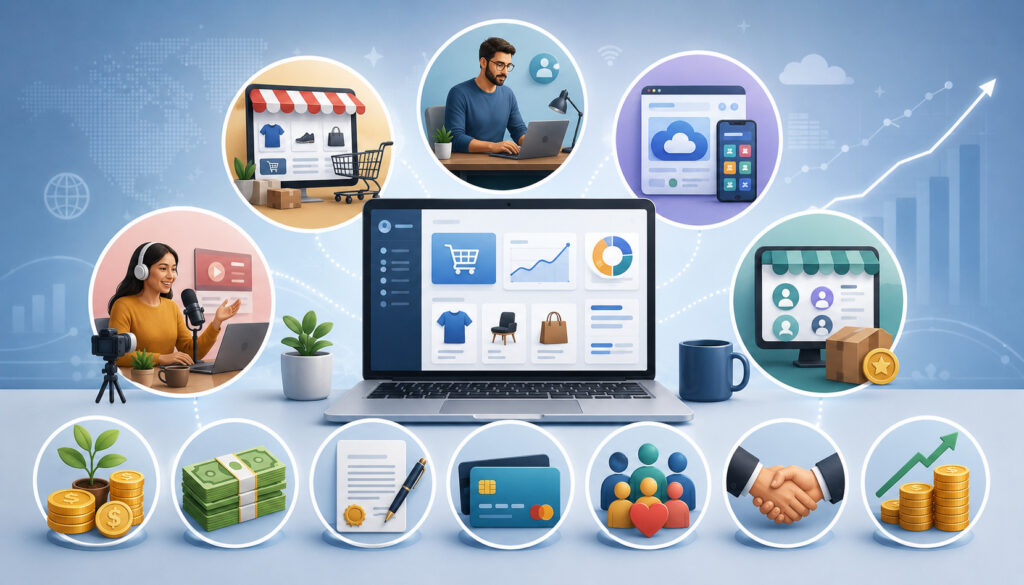
Different online businesses need different funding strategies because their costs, risks, margins, and revenue models vary. A one-person consulting business may need a small amount of startup capital for a website, scheduling tool, proposal software, and marketing.
An eCommerce business may need far more money for inventory, packaging, fulfillment, returns, and advertising. A SaaS business may need significant runway before subscription revenue catches up with product development costs.
The right funding path depends on what drives revenue. If the business earns money through online sales of physical products, inventory and fulfillment may be the biggest cash flow challenges. If it earns subscription revenue, product development, churn, customer support, and recurring infrastructure may matter more.
If it earns through services, the owner may need to manage invoice timing, contractor payments, and lead generation costs. If it earns through content, the challenge may be audience growth, equipment, editing, and sponsorship timelines.
Funding should also match risk tolerance. A small creator business may prefer bootstrapping and low fixed costs. A marketplace seller may use a line of credit or inventory financing once sales are proven.
A SaaS founder targeting rapid growth may consider angel investors or venture capital. A digital service agency may use invoice financing or a business line of credit to smooth cash flow.
Funding an eCommerce Business
Funding an eCommerce business often requires careful planning around inventory, marketing, fulfillment, returns, and cash flow. Even a profitable online store can run short on cash if money is tied up in inventory before sales arrive.
Owners may need funds for product sourcing, packaging, warehousing, shipping supplies, payment processing costs, paid advertising, customer support, and return management.
Inventory financing, business lines of credit, business credit cards, revenue-based financing, and startup business loans may all fit different stages of an eCommerce business. A new store may rely on savings, microloans, or a small credit card balance for launch costs.
A store with proven sales may qualify for a line of credit or inventory financing. A fast-growing brand may consider investors if it has strong margins and market potential.
The biggest risk is funding growth before understanding unit economics. Owners should know product cost, shipping cost, platform fees, advertising cost, refund rate, chargeback risk, and profit margin before borrowing. Revenue alone is not enough; the business must have enough margin to repay funding and still operate.
Funding a SaaS or Subscription Business
Funding a SaaS or subscription business is different because the biggest costs often come before revenue becomes stable.
Product development, software infrastructure, technical talent, security, customer support, onboarding, and ongoing improvements can require significant investment. Subscription revenue may grow slowly at first, and customer churn can affect projections.
SaaS startup funding may come from bootstrapping, angel investors, venture capital, startup business loans, grants, or revenue-based financing once recurring revenue is established.
Investor funding may be more relevant for SaaS businesses that target large markets, have scalable technology, and need speed. However, not every subscription business needs investors. A smaller software tool can grow through customer revenue if costs are controlled.
Owners should understand monthly recurring revenue, churn, customer acquisition cost, customer lifetime value, support costs, and runway. These numbers help determine whether the business needs outside capital and how much.
Funding a Digital Service or Creator Business
Digital service and creator businesses often have lower startup costs than product-based businesses, but they still need funding discipline. Common expenses include equipment, software subscriptions, website development, portfolio assets, content production, contractor support, editing tools, advertising, email marketing, bookkeeping, and professional services.
A consultant, designer, writer, agency owner, educator, or creator may start with savings and gradually reinvest revenue. Business credit cards can help with small recurring tools if paid responsibly.
Invoice financing may help service businesses that wait for client payments. Microloans may help purchase equipment or fund a launch campaign. Crowdfunding may support a creator-led project when there is a committed audience.
The main challenge is inconsistent cash flow. Client projects may be seasonal. Content revenue may fluctuate. Sponsorships may take time. Digital products may sell well during launch but slow afterward. Owners should build a cash reserve and avoid taking on fixed repayment obligations without predictable revenue.
Debt Financing vs Equity Financing for Online Businesses
Debt financing means borrowing money that must be repaid. Equity financing means receiving money in exchange for ownership in the business. Both can help fund an online business, but they create different obligations and risks.
Debt financing includes startup business loans, microloans, credit cards, business lines of credit, equipment financing, inventory financing, invoice financing, and some forms of working capital funding.
The benefit is that the owner keeps ownership. The lender does not usually get a share of future profits or control decisions. The drawback is repayment. Payments may be required even when sales are slow. Debt can also involve interest, fees, collateral, or a personal guarantee.
Equity financing includes angel investors and venture capital. The benefit is that the business may receive capital without regular loan payments. Investors may also bring advice, connections, and credibility. The drawback is dilution. The founder gives up ownership and may need to meet investor expectations for growth, reporting, and future exits.
Online business models influence the choice. A small digital service business with steady cash flow may prefer debt or bootstrapping. A scalable SaaS company with high growth potential may consider equity. An eCommerce business may use debt for inventory if sales are proven, but equity may make sense if the brand needs major growth capital.
The best choice depends on repayment ability, ownership goals, risk tolerance, market size, margins, and growth speed.
Online Business Funding Comparison Table
The following table compares common funding options for online businesses. It should not be used as a final decision tool on its own, but it can help owners narrow their choices before speaking with lenders, advisors, or financial professionals.
| Funding Source | Best Use Case | Repayment Type | Approval Difficulty | Funding Speed | Risk Level | Key Consideration |
| Bootstrapping | Testing an idea with low costs | No formal repayment | Low | Immediate | Medium personal risk | Protect emergency savings |
| Friends and family | Early launch support | Loan, gift, or equity | Low to medium | Varies | Relationship risk | Use written agreements |
| Business credit cards | Small recurring expenses | Revolving debt | Medium | Fast | Medium to high | Avoid carrying balances |
| Startup business loans | Launch and operating costs | Fixed repayment | Medium to high | Moderate | Medium | Requires repayment plan |
| Microloans | Smaller startup needs | Fixed repayment | Medium | Moderate | Medium | May include business support |
| Business grants | Specific eligible projects | Usually no repayment | High | Slow | Low financial risk | Competitive and restrictive |
| Crowdfunding | Product or audience launch | Rewards or presales | Medium | Campaign-based | Medium | Requires strong marketing |
| Angel investors | Scalable early-stage business | Equity or convertible terms | High | Slow to moderate | Ownership dilution | Needs investor pitch |
| Venture capital | High-growth scalable model | Equity | Very high | Slow | High control tradeoff | Growth expectations are significant |
| Line of credit | Cash flow gaps | Revolving debt | Medium | Moderate | Medium | Best for short-term needs |
| Inventory financing | Product restocking | Debt tied to inventory | Medium | Moderate | Medium | Requires demand confidence |
| Equipment financing | Hardware or production tools | Asset-based repayment | Medium | Moderate | Medium | Equipment should support revenue |
| Invoice financing | Waiting on client invoices | Fee-based advance | Medium | Fast | Medium | Reduces margin |
| Revenue-based financing | Proven online sales | Percentage of revenue | Medium | Fast to moderate | Medium to high | Compare total repayment cost |
What Lenders and Investors May Review
Lenders and investors review online businesses differently, but both want to understand risk, readiness, and the likelihood that the business can produce results. Lenders usually focus on repayment ability. Investors usually focus on growth potential and return opportunities. Both may review the owner’s experience, financial records, and business model.
A lender may review credit score, business credit profile, bank statements, revenue history, payment processing data, cash flow, debt obligations, profit margins, collateral, personal guarantee, and industry risk.
For newer businesses, personal credit and owner financial history may matter more because the business does not yet have a long track record. Official guidance also explains that new business loan eligibility is often based on the owner’s personal credit while business credit is still being established.
Investors may review market size, revenue model, customer acquisition cost, website traffic, conversion rates, subscription revenue, churn, growth rate, product differentiation, team skills, intellectual property, competitive landscape, and financial projections. They may also ask why the business needs investor capital instead of growing through revenue or debt.
Online businesses should be ready to share data. An eCommerce seller may provide sales trends, inventory turnover, return rates, advertising performance, and gross margins. A SaaS business may provide recurring revenue, churn, activation rates, and customer acquisition cost. A service provider may provide contracts, invoices, client retention, and cash flow forecasts.
The more organized the records, the easier it is for funding providers to evaluate the business.
How to Prepare Before Applying for Online Business Funding
Preparation can improve funding readiness and help owners avoid expensive mistakes. Before applying for online business financing, the business should have a clear funding purpose, organized records, realistic projections, and a repayment or return plan.
Owners should know how much money they need, what it will fund, how long it should last, and how it may help the business generate revenue or improve operations.
Preparation begins with separating personal and business finances. A business bank account, bookkeeping system, and clean expense tracking can make lender review easier. Owners should also track online sales, platform fees, payment processing costs, refunds, advertising spend, inventory purchases, contractor payments, and software subscriptions.
A funding request should also include financial projections. These do not need to be perfect, but they should be realistic. Projections should show expected revenue, cost of goods sold, operating expenses, marketing spend, repayment obligations, and cash flow.
For online businesses, projections should also consider customer acquisition cost, conversion rate, subscription churn, inventory turnover, or client payment timing.
Official small business planning resources often recommend using business plans, startup cost calculations, and funding preparation tools before seeking capital.
Build a Clear Business Plan
A business plan helps explain how the online business works and why funding is needed. It should describe the business model, target audience, products or services, pricing, marketing channels, operations, competitors, revenue model, and growth strategy. It should also explain how the business will use funding and how that funding supports measurable goals.
For an eCommerce store, the plan may include product categories, suppliers, inventory strategy, fulfillment process, customer acquisition channels, and return policies.
For a SaaS business, it may include product features, development roadmap, subscription pricing, customer support plan, and churn management. For a digital service business, it may include service packages, lead generation, client onboarding, contractor support, and project delivery.
A strong business plan does not need to be overly complicated. It should be clear, realistic, and connected to numbers. Funding providers want to see that the owner understands both opportunity and risk.
Organize Financial Records
Financial records are essential for funding readiness. Even early-stage online businesses should organize sales reports, expense records, bank statements, bookkeeping files, payment processing reports, platform reports, invoices, tax records, inventory reports, and cash flow forecasts.
Clean records help lenders understand repayment ability. They help investors understand growth potential. They also help the owner make better decisions. Without accurate records, it is difficult to know whether the business is profitable, which products have strong margins, which marketing channels work, or how much funding is truly needed.
Online businesses should track both revenue and costs in detail. Gross sales can be misleading if platform fees, shipping, refunds, ad spend, payment processing, software subscriptions, and contractor costs are not included. A business with strong sales may still have weak profit margins.
Bookkeeping should be updated regularly, not only when applying for funding. Better records can also support tax preparation, pricing decisions, and cash flow planning.
Calculate How Much Funding You Really Need
One of the most common funding mistakes is asking for too much or too little. Too little funding can leave the business undercapitalized, forcing the owner to seek more money quickly. Too much funding can create unnecessary repayment pressure or ownership dilution.
To calculate the right amount, connect every dollar to a purpose. Start with one-time startup costs, then add several months of operating expenses. Include marketing, inventory, software, payment processing, contractor support, taxes, returns, shipping, and emergency reserves. Then estimate how revenue will develop and when the business may reach stable cash flow.
Owners should also test different scenarios. What happens if launch sales are slower than expected? What if advertising costs rise? What if inventory sells out too quickly or too slowly? What if customer refunds are higher than planned? These questions help create a safer funding estimate.
A good funding amount should support the business plan without encouraging careless spending. The goal is not to borrow the maximum available. The goal is to secure enough capital to reach the next stable milestone.
Common Mistakes to Avoid When Funding an Online Business
Funding can help an online business grow, but the wrong funding decision can create long-term pressure. One common mistake is relying only on paid advertising without understanding customer acquisition cost, conversion rates, and profit margins. Paid ads can bring traffic quickly, but they can also consume cash if the offer, pricing, or website experience is not ready.
Another mistake is ignoring cash flow. Online businesses often face timing gaps. Inventory must be purchased before sales. Contractors may need payment before clients pay invoices. Subscription revenue may grow gradually. Marketplace payouts may not arrive immediately. Refunds, chargebacks, and shipping costs can also affect cash flow.
Some owners underestimate inventory costs. They may budget for the first purchase but forget packaging, storage, damaged goods, returns, samples, supplier minimums, and reorder timing. Others use personal accounts for business expenses, which makes bookkeeping harder and can weaken funding applications.
Expensive funding taken too early is another risk. Fast money may look attractive, but short repayment terms or high fees can strain a young business. Owners should compare repayment terms, fees, total cost, and impact on cash flow before accepting any offer.
Other mistakes include overestimating early revenue, ignoring platform fees, failing to plan for refunds, not building a cash reserve, and accepting investor money without understanding dilution.
When to Combine Multiple Funding Sources
Many online businesses use more than one funding source over time. Combining funding sources can be responsible when each source has a clear purpose and the total repayment burden remains manageable. The goal is to match each funding type to the right need.
For example, an owner may use personal savings for business setup, a business credit card for small recurring software tools, a microloan for launch marketing, and a business line of credit for inventory gaps.
An eCommerce business may use inventory financing for proven products and reserve cash for returns or shipping changes. A creator may bootstrap content production and use crowdfunding for a specific project. A SaaS founder may use savings for early development and seek angel investors after validating demand.
Combining funding can also reduce risk. Instead of taking one large loan, the owner may use smaller tools for specific needs. However, combining funding becomes risky when the owner loses track of repayment dates, fees, interest, or cash flow obligations.
A funding stack should be reviewed regularly. Owners should know total debt, monthly payments, available credit, interest rates, investor obligations, and expected cash inflows. If multiple funding sources are used, bookkeeping becomes even more important.
Sustainable financing means the business can keep operating while meeting obligations. It does not mean using every available funding option.
What is the best way to fund an online business?
The best way to fund an online business depends on the business model, startup costs, revenue stage, credit profile, risk tolerance, and growth goals. A low-cost consulting or creator business may be able to start with savings and reinvested revenue.
An eCommerce business may need inventory financing, a line of credit, or a startup loan once sales are proven. A SaaS business with large growth potential may consider angel investors or venture capital.
No funding source is best for every situation. The right option should match the purpose of the money. If funds are needed for small recurring tools, a business credit card may work if paid responsibly. If funds are needed for inventory, inventory financing or a line of credit may fit better. If funds are needed for rapid technology growth, investor funding may be more realistic.
How much money do I need to start an online business?
The amount needed depends on what the business sells and how it operates. A service business may need only a website, software, branding, and marketing budget.
An eCommerce store may need product samples, inventory, packaging, shipping systems, payment tools, and advertising. A SaaS startup may need development, hosting, security, customer support, and a longer runway.
To estimate the amount, list one-time startup costs and ongoing monthly costs. Then add a cash reserve for slow sales, refunds, software changes, shipping issues, or unexpected expenses. The goal is to calculate enough funding to launch and operate until the business has more predictable cash flow.
Can I get online business funding with no revenue?
It may be possible, but options are usually more limited. Without revenue history, lenders may rely more heavily on personal credit score, owner experience, collateral, business plan, personal guarantee, and financial projections. Some owners use savings, friends and family funding, microloans, grants, crowdfunding, or business credit cards to start.
Investor funding may be possible for certain scalable businesses, especially if the founder has a strong team, market opportunity, prototype, audience, or early user interest. However, no-revenue funding usually requires a stronger explanation of how the business will make money and why the risk is reasonable.
Are business credit cards useful for online businesses?
Business credit cards can be useful for online businesses when used for manageable expenses and paid on time. They may help cover software subscriptions, website tools, small advertising tests, shipping supplies, content tools, and professional services. They can also help separate business and personal spending.
The risk is carrying balances without a repayment plan. Interest can become expensive, and credit card debt can grow quickly if the business uses paid ads or inventory purchases that do not generate enough profit. A business credit card should support cash flow, not replace a real funding strategy.
Can an eCommerce business get inventory financing?
An eCommerce business may be able to get inventory financing if it has sales history, demand data, supplier information, and a clear plan for selling the inventory. Lenders may review revenue trends, inventory turnover, profit margins, product demand, and business bank statements.
Inventory financing can be helpful when a store needs to restock proven products or prepare for seasonal demand. It is riskier when used for untested products, trend-based inventory, or large purchases without clear demand. Owners should calculate expected margins after shipping, platform fees, payment processing, returns, and financing costs.
Is crowdfunding a good option for online businesses?
Crowdfunding can be a good option for online businesses with a strong product, audience, story, or community. It may work well for product launches, creative projects, digital products, memberships, and creator-led businesses. It can also help validate demand before a full launch.
However, crowdfunding is not easy money. Campaigns require planning, marketing, visuals, pricing, communication, and fulfillment. Owners should calculate production costs, shipping costs, platform fees, taxes, refunds, and delivery timelines before launching a campaign.
Do online businesses qualify for business grants?
Some online businesses may qualify for business grants, but grants usually have specific eligibility rules. They may support certain industries, communities, research activities, training efforts, technology development, or economic goals. A business must match the grant’s purpose and follow application requirements.
Grants are competitive and may take time. They should not be treated as guaranteed funding. Online business owners should prepare documents, project descriptions, budgets, and measurable goals before applying. Grants can be useful, but they are usually best used as part of a broader funding plan.
Should I use a loan or investor funding for an online business?
A loan may be a better fit when the business can repay debt from cash flow and the owner wants to keep ownership. Loans may work for inventory, equipment, working capital, or marketing when the business has a realistic repayment plan. The risk is that payments are required even if sales slow down.
Investor funding may fit businesses with high growth potential, scalable technology, or large market opportunities. It can provide capital without regular loan payments, but it usually requires giving up ownership. The right choice depends on growth goals, repayment ability, control preferences, and the business model.
What documents are needed to apply for online business financing?
Documents may vary by funding source, but common items include a business plan, bank statements, personal identification, business formation documents, tax records, sales reports, platform reports, payment processing statements, profit and loss statements, cash flow projections, inventory reports, invoices, and a use-of-funds summary.
Newer businesses may also need owner credit information, personal financial details, resumes, contracts, supplier quotes, or financial projections. Clean records can make the application process easier and help funding providers understand the business.
How can I avoid taking on too much debt?
To avoid too much debt, start by calculating the exact funding need and connecting every dollar to a clear use. Compare repayment terms, fees, interest, total cost, and cash flow impact before accepting funding. Avoid borrowing based only on best-case revenue projections.
It is also wise to build a cash reserve, track expenses, monitor profit margins, and avoid using short-term debt for long-term problems. If repayment depends on unrealistic sales growth, the funding may be too risky. Sustainable financing should support the business, not overwhelm it.
Conclusion
Learning how to fund an online business starts with understanding the business model, startup expenses, operating costs, revenue stage, and growth goals.
Online businesses may have lower overhead than physical businesses, but they still need money for website development, software subscriptions, inventory, advertising, fulfillment, content production, payment processing, contractors, customer support, and working capital.
The right funding option depends on the purpose of the money. Bootstrapping may fit a lean launch. Business credit cards may help with small recurring expenses. Microloans and startup business loans may support early costs.
A business line of credit may help with cash flow gaps. Inventory financing may support product-based growth. Invoice financing may help service businesses waiting on client payments. Crowdfunding may work for audience-driven launches. Angel investors and venture capital may fit scalable businesses with strong growth potential.
The most important step is preparation. Estimate costs carefully, organize financial records, separate personal and business finances, understand repayment terms, and compare funding options before making a decision.
The fastest funding option is not always the best one. A sustainable funding path should help the business grow while protecting cash flow, ownership goals, and long-term stability.