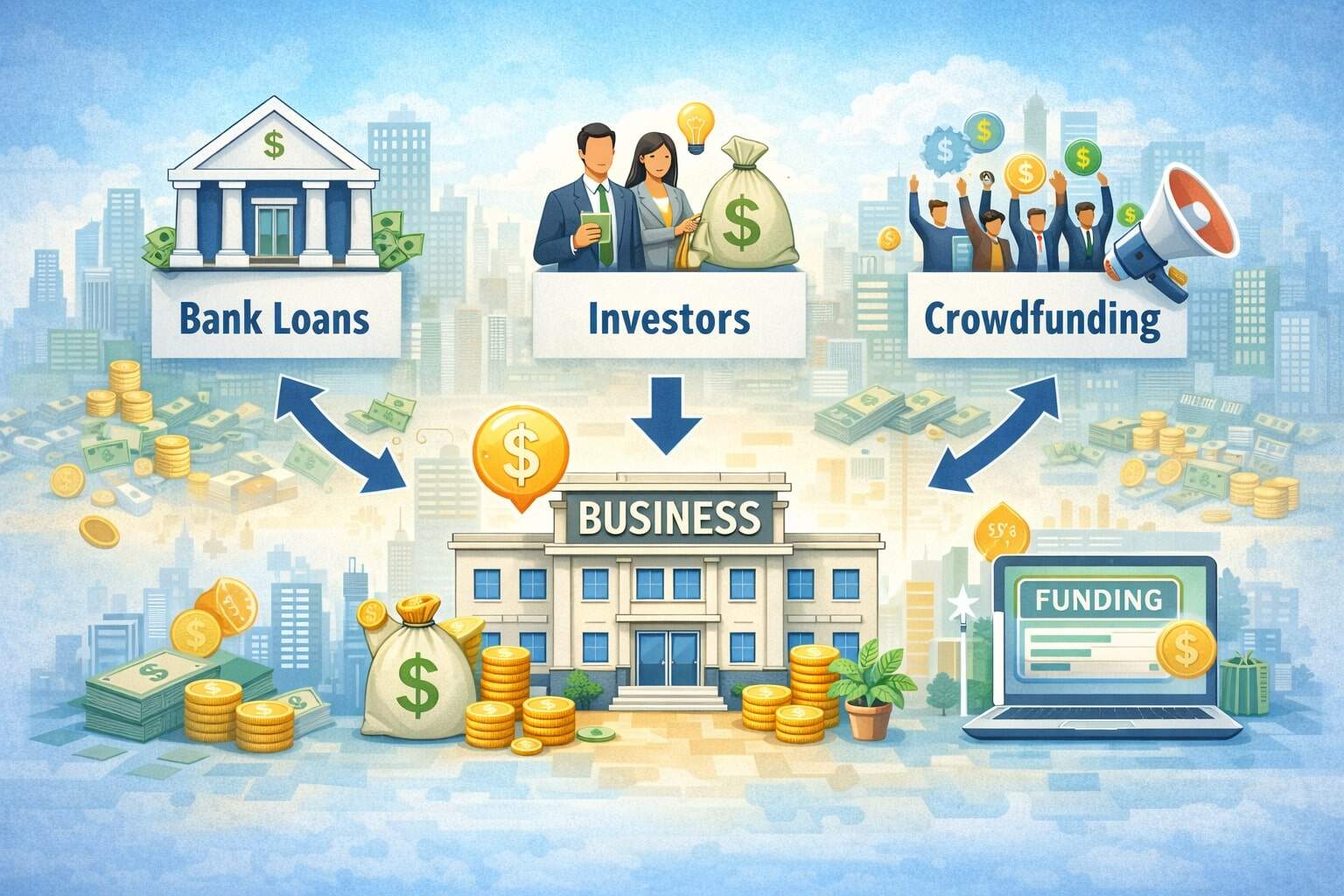
How Business Funding Works: Step-by-Step Guide
Business funding is the process of getting money to start, run, or grow a company—without breaking your cash flow or putting your business at unnecessary risk. The best business funding plan isn’t “get the biggest amount possible.”
It’s matching the right type of capital to a specific business goal, at the right time, with a repayment structure your revenue can comfortably support.
In this step-by-step guide, you’ll learn how business funding works in real life—from preparing your numbers and picking the right funding type to submitting a strong application, negotiating terms, and managing funds after approval.
You’ll also learn where the market is headed (including embedded lending and AI-driven underwriting), how lenders evaluate risk, and what compliance and documentation changes may affect business funding decisions in the near future.
Step 1: Get Clear on Why You Need Business Funding

Before you apply for business funding, define the purpose in one sentence: “I need $X to do Y, and it will generate Z outcome by (date).”
This matters because every lender or investor is silently asking: “What will this money do, and how does it reduce risk?” If your answer is vague (“growth,” “marketing,” “inventory”), you may get weaker offers—or the wrong type of business funding altogether.
Start by sorting your need into one of four buckets:
- Working capital (payroll, rent, suppliers, short-term cash gaps). This usually fits revolving credit or short-term business funding tools that refill as you pay down balances.
- Asset-based (equipment, vehicles, large tools, buildouts). This often fits equipment financing or term loans because the asset supports the deal.
- Expansion (new location, hiring, long-term scaling). This often requires longer repayment schedules so your business funding doesn’t crush monthly cash flow.
- Bridge (you’re waiting on receivables, payouts, seasonal spikes). This can fit invoice-related funding or products tied directly to incoming cash.
A strong business funding plan also includes constraints. What monthly payment can you support? Are you okay with collateral? Do you need approval fast? Are you willing to share equity? When you define these limits early, you avoid “expensive emergency capital” that quietly becomes permanent business funding.
Finally, define success metrics: revenue lift, margin change, inventory turns, cost savings, or time-to-break-even. This makes business funding easier to approve because it turns your request into an investment case—not just a money request.
Step 2: Know the Main Types of Business Funding (And When Each Works)

Business funding generally comes in two big categories: debt financing (you repay) and equity financing (you share ownership). A third category—often overlooked—is non-dilutive business funding, like grants or incentives, where you may not repay and you don’t give up equity, but you must qualify and comply with strict rules.
Debt-based business funding (loans, lines, and cash-flow financing)
Debt-based business funding is the most common because it doesn’t dilute ownership. You receive capital and repay it over time, usually with interest, fees, or both.
The key tradeoff is predictability: debt business funding can be structured with stable payments (term loans) or flexible access (lines of credit). Lenders care about your ability to repay, so they focus on cash flow, credit profile, time in business, and sometimes collateral.
Where debt business funding shines:
- You have consistent revenue and want to keep ownership.
- You can handle monthly payments even in slower months.
- You want to build business credit and qualify for better rates later.
Where it can hurt:
- Payments start before the growth “kicks in.”
- Short-term products can become expensive if used too long.
- Tight cash flow + high fixed payments can create a cycle of refinancing.
Debt business funding also includes products that feel “loan-like” but behave differently—like receivables-based advances or revenue-based repayment structures.
These are not automatically “bad,” but they must match your revenue patterns, margins, and seasonality. When the repayment speed changes with sales volume, your true cost of business funding can vary.
Equity-based business funding (angels, venture, and strategic capital)
Equity business funding means selling part of your company to get capital and support. This can be powerful when your business model scales fast and needs capital before profits show up. Investors will scrutinize market size, competitive advantage, unit economics, and growth trajectory.
Equity business funding is best when:
- You’re building something that can grow quickly without linear cost increases.
- You need large capital amounts that debt lenders won’t approve yet.
- Mentorship, introductions, or strategic partnerships matter as much as money.
The downside is control and dilution. You may give up board seats, decision rights, and a portion of future upside. Also, equity business funding often comes with growth expectations that may not fit every business.
Non-dilutive business funding (grants, credits, incentives)
Non-dilutive business funding can be a game-changer, but it’s rarely “free money.” Grants and incentives typically require documentation, specific use of funds, reporting, and strict eligibility. The upside: you preserve ownership and avoid monthly payments. The challenge: timelines can be slow, competition is high, and the administrative effort is real.
A smart strategy is to layer business funding: use non-dilutive programs for eligible costs, then use debt business funding for working capital, and only consider equity when the growth math truly supports it.
Step 3: Understand How Lenders Decide “Yes” or “No”

Business funding approval is not random. Most lenders evaluate risk using a combination of the “5 C’s”: Character, Capacity, Capital, Collateral, and Conditions. Even fintech platforms that automate approvals still map to these fundamentals—just faster and with different data sources.
Capacity: cash flow is the foundation of business funding
Capacity is your ability to repay. For business funding, lenders typically examine revenue consistency, margins, existing debt obligations, and cash flow volatility. If your monthly revenue swings wildly, the lender may shorten the term, reduce the amount, or price the business funding higher to compensate for risk.
To strengthen capacity, document:
- Bank statements and cash inflows
- Profit and loss statements (monthly is best)
- A realistic forecast tied to actual assumptions (not optimism)
- Evidence of stable customers or recurring contracts
Many business funding decisions come down to one question: after expenses and existing obligations, is there enough “free cash” left to comfortably repay this new payment? If not, you may still get business funding, but it will likely be structured as shorter-term or tied to sales volume.
Credit and character: why “trust” still matters in business funding
Credit history signals how reliably you repay obligations. For business funding, lenders may look at personal credit (especially for small or newer businesses), business credit files, and public records.
Character also includes how you present your business: clean documentation, consistent reporting, and transparent explanations for past issues.
If you had a setback (late payments, a slow year), address it directly with context and proof of improvement. A well-prepared narrative often helps more than people expect, because business funding underwriters are trained to spot both risk and credibility.
Collateral and conditions: how terms change based on risk
Collateral reduces lender risk. It can be hard assets (equipment, property) or sometimes receivables. Conditions include industry risk, economic cycles, and lending environment. When rates rise or markets tighten, business funding can become more conservative—requiring stronger documentation or higher coverage.
Trends also matter: lenders increasingly use automation and data integrations, and embedded finance is expanding where business funding is offered directly inside software platforms. That changes how “conditions” are evaluated because underwriting can pull real-time performance signals.
Step 4: Build a Business Funding “Document Stack” That Gets Approvals Faster

A major reason business funding gets delayed isn’t the business—it’s incomplete or inconsistent documentation. Build a “funding-ready” packet so you’re not scrambling every time you apply.
At minimum, most business funding applications may ask for:
- Recent bank statements (often 3–6 months)
- Profit & loss statement and sometimes balance sheet
- Tax returns (business and sometimes personal)
- Proof of ownership, entity documents, EIN confirmation
- ID verification and basic business information
- A short use-of-funds explanation
If you’re pursuing larger business funding (especially longer-term loans), add:
- Accounts receivable and payable aging reports
- Debt schedule (who you owe, monthly payments, payoff amounts)
- Lease agreements and major contracts
- Business plan or expansion plan (simple but specific)
Consistency is critical. If your bank statements show one story and your financial statements show another, your business funding file gets flagged. Even honest mismatches (timing differences, cash vs accrual) should be explained upfront.
Also, be aware that lending data requirements and compliance timelines can influence what lenders request and how they collect it. For example, the small business lending data rule under Section 1071 has been implemented with phased compliance timing updates, which can affect processes at some institutions.
Finally, consider entity compliance items that can come up during onboarding or underwriting. Beneficial ownership reporting requirements have seen major changes and legal/regulatory updates, and expectations can shift depending on who is collecting information and why. Keep your ownership and control details organized to avoid last-minute friction.
Step 5: Choose the Right Business Funding Path (Match Product to Purpose)
The best business funding choice depends on your timeline, your margins, and how predictable your cash flow is. Here’s how to match business funding types to common goals—without falling into the “wrong tool, right need” trap.
Lines of credit for ongoing working capital business funding
A line of credit is flexible business funding: you draw what you need, pay interest on what you use, and reuse it as you repay. This is ideal for inventory cycles, short-term gaps, and smoothing cash flow. The biggest advantage is control: you’re not forced to borrow the full amount on day one.
To use a line well:
- Borrow for short cycles (buy → sell → repay)
- Avoid using it to cover permanent losses
- Track utilization and renewal terms
A line of credit becomes risky business funding when it turns into long-term debt with no payoff plan. If you’re constantly revolving at high utilization, consider restructuring into longer-term business funding with a term loan so payments fit your cash flow better.
Term loans and SBA-style loans for growth-focused business funding
Term loans provide lump-sum business funding with a fixed repayment schedule. They fit expansion, equipment, renovations, and refinancing expensive debt into a lower-cost structure.
Some government-backed options can offer favorable structures and longer terms for qualifying businesses; fee schedules and rules can change by fiscal year, so it’s worth checking current program details before applying.
If you’re seeking these loans, expect deeper documentation and slower timelines—but potentially stronger long-term value. The goal is to avoid short-term business funding for long-term projects.
Alternative business funding for speed and flexibility
Alternative business funding includes revenue-based financing, receivables-driven advances, and crowdfunding models. These can be useful when time is critical, collateral is limited, or traditional underwriting doesn’t fit your business profile. The tradeoff is cost and complexity—especially if repayment is tied to daily or weekly sales.
Alternative business funding is rising in popularity and innovation, including embedded finance and platform-led offers. The future likely includes faster approvals, more personalized terms, and more real-time monitoring.
Step 6: Apply Step-by-Step (And Avoid Common Business Funding Mistakes)
Once you’ve chosen your business funding path, treat the application like a project with checkpoints. This reduces delays and improves the quality of offers you receive.
Step-by-step business funding application flow
- Pre-qualify where possible (soft checks, estimated ranges).
- Submit clean documentation (consistent statements, clear use of funds).
- Answer underwriting questions fast (delays can trigger re-verification).
- Review the offer details (APR/fees, term length, payment frequency, prepayment rules).
- Confirm funding timeline and disbursement method.
- Close and document (store the agreement, repayment schedule, and covenants).
A critical business funding skill is comparing offers correctly. Don’t compare just monthly payment. Compare:
- Total cost of capital (fees + interest + required add-ons)
- Payment frequency (daily/weekly vs monthly)
- Flexibility (prepayment, renewals, redraw)
- Security (collateral, guarantees, blanket liens)
- Covenants (rules you must follow)
Mistakes that quietly sabotage business funding outcomes
- Using short-term business funding for long-term projects: This creates cash pressure and repeated refinancing.
- Borrowing the maximum instead of the need: Extra money feels safe but increases repayment burden.
- Ignoring payment frequency: Daily/weekly payments can strain cash flow even if the “rate” looks manageable.
- Not planning the first 90 days: If the money is not deployed fast and correctly, the repayment starts before results show up.
If you treat business funding as a system—goal → product → terms → deployment—you’ll make decisions that improve profitability, not just liquidity.
Step 7: What Happens After Approval (Deploy, Track, and Refinance Smartly)
Business funding success is mostly determined after you receive the money. The approval is the beginning, not the finish line. The first job is to deploy capital according to the plan you described—because drifting from the plan is how businesses end up with expensive business funding and no measurable return.
Set up a simple tracking system:
- A separate account or ledger category for funded money
- A weekly cash flow review (inflow, outflow, obligations)
- A KPI dashboard tied to your stated goal (inventory turns, CAC, gross margin, runway)
If the business funding was for inventory, measure sell-through and margin by product line. If it was for marketing, track conversion rates, payback period, and profit per customer—not vanity metrics.
Also, plan your refinancing path early. Many businesses start with higher-cost business funding and later refinance into lower-cost structures as revenue stabilizes and documentation improves.
Refinancing can reduce monthly payments, extend terms, or consolidate multiple debts. Just avoid “extend and pretend” refinancing that increases total cost without improving cash flow.
Finally, keep compliance and reporting organized because lenders may request periodic updates, and market requirements can evolve. Data collection practices in small business lending are changing over time, which can influence what gets asked and how it’s documented.
Step 8: Future of Business Funding (2026 and Beyond Predictions)
Business funding is shifting from paper-heavy processes to data-driven decisions, faster offers, and more embedded options. Two forces are reshaping the landscape: technology and regulation.
Embedded finance and AI underwriting will make business funding feel “invisible”
More business funding will be offered inside tools businesses already use—payment platforms, commerce dashboards, accounting software, and vertical SaaS. Offers may be triggered by real-time signals: consistent sales, low chargebacks, improving margins, repeat customers, or stable subscriptions. This can reduce friction and speed up approvals.
AI-driven underwriting will likely:
- Improve risk detection (fraud, volatility, hidden debt stress)
- Enable more personalized terms based on actual performance
- Shorten time-to-funding for qualified businesses
But it can also increase monitoring. Some business funding products may adjust limits, pricing, or renewal eligibility based on live performance.
Compliance and data rules may change documentation expectations
Regulatory developments can influence the business funding process, especially for lenders that must collect and report specific data. The Section 1071 small business lending rule is an example of a framework that affects how applications are handled, what data points are collected, and how institutions plan compliance timelines.
Additionally, beneficial ownership reporting requirements and their enforcement status have seen significant changes, including updates reflected in federal rulemaking and public reporting. This is relevant because ownership and control details often surface in business funding onboarding and verification workflows.
Practical prediction: businesses that keep “funding-ready” records—clean bookkeeping, organized ownership documents, predictable reporting—will get faster and better business funding offers as automated underwriting becomes more common.
FAQs
Q.1: What is the easiest business funding option to qualify for?
Answer: The easiest business funding option is usually the one that matches your current business profile and can be verified quickly. For many businesses, that means business funding tied to cash flow signals rather than long historical records—especially if the company is newer or has limited collateral.
However, “easiest” often comes with a tradeoff: the business funding may be shorter-term, more expensive, or require more frequent repayment.
If your business has steady deposits and clean bank activity, you may qualify for faster business funding decisions. If your business has assets (equipment) or strong invoices, you may qualify for funding structures supported by those assets.
If your business has strong financial statements and tax returns, you may access longer-term business funding with better pricing.
To make business funding easier, focus on controllables:
- Keep bookkeeping current (monthly P&L at minimum)
- Reduce overdrafts and negative days in accounts
- Separate business and personal expenses
- Prepare a clear use-of-funds summary
The key is not chasing the easiest business funding blindly. It’s choosing the easiest appropriate option—one your cash flow can comfortably repay without forcing you into repeat refinancing.
Q.2: How much business funding can I get, and how is it calculated?
Answer: Business funding amounts are commonly based on your ability to repay, not just your revenue. Many lenders estimate a safe payment range using cash flow, existing debt, and risk level, then back into the business funding amount based on term length and pricing.
Your business funding capacity is influenced by:
- Average monthly revenue and volatility
- Gross margin (high-revenue/low-margin businesses can still be “tight”)
- Existing obligations (loans, leases, credit cards)
- Time in business and industry stability
- Credit profile and history
If you want larger business funding approvals, improve coverage: increase cash reserves, reduce unnecessary debt, stabilize revenue streams, and strengthen financial reporting. Even simple improvements (cleaner statements, fewer unexplained transfers) can lead to better business funding outcomes.
Also remember that “approved amount” isn’t always the “smart amount.” The best business funding strategy is borrowing only what you can deploy quickly and profitably, with a clear repayment plan.
Q.3: Is business funding the same as a business loan?
Answer: A business loan is one type of business funding, but business funding is broader. Business funding includes loans, lines of credit, equipment financing, invoice-based funding, crowdfunding, grants, and equity investment. A business loan specifically refers to a debt product where you receive money and repay it on agreed terms.
Think of business funding as the full toolbox. A business loan is one tool inside it. The reason this matters is that businesses often default to “loan thinking” when another structure may fit better.
For example, short-term working capital needs may fit a revolving line, while equipment purchases may fit asset-backed financing. Fast approvals may fit alternative business funding models, while major expansions may fit longer-term structures.
When comparing business funding options, focus on:
- What triggers repayment (fixed schedule vs performance-based)
- Total cost and flexibility
- Speed vs price tradeoff
- How well the funding matches the project timeline
Choosing the right business funding tool is often more important than choosing the lowest advertised rate.
Q.4: Will business funding affect my credit score?
Answer: Business funding can affect credit, but it depends on the type of business funding and how it’s reported. Some lenders check personal credit during underwriting, especially for newer companies.
Some report repayment performance to business credit bureaus, which can help build your business profile over time. Late payments, high utilization, or defaults can harm credit and reduce future business funding options.
To protect your profile:
- Borrow within your repayment comfort zone
- Set up auto-pay or strong reminders
- Keep utilization reasonable on revolving business funding
- Communicate early if cash flow issues arise
The long-term upside is that responsible business funding can make future approvals easier and cheaper. Better credit + better documentation often leads to better terms, higher limits, and more flexible business funding structures.
Q.5: What business funding trends should I prepare for next year?
Answer: The biggest business funding trends are speed, embedded offers, and data-driven underwriting. More lenders and platforms are using automation and AI to evaluate applications faster and price risk more dynamically.
Embedded finance is expanding, meaning business funding offers may show up inside the software and platforms you already use.
At the same time, compliance and data collection practices continue evolving. The Section 1071 small business lending rule has updated compliance timelines that influence how institutions implement data collection and reporting.
And business verification expectations can shift with beneficial ownership reporting changes and enforcement posture reflected in federal updates and public guidance.
If you want to stay ahead, the most practical move is simple: keep your finances clean, your ownership documents organized, and your cash flow predictable. That’s the foundation of better business funding offers in any market.
Conclusion
Business funding works best when it’s treated as a strategy, not a rescue. The step-by-step path is clear: define the goal, match the funding type to the timeline, build a strong documentation stack, apply intelligently, compare offers correctly, and deploy funds with measurable tracking. When you do that, business funding becomes a growth tool that increases profitability instead of stress.
The market is also evolving. Business funding is getting faster and more data-driven, with embedded finance and AI underwriting shaping approvals and pricing. At the same time, lenders’ processes can be influenced by compliance and reporting requirements, including evolving timelines around small business lending data collection.
That means the businesses that stay “funding-ready”—organized books, predictable cash flow, clean documentation—will increasingly be the ones that get the best business funding options first.