
How Startups Can Get Funding Without Revenue
Getting funding without revenue is not only possible—it’s a normal stage for many startups building products that take time to launch, certify, integrate, or scale. The key is understanding what investors (and other funders) substitute for revenue when they decide whether to back you.
In pre-launch and early-launch stages, they look for evidence that your team can execute, your market has real demand, your solution is meaningfully differentiated, and your plan to reach revenue is realistic.
In today’s market, funding without revenue is still available, but the bar has shifted. More funders want proof of momentum (even if it’s not sales yet), tighter storytelling, clearer go-to-market plans, and capital-efficient execution.
Data from Carta shows pre-seed fundraising volume has been pressured at times, while some valuation caps for the smallest rounds have increased—often tied to expectations of higher upside and productivity gains from modern AI tools. This mix creates opportunity: founders who can show speed, focus, and credible traction signals can still win.
This guide walks through the most reliable ways to secure funding without revenue, how to package your proof, which deal structures fit your stage, how to avoid common traps, and what the near-future likely looks like for pre-revenue rounds.
Understanding What Replaces Revenue in Pre-Revenue Fundraising

When you seek funding without revenue, you’re asking someone to take risk earlier than typical lenders or late-stage investors. Since revenue is the most obvious proof of demand, you must replace it with other evidence. Think of it as “traction proxies”—signals that suggest revenue is likely once the product is available, distributed, and priced correctly.
The strongest traction proxies are specific and verifiable: signed letters of intent (LOIs), paid pilots (even small), usage growth in a private beta, conversion rates from waitlists, retention in a limited rollout, partnerships that include distribution, or regulatory milestones that de-risk adoption.
A thoughtful pre-revenue founder doesn’t just say, “We have interest.” They show the funnel: how many target users were reached, what percentage opted in, what percentage stayed active, and what feedback indicates willingness to pay. Investors also underwrite the team heavily at this stage.
For funding without revenue, your execution credibility can act like a substitute for current income. Relevant domain expertise, previous startup experience, technical depth, and a demonstrated ability to ship quickly can significantly change the conversation.
In many deals, especially pre-seed, funders accept that revenue will come later—but they want proof you can get there with the capital requested.
Finally, your market narrative matters. A large, urgent problem with a clear buyer and a realistic path to distribution makes funding without revenue easier. A vague market, unclear buyer, or crowded category without differentiation makes it harder—no matter how polished the pitch deck looks.
Building “Traction Without Revenue” That Investors Actually Believe

If your goal is funding without revenue, you should design your early strategy around credible traction signals, not vanity metrics. Many founders over-collect weak indicators (social followers, press mentions, generic “interest”) and under-collect the evidence that matters (retention, willingness to pay, buyer-specific feedback, and distribution access).
Start with a narrow ICP (ideal customer profile). Then run structured discovery: quantify the pain, document alternatives they use now, and record how they buy similar solutions. Your discovery output should not be a pile of anecdotes—it should look like a pattern.
When you can say, “We interviewed 40 buyers in the same role; 28 reported the same workflow failure; 19 have budget authority; 11 asked for a pilot,” you’re making funding without revenue feel rational instead of speculative.
Next, build an MVP that tests the riskiest assumption. Investors fund risk reduction. If the risk is technical feasibility, show a working prototype and measurable performance. If the risk is adoption, show engagement and retention.
If the risk is distribution, show partner conversations that progressed to concrete next steps. If the risk is pricing, run pricing tests or secure pilot commitments tied to paid expansion.
Also, prioritize proof that can be validated. A waitlist is stronger if it’s targeted and segmented (job title, company size, use case). A pilot is stronger if it has a champion, a timeline, and success criteria.
For funding without revenue, your traction should answer: “Why will this earn money later?” and “What must be true for that to happen?”
In the current environment, many funders also care about capital efficiency—how much progress you can make per dollar. This is one reason “tiny teams” and high-output execution have become a recurring theme in forward-looking venture discussions.
The faster you learn and ship, the more believable your path from funding without revenue to sustainable revenue becomes.
The Most Common Deal Structures for Funding Without Revenue
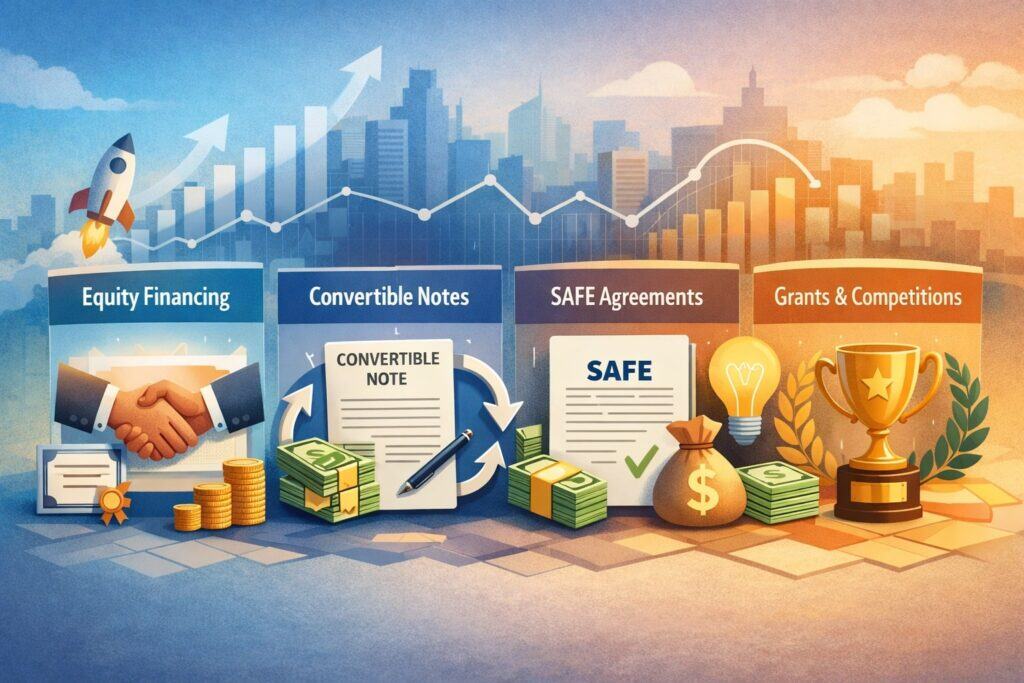
The instrument you choose can significantly affect founder dilution, future fundraising flexibility, and legal cost. For funding without revenue, early-stage rounds often use simpler structures designed for speed and uncertainty.
SAFE Agreements: Fast, Founder-Friendly, and Common in Pre-Seed
A SAFE (Simple Agreement for Future Equity) is widely used for funding without revenue because it’s simple: investors give you capital now, and the SAFE converts into equity later when you raise a priced round (or another conversion event).
Many accelerators and early-stage investors prefer SAFEs because they reduce negotiation friction and legal complexity.
A major signal of standardization is the Y Combinator “standard deal,” which invests $500,000 using SAFE-based components, with equity terms tied to conversion mechanics. YC’s public deal page is useful not because every startup should copy it, but because it shows how institutional early funding often gets structured when revenue hasn’t started yet.
For founders pursuing funding without revenue, SAFEs can be attractive when you want speed, minimal upfront valuation debates, and investor alignment with future milestones.
However, SAFEs still require careful attention to key terms: valuation cap, discount, MFN clauses, pro rata rights, and what triggers conversion. A cap that feels “high” today can still create painful dilution later if you stack multiple SAFEs.
For funding without revenue, it’s common to raise in tranches—just make sure the total stack doesn’t quietly become your most expensive capital.
Convertible Notes: Useful When Investors Want Debt-Like Protections
Convertible notes also enable funding without revenue, but they are debt until they convert. That means maturity dates, interest, and sometimes more investor protections. Notes can be helpful when investors want a clearer repayment fallback or when your round needs familiar debt framing.
Notes can create pressure if you don’t raise a priced round before maturity. For funding without revenue, that pressure may be risky if your product timeline is long or your next round timing is uncertain. If you use notes, negotiate realistic maturity timelines and ensure your milestones can be met without sprinting into bad terms.
Priced Equity Rounds: Sometimes Best When Your Story Is Strong Enough
A priced round sets your valuation now. For funding without revenue, it can work when you have unusually strong traction proxies, exceptional team credibility, or a competitive round dynamic.
The benefit is clarity: you know dilution immediately, and you avoid a SAFE stack. The downside is that priced rounds can require more legal work, more negotiation, and higher expectations.
If you’re genuinely ready—clear market pull, strong pipeline, product proof—priced equity can simplify your cap table and signal confidence. But many pre-revenue startups do better with a clean SAFE round, then price later when revenue or repeatable traction is clearer.
Angels and Micro-Funds: The Most Reliable Path to Pre-Revenue Capital

For many founders, the fastest route to funding without revenue is angels and micro-funds. These investors are structurally designed to take earlier risk and back teams before revenue exists. The best angel checks often come from operators who understand your problem space, not just people chasing hype.
To raise effectively from angels, you need three things: a sharp narrative, credible traction proxies, and a trustworthy execution plan. Angels typically decide faster than large funds, but they still need clarity: what problem you solve, who pays, how you’ll reach them, why you’re different, and what milestones the capital buys.
Micro-funds (smaller venture funds) often sit between angels and traditional ventures. They can lead or co-lead pre-seed rounds and bring process and follow-on credibility.
For funding without revenue, micro-funds frequently want evidence of rapid learning: weekly product improvements, increasing engagement in pilots, and expanding high-quality conversations with target buyers.
A practical advantage of angels and micro-funds is flexibility. They may accept smaller rounds, creative terms, or non-traditional traction. Your job is to reduce their perceived risk: show a thoughtful roadmap, highlight what you’ve already de-risked, and be honest about what’s still unknown.
Also, make your round easy to join. Many pre-revenue rounds are syndicated: one or two lead investors plus a group of smaller checks. If you make it simple—clear terms, clear materials, clean data room—you increase the odds of closing funding without revenue without months of delay.
Accelerators and Venture Programs That Fund Startups Before Revenue
Accelerators can be a strong route to funding without revenue, especially if you want structured mentorship, investor access, and a credible signal for your next round. The biggest accelerators tend to have standardized terms and predictable timelines, which helps founders plan.
Y Combinator is one of the most referenced examples because it publicly documents its standard deal and invests early, before many companies have meaningful revenue. YC’s standard deal invests $500,000 with an equity component and additional SAFE-based investment structure.
Whether or not you apply to YC, the takeaway is important: institutional programs still invest heavily in funding without revenue when the team and trajectory look strong.
Accelerators also create a forcing function. You learn to articulate your story, define milestones, and compress your build-measure-learn cycles. In the current market, that speed matters.
Many investors increasingly reward founders who can operate lean, ship quickly, and demonstrate measurable progress with limited headcount—especially as tooling improves productivity.
The trade-off is that accelerators take equity (directly or through conversion mechanisms) and time. They’re worth it when the network and credibility meaningfully increase your probability of raising your next round or landing key partnerships.
If you pursue funding without revenue through accelerators, treat it as a financing strategy, not a prestige chase. Choose programs with a track record in your category, a strong mentor bench, and outcomes that match your stage: introductions, pilots, talent, or follow-on capital.
Government Grants and Non-Dilutive Funding Without Revenue
Non-dilutive capital can be one of the best ways to secure funding without revenue because you avoid giving up ownership early. The most cited pathway for technology and R&D-heavy startups is SBIR/STTR—often described as “America’s Seed Fund” by agencies that run these programs.
SBIR/STTR programs fund research and development in phases, with rules around eligibility, commercialization planning, and reporting. For founders, this matters because grants can fund technical progress that makes future venture rounds easier.
If you’re building deep tech, life sciences, defense-related tech, energy tech, or other R&D-intensive products, SBIR/STTR can directly support the milestones investors want to see before they offer funding without revenue at attractive terms.
It’s also important to watch program timelines and reauthorization context. Agencies and Congress periodically adjust requirements, disclosure expectations, and commercialization emphasis.
Public policy documents and agency pages can provide guidance on current constraints and expectations for awards and follow-on commercialization paths.
The “hidden” skill in grants is matching: aligning your proposal with an agency’s mission and a specific solicitation. The best applications are not generic.
They are laser-focused on the problem statement, the novelty of your approach, feasibility, and a credible commercialization plan. Even if your first submission doesn’t win, the process can sharpen your story for investors and strengthen your case for funding without revenue.
Non-dilutive funding also includes state and local innovation programs, research partnerships, and competitive challenges. The best founders treat grants like a portfolio: pursue a few high-probability opportunities, reuse core technical content, and build a repeatable internal process.
Equity Crowdfunding and Community Capital for Pre-Revenue Startups
Equity crowdfunding can enable funding without revenue by letting you raise from a broad base of supporters—customers, fans, local community members, or mission-aligned backers. In the U.S., Regulation Crowdfunding (Reg CF) creates a structured way for eligible companies to offer and sell securities online through registered intermediaries.
The SEC explains that Regulation Crowdfunding offerings must be conducted through an SEC-registered broker-dealer or funding portal and notes key constraints, including a maximum aggregate raise of $5 million in a 12-month period, plus disclosure requirements and resale limits.
For founders seeking funding without revenue, Reg CF can work well when you have a compelling story, a community that trusts you, and a product that benefits from public momentum.
The strategic advantage is marketing plus capital. A strong campaign can create awareness, build early adopters, and validate demand—even before revenue is meaningful.
But this only works if you treat it like a real fundraising process: clear financials, credible milestones, transparent risk language, and a strong plan for how funds convert into product progress.
The downside is that crowdfunding introduces compliance complexity, ongoing communication expectations, and a larger investor base. You also need to be careful about what you promise. For funding without revenue, your messaging should emphasize milestones and validation rather than pretending revenue is right around the corner.
If you go the crowdfunding route, build momentum before launch: collect emails, segment supporters, and pre-plan content. A slow start is hard to reverse. A strong start can create social proof that also helps with angel or venture funding without revenue afterward.
Strategic Partnerships, Pilots, and Customer-Led Funding Without Revenue
Some of the best funding without revenue doesn’t come from investors at all. It comes from customers and partners who want your product to exist. This category includes paid pilots, joint development agreements, channel partnerships, and occasionally upfront payments that fund product delivery.
The simplest version is a paid pilot: a target customer pays a smaller amount to test the product with defined success criteria. Even if the pilot revenue is not meaningful financially, it is extremely meaningful as proof.
For funding without revenue, a paid pilot acts like a credibility multiplier: it demonstrates a real buyer, confirms willingness to pay, and validates that procurement can happen.
LOIs can also help if they are specific. The best LOIs include scope, timeline, and conditionality (what must be true to convert to a contract). Weak LOIs are vague and non-committal. Strong LOIs, especially from well-known organizations, can materially shift investor perception and unlock funding without revenue on better terms.
Partnerships can also function as distribution proof. If a platform, reseller, or integrator wants to bring you into their ecosystem, that can reduce go-to-market risk.
Investors love reduced risk. When you can show a credible path to customer acquisition through a partner, funding without revenue becomes easier because the investor can imagine scale without massive marketing spend.
The trap is overbuilding “custom” work. Strategic funding should not turn you into a services company unless that’s your plan. The goal is to use pilots and partnerships to prove demand and shape a scalable product, not to become stuck delivering bespoke features forever.
What a High-Converting Pitch Looks Like When You Have No Revenue
A pre-revenue pitch that wins funding without revenue is clear, evidence-based, and milestone-driven. It does not apologize for lacking revenue. Instead, it explains why revenue is not the right metric yet—and exactly what metrics you have that matter more at this stage.
Your pitch should start with a painful problem and a specific buyer. Then define your “why now” and your unique advantage. After that, show traction proxies: user activity, retention, pilot progress, pipeline, partnerships, and product velocity.
For funding without revenue, the middle of your deck should feel like a risk-reduction story: “Here’s what could kill this company, and here’s how we’ve already reduced that risk.”
Then, present a focused go-to-market plan. Investors are skeptical of vague distribution. Explain who your first customers are, how you reach them, and how the economics work. Even without revenue, you can show pricing research, expected contract sizes, sales cycle assumptions, and early pipeline signals.
Finally, present a use-of-funds plan tied to milestones. The most fundable pre-revenue asks are not “We’re raising $1M to grow.” They are “We’re raising $1M to achieve these 3 milestones that unlock repeatable revenue and set up the next round.” This framing makes funding without revenue feel like buying down risk.
One more important modern detail: investors increasingly reward capital efficiency and rapid iteration. Commentary from venture circles heading into 2026 emphasizes efficiency, ROI, and smaller teams producing outsized results—often enabled by modern AI tooling.
So, if you can show high output with limited burn, your funding without a revenue story becomes easier to believe.
Negotiation, Compliance, and Risk Management for Pre-Revenue Funding
Getting funding without revenue is not only about raising—it’s about raising safely. Early mistakes can haunt you for years. This section is where founders often lose value without realizing it.
Start with cap table hygiene. Avoid stacking too many instruments with inconsistent terms. If you use SAFEs, track the total potential dilution under realistic future valuations. Keep your legal documents standardized and clear. Reduce side letters and one-off rights that complicate future rounds.
Next, understand disclosure and compliance in the fundraising path you choose. If you use equity crowdfunding, you must follow the SEC’s rules around portals, disclosures, and offering limits, and you should understand resale restrictions and reporting expectations.
For funding without revenue, compliance mistakes can be existential because you don’t have cash to fight legal battles later.
Then, watch investor rights that can silently reduce founder control: aggressive pro rata demands, veto rights, board control, or unusual liquidation preferences. Many pre-revenue rounds are relatively founder-friendly, but that doesn’t mean you should ignore terms.
Also protect your operational credibility. Most investors do diligence even for funding without revenue: incorporation, IP ownership, assignment agreements, founder vesting, security practices, and basic financial controls. Build a clean data room early. When you’re organized, you close faster and look more investable.
Finally, be careful with forward-looking claims. It’s fine to project, but don’t promise. For funding without revenue, credibility is everything. A founder who is precise about what is known, what is assumed, and what will be tested earns trust—and trust often closes rounds.
Future Predictions: Where Funding Without Revenue Is Headed Next
The next phase of funding without revenue will likely reward founders who combine speed with proof. Several trends are shaping the environment.
First, capital concentration and selectivity are likely to remain. Even when early-stage investing stays active, investors often cluster around teams and categories they believe can scale efficiently.
News coverage and investor commentary going into 2026 highlights a shift toward measurable payback, efficiency, and teams that can do more with less. Practically, this means founders will need sharper milestones, clearer go-to-market plans, and better traction proxies to win funding without revenue.
Second, AI-enabled productivity is changing expectations. If small teams can ship faster, investors may expect faster iteration cycles and quicker validation, even before revenue. That doesn’t mean every startup must be an AI startup.
It means execution pace will be compared against a faster baseline, which changes how funding without revenue is evaluated.
Third, alternative early-stage platforms and funds are expanding. Some early-stage firms are increasing activity and deploying capital in higher-volume strategies—often tied to specific thematic focus areas. This may create more entry points for founders who weren’t a fit for traditional venture patterns.
Fourth, regulated fundraising pathways like Reg CF will likely remain relevant for community-driven brands and products, especially when founders can convert attention into a credible campaign under SEC rules.
The overall prediction: funding without revenue will continue, but it will be more “proof-driven” than “story-driven.” Founders who treat pre-revenue stages as a deliberate proof-building process—rather than a waiting room—will have the advantage.
FAQs
Q1) Is it realistic to get funding without revenue in 2026?
Answer: Yes, funding without revenue is still realistic in 2026, but you must show substitute proof: credible traction proxies, rapid execution, and a believable plan to reach revenue.
Current investor narratives emphasize efficiency and ROI, meaning founders often need stronger evidence than in more speculative cycles. The good news is that early-stage ecosystems still deploy capital, and standardized early structures and programs remain active.
Q2) What do investors want to see if I have no sales?
Answer: For funding without revenue, investors usually want evidence of demand and execution: LOIs, pilots, waitlist conversion, retention, partnerships, product velocity, and proof that the team can deliver.
They also want a clear buyer, clear pricing logic, and a sensible path to distribution. If you can show that customer acquisition is feasible and the product solves a painful problem, you can often raise even before revenue.
Q3) What’s the best funding option for a truly pre-launch startup?
Answer: The “best” option depends on your category, but the most common routes to funding without revenue are angels, micro-funds, and accelerators.
Accelerators can be especially useful when you want a structured environment and standardized early funding, as shown by public accelerator deal terms. If you’re R&D-heavy, non-dilutive grants (like SBIR/STTR programs) can be powerful because they fund progress without giving up equity.
Q4) Can I raise through equity crowdfunding without revenue?
Answer: Yes, funding without revenue via equity crowdfunding is possible, but you must meet regulatory requirements and be ready for public-facing disclosure.
The SEC outlines key rules, including using an SEC-registered online intermediary and observing offering limits and disclosure obligations. Crowdfunding works best when you have a strong community and a product story that inspires participation.
Q5) How much should I raise when I have no revenue?
Answer: For funding without revenue, raise enough to hit the milestones that unlock revenue—or unlock the next round—without overcapitalizing.
Many strong pre-revenue rounds are milestone-based: build MVP, prove retention, land pilots, finalize partnerships, or clear regulatory steps. A clean “use of funds” plan tied to these milestones often raises faster than a vague “growth” raise.
Q6) What are common mistakes founders make when raising without revenue?
Answer: Common mistakes include relying on weak traction signals, stacking too many SAFEs or notes without modeling dilution, pursuing the wrong investors, overbuilding custom pilot work, and missing compliance steps (especially with crowdfunding).
For funding without revenue, credibility is fragile—overpromising, inconsistent metrics, and messy documentation can quickly kill a round.
Conclusion
The most consistent way to secure funding without revenue is to treat fundraising like a proof-building project. Revenue isn’t the only proof—especially early—but you must replace it with believable signals: strong customer discovery, validated pain, real pilots or LOIs, measurable product engagement, and clear distribution logic.
Pair that with a clean story, a milestone-driven use-of-funds plan, and an instrument that matches your stage (often a SAFE, sometimes a note, occasionally priced equity).
If you’re building R&D-intensive technology, non-dilutive programs like SBIR/STTR can fund critical progress and reduce investor risk. If you have a community-driven product, equity crowdfunding under SEC rules can be a viable path—provided you’re ready for disclosure and operational discipline.
Looking ahead, funding without revenue will likely remain available, but it will increasingly reward clarity, speed, and evidence. As investors focus more on efficiency and measurable outcomes, founders who can demonstrate rapid iteration and credible traction proxies will stand out. In other words: you don’t need revenue to raise—but you do need proof.