
How to Create a Funding Ready Business Financial Plan
A funding ready business financial plan is more than a spreadsheet and a pitch narrative. It’s a decision system that shows how your business makes money, how it protects cash, how it scales, and how investors or lenders get repaid.
A truly funding ready business financial plan answers questions before they’re asked: What drives revenue? What drives costs? When does the company become cash-flow positive? What happens if sales are slower, costs rise, or customer churn increases?
The goal is clarity and credibility. Funding sources—banks, private lenders, angel investors, venture funds, and strategic partners—want a plan that is easy to audit, grounded in realistic assumptions, and aligned with how your business actually operates.
A funding ready business financial plan should connect every number to an operational driver: pipeline, conversion rates, pricing, unit economics, staffing plans, inventory turns, and payment terms. When the narrative and numbers match, confidence rises.
This guide walks you step-by-step through building a funding ready business financial plan that can stand up to diligence, supports negotiations, and helps you run the business better.
You’ll learn what financial statements to include, how to forecast with discipline, which metrics matter most by business model, how to stress test assumptions, and how to present your plan so it gets taken seriously.
What “Funding Ready” Really Means to Investors and Lenders

A funding ready business financial plan is “ready” when a third party can review it, challenge it, and still conclude the plan is coherent, measurable, and financeable. That standard is higher than “looks good.” It means your plan has internal consistency, professional structure, and evidence-based assumptions.
Investors typically evaluate risk and upside. They look for a model that can scale, strong gross margins, repeatable acquisition, and a clear path to a meaningful exit. Lenders care more about downside protection: repayment ability, collateral, predictable cash flows, and covenants.
A funding ready business financial plan anticipates both. It includes scenarios that show what happens when growth is slower, when costs spike, or when receivables take longer to collect.
Funding-ready also means your plan is operationally integrated. Your sales forecast should reflect how many leads you can generate, how many sales reps you have, their ramp time, and realistic conversion rates. Your production forecast should align with capacity, suppliers, and cycle times.
Your cash flow forecast must incorporate payment terms and seasonality. If you claim 200% growth but your hiring plan adds only one salesperson, your funding ready business financial plan will be flagged as unreliable.
Finally, funding-ready means presentation-ready. Numbers are formatted cleanly, assumptions are documented, and your model is built to be audited. Anyone funding a business is buying confidence. Your job is to build that confidence with a funding ready business financial plan that is simple to follow and hard to dismiss.
Define the Funding Objective and Capital Strategy Before You Model Anything
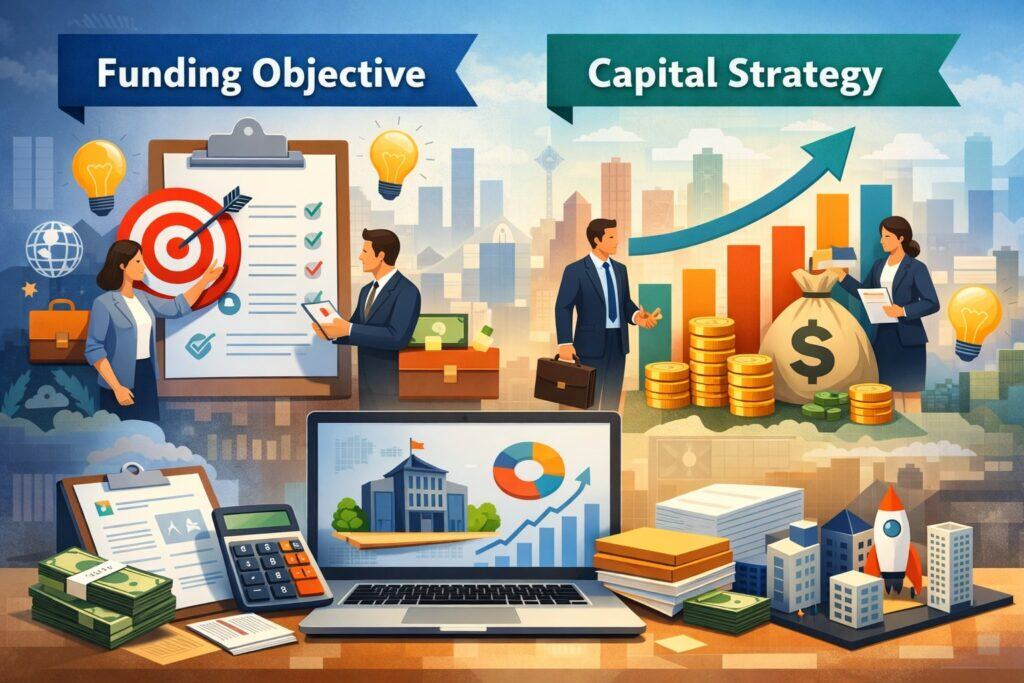
Before you build the statements, define what “funding” means for your specific situation. A funding ready business financial plan changes shape depending on whether you want a working capital line, equipment financing, revenue-based funding, venture investment, or a strategic partnership. Each capital type has a different lens.
Start with a clear funding objective: how much capital you need, when you need it, and what it will be used for. Break the use of funds into categories such as inventory, payroll expansion, product development, marketing, equipment, and contingency reserves.
Then attach measurable outcomes: revenue capacity created, reduced cycle time, improved margins, or faster customer onboarding. A funding ready business financial plan ties capital to milestones.
Next, map your capital strategy. Decide whether you will prioritize non-dilutive capital (like term loans, SBA-style programs, invoice financing, or equipment leases) or equity capital (angels or venture).
Many businesses use a blend: short-term debt for working capital, plus equity for product and growth. Your plan should show why your chosen mix reduces risk and increases return.
Also define your timeline. Funding processes take time, and delays can create cash crunches. A funding ready business financial plan includes a runway buffer and a “minimum viable raise” amount—what you must secure to avoid compromising operations.
When you can communicate a disciplined capital strategy, funders see a management team that understands finance, not just vision.
Build a Credible Assumptions Framework (The Engine of a Funding-Ready Plan)

Assumptions are the foundation of a funding ready business financial plan. If assumptions are vague, the plan becomes guesswork. If assumptions are clear, funders can validate them, debate them, and still trust your process. Your best move is to treat assumptions like product requirements: specific, testable, and connected to evidence.
Start by identifying “value drivers.” For most businesses these include pricing, conversion rates, churn or repeat purchase rate, average order value, sales cycle length, labor efficiency, and cost of goods sold.
Then define each driver with an owner and a data source. Your data source might be historical results, CRM pipeline metrics, industry benchmarks, signed contracts, supplier quotes, or pilot program outcomes.
A funding-ready assumption is not “we will grow fast.” It is “we will generate 1,200 inbound leads per month by month six based on marketing spend, conversion rates from the last three campaigns, and SEO ranking targets; we will convert 4% to trials and 30% of trials to paid.”
That level of precision turns your funding ready business financial plan into something a lender or investor can underwrite.
Document assumptions in plain language. Include rationale and sensitivity ranges (best case, base case, downside). Also note which assumptions are controllable (pricing, staffing) and which are external (interest rates, commodity costs). This discipline improves your forecast and your credibility.
Validate Your Market Opportunity with Financial-Relevant Research

Funders don’t just want a big market. They want a market that can support your model. A funding ready business financial plan uses market research to support pricing, demand, customer acquisition, and retention assumptions—not just to sound impressive.
Translate market research into financial terms. If you’re building a subscription product, show how many target accounts exist in your reachable geography, what percentage fit your ideal customer profile, and what adoption rates are plausible within your sales capacity.
If you’re a local service business, estimate your serviceable radius, job frequency, and seasonal demand patterns. The plan becomes funding-ready when the market story supports the revenue model.
Include competitor pricing and positioning in a practical way. Don’t just list competitors; show how your pricing compares and how you justify margins.
If competitors offer lower pricing, your plan should explain why customers still choose you—faster delivery, better outcomes, compliance, or integrated support. A funding ready business financial plan makes differentiation measurable.
Finally, address market risk. Are customers shifting purchasing behavior? Are there new platforms, regulations, or payment methods changing economics?
Build a forecast that reflects reality: slower initial adoption is normal, and customer acquisition costs often rise before they fall. A plan that admits friction can be more fundable than one that promises perfection.
Create Revenue Forecasts That Match How Sales Actually Happen
Revenue is where most plans fail. A funding ready business financial plan doesn’t “assume” revenue—it builds revenue from activity. Your forecast should be driver-based: units sold, customers acquired, contracts signed, or billable hours delivered.
For product sales, forecast units by channel (online, wholesale, partnerships, direct sales) and connect each channel to conversion rates and marketing activity. For services, forecast billable hours, utilization rate, average project size, and delivery capacity.
For subscription models, forecast new subscribers, churn, expansion revenue, and renewals. Your funding ready business financial plan should show how each of these components grows over time.
Be realistic about sales cycles and ramp time. New sales reps rarely hit full productivity immediately. Marketing spend rarely produces predictable demand in the first month.
Build ramp curves, and show a pipeline-to-revenue bridge: leads → qualified leads → proposals → closed deals → collected cash. This also helps you reconcile revenue forecasts with cash flow forecasts.
Include pricing strategy and discount policy. Funders want to know if revenue is coming from strong pricing power or heavy discounting. If you plan to discount early, show how pricing improves later and why.
A funding-ready plan also accounts for refunds, chargebacks (where relevant), and bad debt. Those are real-world revenue reducers that lenders and investors expect you to model.
Plan Cost of Goods Sold and Gross Margin with Proof, Not Hope
Gross margin is a core indicator of financial health. A funding ready business financial plan shows how gross margin is calculated, what drives it, and how it improves with scale. If gross margin is unclear, funders may assume your business can’t generate sustainable profits.
For product businesses, cost of goods sold includes materials, manufacturing, packaging, freight-in, and sometimes direct labor. Use supplier quotes, bills of materials, and shipping rates to build a per-unit cost model.
For services, include direct labor, contractor costs, project tools, and delivery-related travel. For software, include hosting costs, support, onboarding labor, and third-party integrations. Your plan should make gross margin traceable.
Show what changes gross margin over time. Are you negotiating better supplier terms? Reducing scrap? Increasing automation? Improving utilization? A funding ready business financial plan doesn’t just state margin improvement—it explains the operational initiatives that produce it.
Also account for payment terms. If you must pay suppliers in 15 days but customers pay in 45 days, you may be profitable yet cash-poor. Funders care about that. Your gross margin model should connect to working capital needs and inventory strategy.
A plan that shows margin strength plus disciplined working capital management signals maturity and reduces perceived risk.
Build an Operating Expense Plan That Aligns with Your Growth Strategy
Operating expenses (OpEx) tell funders how you think about scaling. A funding ready business financial plan does not treat OpEx as a simple percentage of revenue. Instead, it forecasts expenses based on headcount plans, tool stacks, facilities, and customer growth.
Start with a headcount plan by department: sales, marketing, operations, product, support, admin. Include role titles, start dates, fully loaded costs (salary plus payroll taxes, benefits, and employer costs), and ramp time.
For sales, include commissions and bonuses tied to revenue. For marketing, include spend by channel and expected performance ranges. For operations, include fulfillment labor, quality control, and logistics management.
A funding-ready plan also distinguishes fixed costs from variable costs. Fixed costs (rent, core software, insurance) are harder to cut quickly; variable costs (ads, contractor hours) can be adjusted.
Funders often stress test your downside case by asking what you can reduce. If your funding ready business financial plan shows clear flexibility levers, you’ll appear more resilient.
Don’t forget “hidden” OpEx: legal, accounting, compliance, customer success tooling, cybersecurity basics, and ongoing training. These are common underestimates. When you model them explicitly, your plan becomes more credible and less likely to break during diligence.
Produce the Three Core Financial Statements Funders Expect
A funding ready business financial plan includes three statements: Profit & Loss (income statement), Balance Sheet, and Cash Flow Statement. Many founders submit only a P&L forecast. That’s not enough. Funders want the full picture: profitability, financial position, and cash movement.
Your P&L shows revenue, COGS, gross margin, operating expenses, and net income. Build it monthly for at least 24 months (often 36 months for growth funding). Monthly granularity helps demonstrate seasonality, hiring ramps, and marketing performance changes.
Your balance sheet shows assets (cash, receivables, inventory, equipment), liabilities (payables, debt), and equity. It’s where working capital lives. A plan can show strong profits but still fail if receivables balloon or inventory piles up.
A funding ready business financial plan includes a balance sheet forecast so lenders can underwrite liquidity and leverage.
Your cash flow statement is where decisions become real. It reconciles net income to actual cash by adjusting for non-cash items and changes in working capital. It also includes investing and financing cash flows.
Funders care about cash because cash is survival. If your model shows cash dips below zero, your plan must show how you avoid that through funding timing, expense pacing, or working capital improvements.
Design a Cash Flow and Runway Model That Survives Real Life
Cash flow is the most important section of a funding ready business financial plan. It shows whether your business can operate without constant emergency fundraising. Even profitable businesses can fail from cash shortages, especially when growth increases inventory, receivables, or hiring costs.
Start by modeling collections. If you invoice customers, forecast Days Sales Outstanding (DSO) and build a receipts schedule. If you sell online, account for payment processor settlement timing and refund rates. If you have subscriptions, model monthly billing cycles and churn. A funding-ready plan includes realistic cash timing, not just revenue timing.
Then model disbursements: payroll dates, rent, vendor payments, inventory purchases, software subscriptions, loan payments, taxes, and planned capital expenditures. Add a minimum cash reserve policy. Many funders like to see at least two to three months of fixed expenses as a buffer, depending on the business.
Include runway metrics. Runway is how long cash lasts at current burn. Burn rate is net cash outflow per month. A funding ready business financial plan tracks runway under multiple scenarios and shows triggers for action—such as “if runway falls below four months, freeze hiring and reduce marketing spend by 20%.”
This approach signals financial discipline. It also helps you negotiate better funding because you are not raising under pressure. A cash-strong plan is often the difference between accepting unfavorable terms and securing capital on your timeline.
Model Working Capital, Inventory, and Payment Terms Like a Pro
Working capital is where funding decisions get made, especially for lenders. A funding ready business financial plan explains how cash is tied up in receivables and inventory, and how quickly that cash returns. Even small improvements in working capital can reduce funding needs dramatically.
If you carry inventory, forecast inventory purchases based on sales, lead times, and safety stock. Include inventory turns and shrinkage assumptions. Show how you prevent overstock and stockouts. Funders want to see that inventory is managed intentionally, not emotionally.
For receivables, include payment terms (net 15, net 30, net 60) and realistic collection behavior. Some customers pay late. Your plan should include a percentage of invoices that pay beyond terms, plus a bad debt reserve if applicable. For payables, include supplier payment terms and whether you can negotiate better terms as volume grows.
A funding-ready plan also highlights cash conversion cycle: days inventory outstanding + DSO − days payable outstanding. Shortening this cycle improves cash flow and reduces reliance on debt. Show working capital initiatives such as early-pay discounts, automated invoicing, tighter credit policies, or vendor term renegotiations.
This section is a credibility marker. Many businesses underestimate working capital, then scramble for emergency financing. A funding ready business financial plan treats working capital as a core operating system, not an afterthought.
Include Unit Economics and Key Metrics That Prove Sustainability
Unit economics show whether growth creates value or destroys it. A funding ready business financial plan includes unit economics appropriate to your model and tracks them over time.
For customer acquisition businesses, focus on CAC (Customer Acquisition Cost), LTV (Lifetime Value), payback period, retention/churn, and contribution margin.
Show how CAC changes with scale, and whether growth depends on paid channels or durable channels like referrals, partnerships, or organic search. Funders often want to see LTV comfortably exceed CAC and a payback period that fits your cash profile.
For transaction-based models, include take rate, gross margin per transaction, frequency, and cohort retention. For services, include utilization, effective hourly rate, gross margin per project, and rework rate.
For product businesses, include gross margin per unit, return rates, warranty costs, and customer repeat rate. Your funding ready business financial plan should highlight the few metrics that truly control performance.
Also include operational KPIs that connect to the financials: sales pipeline coverage, conversion rates, on-time delivery, production yield, support ticket resolution time, and renewal rates. When funders see a plan that links metrics to money, they trust that you can manage the business.
Add Scenario Planning, Sensitivity Analysis, and Stress Tests
Scenario planning is what separates a normal plan from a funding ready business financial plan. Funders assume your base case will be wrong. What matters is whether you understand what could go wrong and what you’ll do about it.
Build three scenarios: base case, upside case, and downside case. The downside case should be plausible, not catastrophic. Common downside adjustments include slower sales growth, higher CAC, delayed hiring productivity, rising input costs, or lower retention. For each scenario, show how profitability, cash flow, and runway change.
Then run sensitivity tests on key drivers. For example: What happens if pricing is 10% lower? If churn rises by 2 points? If supplier costs increase 8%? The point is not to create fear. The point is to demonstrate control.
A funding-ready plan includes “management actions” that respond to triggers: reduce discretionary spend, adjust pricing, slow hiring, tighten credit terms, renegotiate vendor contracts, or prioritize higher-margin segments.
Stress tests are especially important for debt funding. Lenders want to see debt service coverage under lower revenue or higher expenses.
Investors want to see whether you can preserve the runway long enough to reach the next milestone. A funding-ready business financial plan shows that you can steer the business, not just hope for the best.
Prepare Funding-Specific Sections: Use of Funds, Milestones, and Returns
Funders want to know what their money does. A funding ready business financial plan includes a clear “use of funds” narrative tied to milestones and measurable outcomes.
Break the funding into buckets and show timing. For example: 40% for product development over 12 months, 30% for sales hiring starting in quarter two, 20% for marketing spend across three channels, 10% for reserves.
Then map each bucket to milestones: product launch date, target monthly recurring revenue, number of customers, gross margin improvements, new market entry, or operational capacity increases.
If you are raising equity, include a thoughtful view of returns. You don’t need to promise unrealistic outcomes. But you should show how scale creates enterprise value: revenue growth, margin expansion, and market positioning. If you are pursuing debt, show repayment plan, collateral (if any), and how cash flows cover debt service.
Also prepare for diligence questions. A funding-ready plan includes evidence attachments: signed letters of intent, pilot results, pipeline reports, supplier quotes, customer testimonials, or historical financials. The plan becomes easier to fund when it is supported by real-world artifacts.
Incorporate Legal, Tax, and Reporting Standards Where Required
A funding ready business financial plan must respect local and federal realities: taxes, payroll compliance, sales tax or related obligations, financial reporting rules, and any licensing required for your industry. Funders often look for “compliance maturity” because compliance failures can become expensive surprises.
When you reach the point where country-specific clarity is necessary, reference the United States context explicitly: federal tax obligations, state tax differences, payroll withholding, and financial reporting practices commonly expected by lenders and institutional investors.
Many funders will expect clean bookkeeping using accrual accounting, with statements that can be reviewed under widely accepted accounting practices.
If you plan to raise from sophisticated investors or lenders, your funding ready business financial plan should state how you will produce reliable reporting: monthly closes, KPI dashboards, bank reconciliations, and a clear chart of accounts.
If you handle sensitive customer data or payments, funders may also ask about cybersecurity and internal controls. You don’t need to overbuild early, but you should show a credible path to stronger controls as you scale.
This section is not about overwhelming detail. It’s about showing you understand the rules of the game and have a plan to stay audit-ready as funding increases.
Present Your Plan Like a Fundable Package (Model + Narrative + Proof)
Even a great model can be rejected if the package is hard to review. A funding ready business financial plan is delivered as a clean, well-structured set of materials: a financial model, an assumptions summary, and a narrative that explains what matters.
Make the model easy to audit. Use consistent formatting, label inputs clearly, separate assumptions from calculations, and avoid hardcoding numbers deep inside formulas.
Include a summary dashboard: revenue, gross margin, operating expenses, EBITDA (if relevant), cash balance, runway, and key unit economics. Funders should understand your plan in five minutes, then dive deeper.
Your narrative should explain the business model, the market, the go-to-market strategy, and the operating plan. It should also explain the logic of the forecast. Avoid hype. Use clear language. A funding-ready plan reads like a professional investment memo: direct, specific, and grounded.
Finally, include proof. Attach or reference supporting data: historical results, pipeline, customer interviews, signed agreements, and supplier quotes. Your funding ready business financial plan becomes dramatically stronger when it is evidence-backed. Funders don’t expect certainty. They expect rigor.
Common Mistakes That Kill Funding (And How to Avoid Them)
Many plans fail for the same reasons. The first is unrealistic growth without operational support. If your funding ready business financial plan projects rapid growth but your staffing, marketing, or capacity plans don’t match, funders assume the model is fantasy.
The second is confusing revenue with cash. Revenue can look impressive while cash collapses due to receivables, inventory, or large upfront costs. A funding-ready plan includes cash timing and working capital mechanics, not just profit projections.
The third is weak assumptions. If assumptions are not documented, funders cannot validate them. They will either reject the plan or heavily discount it. Another common mistake is ignoring downside risk. A plan without scenarios signals inexperience. A funding ready business financial plan shows both ambition and risk management.
Finally, many businesses present messy materials: inconsistent numbers across documents, unclear categories, and unexplained jumps in expenses. Clean presentation is not cosmetic—it is a trust signal. Funders interpret sloppy financials as sloppy execution. The safest path is building a plan that is simple, consistent, and defensible.
Future Predictions: How Funding Expectations and Planning Standards Are Evolving
Financial planning expectations are rising. A funding ready business financial plan increasingly needs more frequent updates, clearer KPI tracking, and better scenario controls. Funders are shifting toward ongoing visibility, not annual planning. Monthly reforecasting and rolling 12-month cash planning are becoming standard for serious businesses.
Data-driven forecasting will matter more. Businesses that connect CRM, billing, and accounting systems can produce faster, more reliable forecasts. As automation improves, funders may expect cleaner reporting earlier in the business lifecycle. That doesn’t mean you need enterprise systems on day one, but your plan should show a credible path to mature reporting.
Risk management is also becoming a bigger theme. Supply chain volatility, customer concentration, and interest rate swings can change outcomes quickly. A funding-ready plan that includes early warning indicators and contingency actions will stand out.
Additionally, alternative funding options—revenue-based financing, venture debt, and hybrid structures—are becoming more common, and that increases the need for sophisticated cash flow planning.
The bottom line: the future favors operators who treat a funding ready business financial plan as a living management system, not a one-time fundraising document.
FAQs
Q.1: What is the difference between a normal plan and a funding-ready business financial plan?
Answer: A normal plan often describes goals and general projections. A funding-ready business financial plan is built for underwriting and diligence. It includes driver-based assumptions, complete financial statements (P&L, balance sheet, cash flow), working capital modeling, scenarios, and evidence.
It is structured so a lender or investor can test the logic, validate inputs, and see how capital changes outcomes. Funding-ready also means presentation-ready: consistent formatting, clear categories, and a narrative that matches the numbers.
Q.2: How long should a funding-ready business financial plan cover?
Answer: Most funders want monthly forecasts for at least 24 months. Many growth-focused investors prefer 36 months because it shows scaling dynamics and the likely timing of the next raise.
A funding-ready business financial plan also benefits from a longer high-level view (for example, years four and five annually) if it supports an expansion story. But detail matters most in the near-term: hiring, cash needs, and milestone timing.
Q.3: What are the most important metrics to include?
Answer: It depends on the model. A funding-ready business financial plan usually includes revenue growth, gross margin, operating margin, cash balance, burn rate, runway, and working capital metrics like DSO and inventory turns.
For customer acquisition models, CAC, LTV, churn, and payback period are critical. For services, utilization and gross margin per project matter. Funders want metrics that explain performance, not vanity metrics that only sound impressive.
Q.4: How do I prove my assumptions are credible?
Answer: Use evidence: historical financials, CRM pipeline data, conversion rates, signed agreements, supplier quotes, pilot results, and customer feedback. A funding-ready business financial plan documents the source of each key assumption and includes ranges.
You don’t need perfect certainty, but you do need a rational basis. If you’re early-stage, even small datasets—like a few months of results—can be used to build a conservative base case.
Q.5: Should I use accrual or cash accounting in my forecast?
Answer: Funders often prefer accrual-based statements for the P&L and balance sheet because they reflect business performance more accurately, especially with receivables, payables, and deferred revenue. But your funding-ready business financial plan must still include a true cash flow forecast.
Cash is what determines survival. If you’re small and operate mostly on immediate payment, cash accounting may be simpler, but you should be prepared to translate results into funder-friendly reporting as you grow.
Q.6: How detailed should the model be?
Answer: Detailed enough to be auditable, not so complex that it becomes fragile. A funding-ready business financial plan prioritizes clear inputs, logical calculations, and traceable outputs.
Driver-based forecasting is usually better than overly granular line items. Funders should be able to identify key levers quickly: pricing, volume, staffing, marketing efficiency, and payment terms. Complexity should serve clarity, not hide uncertainty.
Q.7: What is the biggest reason funders reject financial plans?
Answer: The biggest reason is credibility. If your funding-ready business financial plan shows unrealistic growth, ignores cash flow, lacks scenarios, or has inconsistent numbers, funders assume execution risk is too high. Another major reason is misalignment between funding type and plan structure.
For example, a lender-focused plan must show debt service coverage and collateral logic, while an equity-focused plan must show scalable economics and value creation.
Conclusion
Creating a funding-ready business financial plan is not about predicting the future perfectly. It’s about building a disciplined financial story that connects your strategy to measurable outcomes and proves you can manage cash, risk, and growth.
When your assumptions are evidence-based, your forecasts are driver-driven, and your statements are complete, funders can underwrite your business with confidence.
A strong funding-ready business financial plan includes clear funding objectives, a structured assumptions framework, credible revenue and cost models, and detailed cash flow planning that accounts for working capital realities.
It also includes scenario planning and stress tests, because funders assume conditions will change. The most fundable plans are both ambitious and controllable.
Treat your funding-ready business financial plan as a living management tool. Update it monthly, track KPIs that drive the numbers, and use it to guide hiring, pricing, and spending decisions.
The businesses that win funding—and keep it—are the ones that can explain their numbers, defend their assumptions, and adapt quickly when reality shifts. That is what “funding-ready” truly looks like.