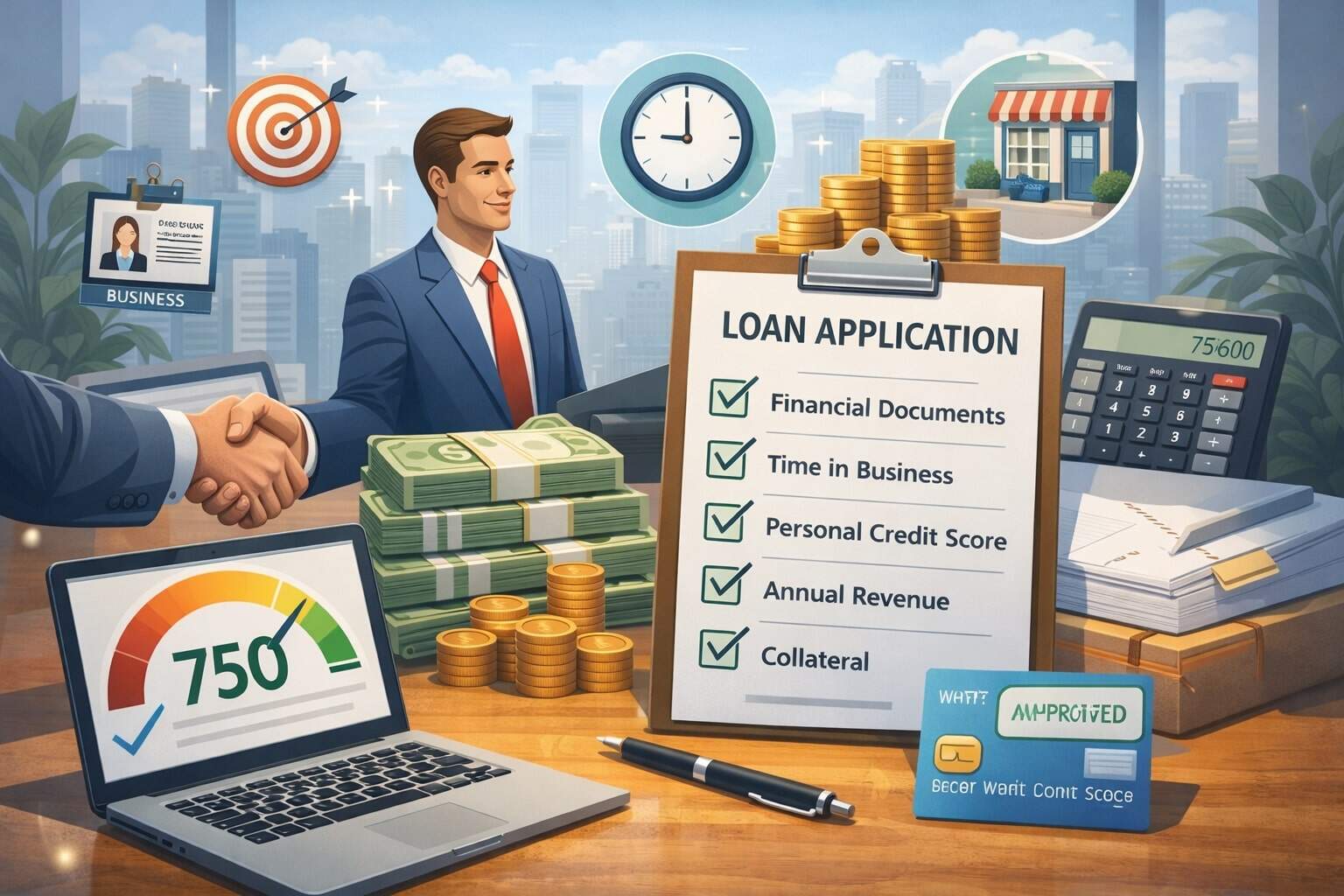
How to Qualify for a Small Business Loan
Qualifying for a small business loan is rarely about a single “magic” number. Lenders approve a small business loan when your application tells a consistent story: the business earns enough, manages cash well, and can repay on time—even if sales dip for a few months.
That story is built from your credit profile, your financial statements, your time in business, your industry risk, and how you plan to use the funds.
In today’s lending market, many banks have been cautious and have tightened standards at different points, especially when economic outlooks look uncertain.
Federal Reserve bank surveys have shown periods where lenders reported tightening standards for business loans and softer demand dynamics. This doesn’t mean you can’t qualify for a small business loan—it means the application needs to be cleaner, better documented, and more lender-friendly than ever.
This guide walks you through what lenders look for, how to prepare your numbers and documents, and how to position your small business loan request so it’s easy to approve.
You’ll also see forward-looking trends (like data-driven underwriting and new compliance requirements) that can influence how you qualify for a small business loan over the next few years.
Understand what lenders really evaluate for a small business loan

A lender doesn’t approve a small business loan because you “need money.” They approve a small business loan because the risk is acceptable and repayment looks dependable. That evaluation usually falls into a few buckets: ability to repay, willingness to repay, and the lender’s ability to recover if something goes wrong.
Ability to repay is mostly cash flow. Lenders want proof that your business generates stable operating cash flow and that your new monthly payment fits comfortably. This is where ratios like Debt Service Coverage Ratio (DSCR) show up. Many lenders prefer a cushion, not a tight squeeze.
Willingness to repay often shows up in your credit history and banking behavior. If your personal or business credit shows consistent on-time payments and responsible borrowing, lenders feel better funding a small business loan.
Finally, lenders care about “secondary sources of repayment.” That includes collateral, down payment, and personal guarantee strength. Even if cash flow is the main path to repayment, a lender often wants a backup plan.
If your application doesn’t address these categories clearly, your small business loan request can be slowed down or declined even when the business is healthy.
The “5 Cs” framework (and how it impacts a small business loan)
Many lenders still think in terms of the classic 5 Cs of credit: Character, Capacity, Capital, Collateral, and Conditions. You don’t need to memorize the phrase, but you do need to build your small business loan file around it.
- Character: Your track record, credit, and honesty in documentation. One inconsistency can hurt more than a slightly lower score.
- Capacity: Your cash flow and DSCR. This is often the biggest yes/no driver for a small business loan.
- Capital: Owner investment and liquidity. Lenders like to see you’ve put real money into the business and maintain cash reserves.
- Collateral: Assets the lender can secure. Not always required for every small business loan, but it strengthens approvals.
- Conditions: Industry risk, local market, interest-rate environment, and the purpose of the loan.
When you prepare for a small business loan, your goal is to reduce “unknowns.” Unknowns force underwriters to assume risk, and assumed risk leads to declines or higher pricing.
Why underwriting has gotten more documentation-heavy
Even when rates change and markets shift, underwriting tends to move toward more documentation when lenders see more risk or when programs tighten rules.
Over the past couple of years, loan programs and lender practices have placed greater emphasis on verifying borrower information and documenting eligibility and ability-to-repay standards.
That doesn’t mean qualifying for a small business loan is impossible—it means you should treat the process like a professional package: organized finances, clean explanations, and a clear repayment plan.
Meet baseline eligibility requirements for a small business loan

Before credit scores or ratios matter, lenders check basic eligibility. A small business loan request can be declined quickly if the business doesn’t meet minimum requirements like time in business, allowable industries, ownership structure, licensing, or acceptable use of funds.
Most lenders prefer at least 12–24 months of operating history for a standard small business loan, though some online lenders and specific programs may consider shorter histories.
If you’re newer, expect the lender to lean more heavily on your personal credit, your experience in the industry, and your cash reserves. For established businesses, the focus shifts toward cash flow trends and debt capacity.
Eligibility also includes “use of proceeds.” If your small business loan is for working capital, inventory, equipment, payroll smoothing, or expansion, that’s typically easier to support than vague purposes like “general needs.” Lenders want a purpose they can underwrite, measure, and link to revenue or efficiency.
Time in business, revenue patterns, and stability
Stability is a major qualifier for a small business loan. Lenders look for predictable revenue, manageable seasonality, and a business model that isn’t constantly changing direction. They’ll compare year-over-year sales, gross margin trends, and month-to-month volatility.
If your sales are seasonal, you can still qualify for a small business loan, but you must explain the pattern and show that busy-season profits cover slow-season obligations. A short written note plus monthly P&L statements can prevent an underwriter from misreading normal seasonality as instability.
Also consider customer concentration. If one client generates a large share of revenue, a lender may treat your small business loan as riskier. To offset that, show signed contracts, long-term purchase orders, or diversification plans.
Legal, licensing, and compliance readiness
For many lenders, a small business loan file must include proof that the business is valid and compliant: formation documents, good standing certificates (when needed), local licensing, and a business bank account that matches the legal entity name.
If the business has unpaid tax obligations, unresolved liens, or licensing gaps, it can derail a small business loan approval. Even when these issues are manageable, lenders often require them to be resolved before funding.
Treat compliance like part of your creditworthiness. A lender isn’t only lending to your revenue—they’re lending to an entity that must be legally able to operate and collect payments.
Build a credit profile that supports a small business loan
Credit is not the only factor in a small business loan, but it often determines how quickly you get approved and what terms you receive. Many lenders evaluate both personal and business credit, especially for closely held businesses.
Personal credit matters because many small business loan structures require a personal guarantee, and lenders want to know how you handle obligations. Business credit matters because it can validate your company’s payment history with vendors, leases, and accounts.
One common misconception is that a single score “qualifies” you for a small business loan. In reality, lenders look at the full report: late payments, utilization, collections, bankruptcies, and the pattern of behavior. One old blemish with a strong recent trend is often less harmful than repeated smaller issues.
Improve personal credit without slowing your funding timeline
If you’re applying for a small business loan soon, focus on improvements that can show results quickly. The most practical steps include:
- Lower credit utilization (especially on revolving lines)
- Fix errors on credit reports
- Avoid new hard inquiries right before applying for a small business loan
- Bring delinquent accounts current and document payment plans
Avoid drastic moves that create more questions than answers, like opening several new accounts. Underwriters prefer stable, predictable credit behavior.
If your credit is weaker, you can still qualify for a small business loan by offsetting risk with higher cash flow, collateral, a larger down payment, or a co-borrower structure (where permitted). The key is to show the lender why repayment will be reliable despite the score.
Establish and strengthen business credit signals
Business credit helps your small business loan application feel more “institutional.” That means:
- Using trade lines (vendors that report payment history)
- Maintaining on-time payments with suppliers
- Keeping consistent business address, phone, and registration data across records
- Using business banking regularly instead of mixing personal and business cash
Even if a lender focuses on cash flow, business credit reduces uncertainty. It also helps when you want to qualify for larger amounts later, because lenders can see the business behaving like a stable borrower.
Prove cash flow and debt capacity for a small business loan
Cash flow is the heart of qualifying for a small business loan. Lenders want to know whether your business produces enough free cash each month to comfortably make the new payment after covering existing obligations.
Expect a lender to review your profit and loss statement, balance sheet, bank statements, and tax returns. They’ll look for consistency across these documents. If your tax returns show one number but your internal P&L shows something very different, your small business loan may stall until you reconcile the gap.
Many lenders also adjust your income for “add-backs” such as depreciation, amortization, certain one-time expenses, or owner compensation structures. But add-backs must be well documented. The more credible and consistent your adjustments, the stronger your small business loan case becomes.
Debt Service Coverage Ratio (DSCR) and how to make it lender-friendly
DSCR generally compares cash flow available for debt payments to the total debt payments due. While the exact calculation varies, the idea is simple: lenders want a cushion.
If your DSCR is tight, you can improve it without “faking numbers” by:
- Requesting a longer term (lower monthly payment)
- Reducing the loan amount to match actual needs
- Paying down high-payment short-term debt before applying for a small business loan
- Increasing documented revenue (through better invoicing and deposits that match your books)
- Cutting recurring expenses and showing the change over several months
A strong DSCR tells a lender your small business loan won’t fail from a minor dip in revenue. That cushion is especially valuable in industries with seasonal swings or variable demand.
Bank statements: the fastest way lenders validate reality
Bank statements are often the quickest “truth test” in a small business loan file. Underwriters examine deposits, average daily balance, overdrafts, negative days, and irregular transfers.
To strengthen your small business loan position:
- Avoid frequent overdrafts (even if you cover them quickly)
- Keep payroll and tax payments predictable
- Reduce unexplained cash withdrawals
- Keep business funds in business accounts rather than moving money constantly
If you do have irregularities (for example, a one-time large withdrawal for equipment), note it proactively. A short explanation can prevent the lender from assuming the worst.
Prepare financial statements and records lenders require for a small business loan
Documentation isn’t busywork—it’s how lenders reduce uncertainty. The difference between a slow, frustrating process and a smooth approval often comes down to how “underwriter-ready” your documents are.
For most small business loan applications, you’ll need a combination of:
- Business and personal tax returns (often 2–3 years)
- Year-to-date P&L and balance sheet
- 6–12 months of business bank statements
- Accounts receivable/payable aging reports (when relevant)
- Current debt schedule (loans, leases, credit lines with payments and balances)
- Legal documents (formation, ownership, licenses)
When these records match and are easy to follow, the lender can approve the small business loan faster and with fewer conditions.
Tax returns vs. internal financials: avoid common inconsistencies
A common issue in small business loan underwriting is mismatch between tax returns and internal financial statements. Sometimes it’s legitimate (for example, accounting method differences), but lenders still need clarity.
If you use deductions aggressively, taxable income may look low even when cash flow is fine. That can reduce how much small business loan you qualify for. The solution is not to “hide” deductions—it’s to present a clear reconciliation showing cash flow, owner distributions, and add-backs with documentation.
If your bookkeeping is behind, fix it before you apply. Updated books can directly increase your approval odds and prevent delays.
A clean debt schedule can raise your loan approval ceiling
Underwriters often ask for a debt schedule, listing every obligation: balances, monthly payments, interest rates, and maturity dates. Many borrowers underestimate how much this matters.
A clear debt schedule helps the lender:
- Calculate DSCR accurately
- See if refinancing improves affordability
- Identify short-term high-payment debt that hurts a small business loan decision
If you have multiple short-term obligations, consolidating them into a longer-term small business loan can actually improve your debt capacity. But the underwriting must show that the consolidation meaningfully reduces payment stress.
Strengthen collateral, down payment, and guarantees for a small business loan
Not every small business loan requires collateral, but collateral can strongly improve approval odds and pricing. Lenders want to understand what assets exist, what they’re worth, and whether they’re already pledged elsewhere.
Collateral can include equipment, vehicles titled to the business, inventory (sometimes), accounts receivable (in certain lending structures), or real estate. Even when collateral coverage is partial, it can still reduce risk and make a small business loan easier to approve.
Personal guarantees are also common. They give the lender an added layer of protection and signal borrower commitment. While not all lenders require the same guarantee structure, being prepared for it is part of qualifying for a small business loan.
How to document collateral without slowing the process
Collateral delays often happen because borrowers don’t have basic documentation ready. If you’re using equipment as support for a small business loan, gather:
- Purchase invoices
- Serial numbers
- Current condition notes
- Proof of ownership and lien status
If you’re using real estate, you’ll likely need mortgage statements, insurance proof, and property tax information. Some programs have hazard insurance rules that can apply at lower loan amounts than many borrowers expect.
The key is to treat collateral like part of your package—not an afterthought. When you present it cleanly, the lender can evaluate the small business loan faster and with fewer follow-up requests.
Owner liquidity and reserves: the hidden qualifier
Liquidity matters because it shows your business can survive bumps. Even profitable businesses can fail if they run out of cash during a slow period.
Lenders often like to see:
- Some cash reserves after closing
- Proof you can cover a few months of payments if needed
- Reasonable working capital relative to payroll and expenses
If you’re using most of your cash as a down payment for a small business loan, the lender may worry you’ll be too thin. A smarter structure can be to keep reserves while still meeting down payment requirements through a mix of cash, seller contributions (where allowed), or financing structures.
Write a lender-ready business plan narrative for a small business loan
You don’t always need a long business plan to qualify for a small business loan, but you do need a clear narrative. Underwriters and credit committees want to understand what the business does, how it makes money, why the loan is needed, and how repayment will happen.
A strong narrative reduces risk because it makes your numbers understandable. It also prevents underwriters from filling gaps with assumptions.
Your small business loan narrative should include:
- Business overview and ownership structure
- Products/services and customer base
- Revenue drivers (what causes sales to increase)
- Key costs and margin structure
- How the loan funds will be used
- How the use of funds improves cash flow or stability
Explain “why now” and connect it to repayment
Lenders hear “I need a small business loan to grow” all the time. What they want is: why now, and what changes because of this loan?
Examples that underwriters understand:
- “This small business loan funds equipment that increases production capacity by 30%, reducing turnaround time and increasing monthly revenue.”
- “This small business loan refinances short-term debt, lowering monthly payments and raising DSCR.”
- “This small business loan funds inventory ahead of peak season, backed by historical sales data and purchase orders.”
When you connect the loan to measurable outcomes, it becomes easier to approve.
Provide realistic projections (and show assumptions)
Projections can help a small business loan approval, but only if they’re realistic. Underwriters don’t want inflated growth curves. They want conservative assumptions tied to real drivers: historical conversion rates, signed contracts, capacity constraints, or documented demand.
A lender-friendly projection includes:
- Monthly revenue expectations
- Cost assumptions (labor, materials, rent)
- Net operating income trend
- New loan payment included in the model
- A downside scenario (what if revenue is 10–20% lower?)
Showing a downside plan can actually strengthen your small business loan request because it signals you’ve thought like a risk manager.
Choose the right type of small business loan for your situation
Many borrowers get declined for a small business loan not because the business is bad, but because the loan type doesn’t match the use of funds. The “right” loan aligns with the life of the asset and the speed of return.
For example, using a short-term loan to finance a long-term buildout can strain cash flow. Using a long-term small business loan for a short-term inventory cycle might be unnecessary or expensive.
Common categories include:
- Term loan for expansion, consolidation, or major purchases
- Line of credit for working capital swings
- Equipment financing tied to specific assets
- Invoice/receivables financing for B2B cash flow timing
- Program-based guaranteed loans for qualifying uses
When a guaranteed program can improve approval odds
Guaranteed lending programs can help borrowers who have solid businesses but need additional support due to limited collateral or other factors. These programs have specific rules, documentation requirements, and sometimes fee structures that change by fiscal year.
For example, annual fee schedules for a major federal guarantee program’s 7(a) loans are published and updated periodically. And broader policy and procedure updates can adjust eligibility and underwriting standards.
If you’re targeting a guaranteed small business loan, treat the documentation standards as stricter, not looser. The upside is that strong packaging can lead to better approvals and terms when you fit the criteria.
Match the lender to your risk profile and documentation strength
Not all lenders underwrite the same way. A community bank may prefer relationship history and conservative structures. An online lender may move faster but price higher. A specialty lender may understand your industry better.
To qualify for a small business loan efficiently:
- If your financials are pristine and you want the best pricing, banks and credit unions can be strong options.
- If you need speed and can handle higher cost, certain non-bank lenders may work.
- If you have collateral like equipment or receivables, asset-based structures can fit better than a general small business loan.
The best strategy is to choose the lending channel that matches your strengths, not just the lowest advertised rate.
Submit a complete small business loan application package
A complete package isn’t just “having documents.” It’s having the right documents in a clean format, with consistent numbers and clear explanations. Underwriters reward completeness because it reduces time and uncertainty.
A strong small business loan submission typically includes:
- A cover summary (1–2 pages) explaining the request
- Clear use-of-funds breakdown
- Debt schedule
- Financial statements and tax returns that reconcile
- Bank statements showing stable deposits and balances
- Business formation and ownership documents
- Any supporting contracts, invoices, or bids
When you submit a small business loan file like this, you shift the lender from “investigation mode” to “approval mode.”
Avoid the top packaging mistakes that trigger delays
The most common issues that slow a small business loan are fixable:
- Missing pages in bank statements or tax returns
- Unexplained large deposits or transfers
- Financials that don’t match tax filings without explanation
- Vague use of proceeds (“working capital” with no detail)
- No debt schedule, or inaccurate payment numbers
Think of underwriting as a checklist. Every question the lender must ask is a delay. Your job is to answer those questions before they ask.
What to expect during underwriting and verification
Underwriting often includes identity and entity verification, bank account validation, revenue confirmation, and sometimes third-party checks. In some market segments, lenders have increased verification expectations due to risk concerns and program rule tightening.
Expect follow-up questions. The best way to keep your small business loan moving is to respond quickly, provide direct documentation, and avoid contradictory explanations.
Increase your approval odds for a small business loan in 30–90 days
If you’re not ready today, you can often become ready within one to three months. Lenders don’t need perfection—they need evidence of improvement and stability.
To raise small business loan approval odds:
- Clean up bookkeeping and produce accurate monthly financials
- Reduce overdrafts and stabilize cash balances
- Pay down high-utilization revolving debt
- Build reserves and keep them visible in statements
- Create a simple lender narrative and use-of-funds plan
- Resolve tax filings and document payment plans if needed
Small improvements across several areas can create a meaningful underwriting shift.
Use smart debt strategy to improve DSCR and affordability
One of the best ways to qualify for a small business loan is to improve monthly affordability. That might mean paying off a high-payment short-term note or consolidating multiple obligations.
If you have:
- Several merchant or short-term daily/weekly payments
- High credit card minimum payments
- Equipment leases stacking up
…your cash flow may look worse than it truly is. A well-structured small business loan can replace those payments with a single predictable monthly payment, improving your ratios.
Just be careful: lenders will review how the refinance changes risk. Be transparent about what debt will be paid off at closing and provide payoff statements.
Strengthen banking habits that underwriters trust
Underwriters trust patterns more than promises. They want to see:
- Predictable deposits
- Consistent payroll cadence
- Few negative days
- Less cash leakage through unexplained transfers
Even if revenue is strong, messy banking can hurt a small business loan. If you fix banking habits for 60–90 days before applying, your statements can become your strongest evidence.
What to do if you’re denied a small business loan
A denial is not always a “no forever.” It’s often “not under these conditions.” The fastest way forward is to ask for specific reasons and turn them into an action plan.
Common denial reasons for a small business loan:
- Insufficient cash flow or low DSCR
- Too short time in business
- Credit issues (recent delinquencies, high utilization)
- Unverifiable revenue or inconsistent documents
- Industry risk or customer concentration
- Lack of collateral or insufficient reserves
A good lender will tell you what they needed to see. Use that feedback to rebuild your file.
Turn the denial into a lender-ready improvement plan
Create a simple plan with measurable targets:
- “Increase average monthly deposits to X”
- “Reduce credit utilization below Y%”
- “Maintain average daily balance above Z”
- “Produce two consecutive months of clean P&L and balance sheet”
- “Pay off or refinance one high-payment obligation”
Then re-apply for a small business loan when you can prove those changes with statements and reports, not just explanations.
Consider alternatives without harming your next application
Some alternatives can help without damaging future small business loan eligibility:
- Smaller loan amount to prove performance
- Secured loan with specific collateral
- Line of credit sized to actual working capital needs
- Receivables-based financing if you have strong B2B invoices
Be cautious with very expensive short-term products if they’ll strain cash flow and lower your DSCR later. Your goal is to improve your profile, not trap the business in high-cost payments.
Future predictions: how qualifying for a small business loan may change
Small business lending is becoming more data-driven and more regulated in how application information is collected and reported. Expect underwriting to rely more heavily on digital cash flow signals, automated verification, and standardized documentation.
One major trend is increased focus on small business lending data collection and reporting requirements for covered institutions.
The Consumer Financial Protection Bureau’s small business lending rule under Regulation B (often referenced as the Section 1071 rule) has compliance resources and has seen changes to compliance timelines through interim actions.
While these rules primarily affect lenders’ processes, borrowers may feel the impact through more structured applications and additional data fields.
At the same time, guaranteed program rules and procedures can evolve, affecting eligibility, underwriting expectations, and fees. Updates to procedures and fee schedules have been issued for major programs, and borrowers should expect periodic changes going forward.
Expect more cash-flow underwriting and faster verification
In the next few years, more lenders will evaluate a small business loan using transaction-level data: deposits, payroll, subscriptions, chargebacks, and seasonal cash patterns. That can help businesses with thin credit files but strong real revenue.
The flip side is that messy banking and inconsistent deposits could hurt more than before. To prepare, keep clean books, separate business and personal funds, and maintain stable banking patterns.
Expect program and market cycles to affect approval standards
Lending standards tend to shift with economic outlooks. Federal Reserve survey releases have shown that banks can tighten or loosen standards based on perceived risk and demand.
This means qualifying for a small business loan will continue to be partly cyclical. Your best defense is controllable fundamentals: cash flow cushion, strong documentation, and a well-matched loan structure.
FAQs
Q.1: What credit score do I need for a small business loan?
Answer: There isn’t one universal score for a small business loan. Many lenders look at your full credit report and repayment history, not just the score. In general, stronger scores and clean payment histories open more options and better terms.
If your score is lower, you can still qualify for a small business loan by offsetting risk with stronger cash flow, more reserves, collateral, or a smaller loan amount. The most important thing is consistency: fewer recent late payments and reasonable utilization often matter as much as the headline score.
Q.2: How much revenue do I need to qualify for a small business loan?
Answer: Revenue requirements depend on the lender and the loan type. For a small business loan, what matters more than total revenue is whether the business has enough net operating income and cash flow to cover the new payment with a cushion.
A business with moderate revenue but strong margins can qualify more easily than a high-revenue business with thin margins and heavy existing debt. Lenders often validate revenue through bank statements, tax returns, and financial statements, so clean documentation can be as important as the number itself.
Q.3: Can I qualify for a small business loan with less than one year in business?
Answer: It’s harder, but possible in some cases. Many traditional lenders prefer 12–24 months of operating history for a small business loan, but some lenders and certain programs consider newer businesses, especially if the owner has strong industry experience, strong personal credit, and meaningful cash reserves.
If you’re new, expect the lender to request more documentation and to scrutinize your personal financial strength more heavily.
Q.4: Does a small business loan require collateral?
Answer: Not always. Some small business loan options are unsecured, especially at smaller amounts, but collateral can improve approval odds and pricing.
When collateral is required, the lender will want proof of ownership, current value, and lien status. Even when collateral doesn’t fully cover the loan, it can still strengthen the overall risk profile and make the small business loan easier to approve.
Q.5: Why do lenders ask for both tax returns and bank statements?
Answer: Because lenders want consistency. Tax returns show reported income; bank statements show real cash movement.
For a small business loan, underwriting often compares these documents to confirm that revenue is legitimate, stable, and sufficient to repay debt. If numbers differ, you can still qualify, but you’ll need a clear reconciliation and credible documentation (not guesses).
Q.6: How long does it take to get approved for a small business loan?
Answer: Timelines vary widely. A small business loan from a bank can take weeks depending on underwriting depth and document completeness. Some online lenders move faster, especially with cash-flow data access.
The biggest factor you control is how complete your package is. Clean financials, a debt schedule, clear use of funds, and quick responses to questions can dramatically reduce delays.
Conclusion
To qualify for a small business loan, focus on what lenders actually approve: stable cash flow, documented affordability, consistent records, and a clear repayment story. Strong credit helps, but it’s not the only way to win approval.
When your bank statements match your financial statements, when your use of funds is specific, and when your DSCR has breathing room, your small business loan request becomes simpler to underwrite—and simpler to approve.
The best approach is to prepare like an underwriter: reduce unknowns, explain anomalies before they’re questioned, and choose a loan type that matches the purpose.
As lending evolves toward more structured data collection and more cash-flow-based decisioning, clean documentation and stable banking behavior will matter even more.