SBA 7(a) vs SBA 504 Loans: The Complete Guide for Small Business Owners
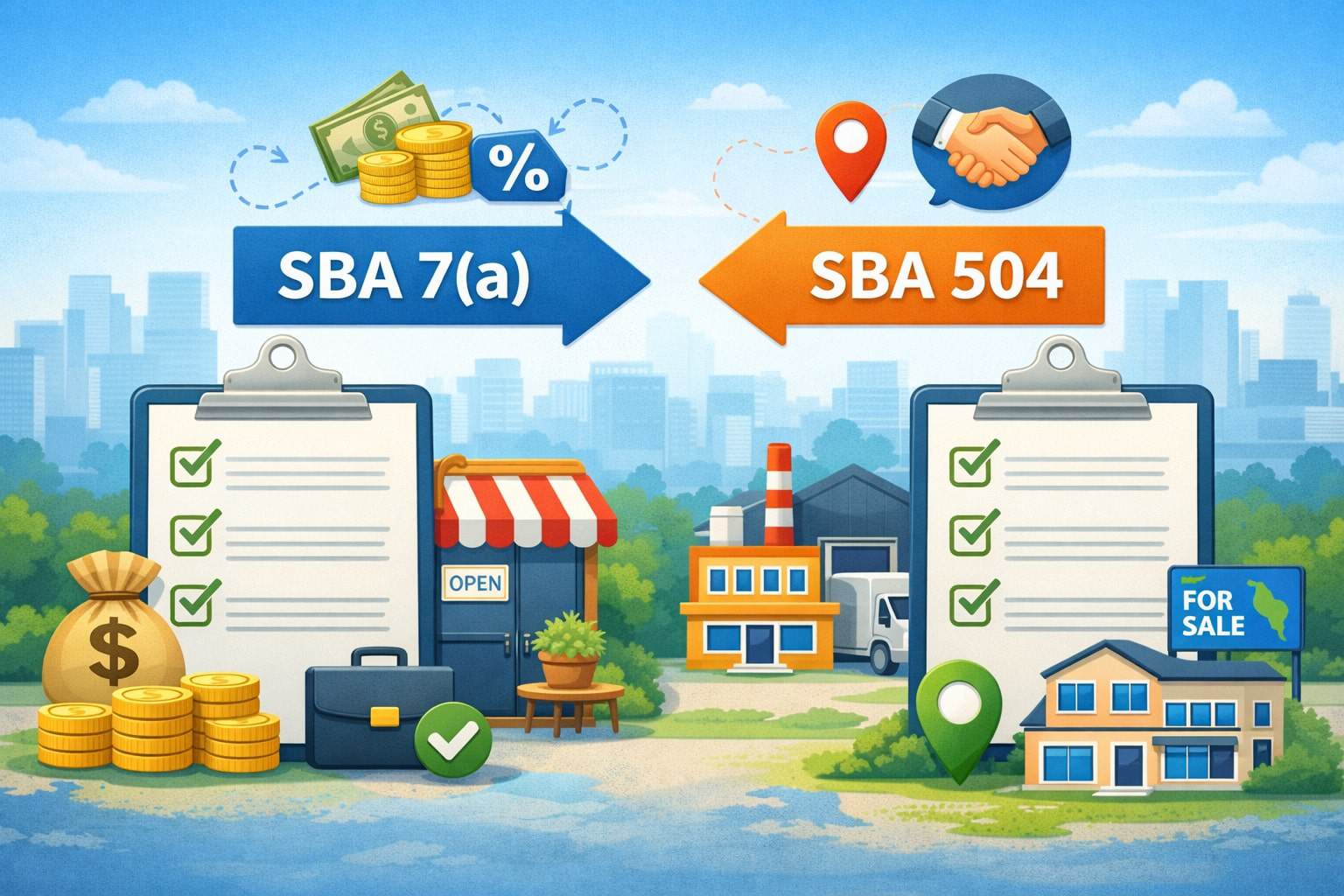
If you’re weighing SBA 7(a) vs SBA 504 loans, you’re already asking the right question: What are you financing, and what do you need the money to do? Both options are SBA-backed financing programs offered through approved lenders, but they solve different problems.
An SBA 7(a) loan is the flexible “Swiss Army knife.” It can fund working capital, inventory, equipment, leasehold improvements, business acquisitions, partner buyouts, and refinance (when eligible).
It usually comes with variable rates (though fixed is sometimes available), and it’s designed to support a wide range of business goals. The SBA sets rules for loan size, guarantees, fees, and lender procedures, but the lender still underwrites and services the loan.
An SBA 504 loan is the purpose-built “fixed-asset specialist.” It’s primarily meant for owner-occupied commercial real estate and long-life equipment that helps you expand capacity and create jobs.
The big advantage is long-term, fixed-rate financing on the SBA-backed debenture portion, often with lower down payments than conventional commercial loans. The structure is different too: it typically involves a bank + a Certified Development Company (CDC) + you as the borrower.
This guide breaks down SBA 7(a) vs SBA 504 loans in plain language—how they work, costs, eligibility, timelines, and how to pick the best fit for your goals in 2026 and beyond.
Understanding SBA-backed lending and why the comparison matters
The SBA doesn’t usually hand money directly to your business. Instead, it guarantees a portion of the loan made by a lender (and in the 504 program, supports a debenture structure through CDCs).
That guarantee reduces lender risk, which can unlock longer terms, better rates, and lower down payments than many conventional options—especially for growing businesses that don’t fit traditional bank boxes.
When people search SBA 7(a) vs SBA 504 loans, they’re often trying to decide between two very different financial tools:
- 7(a) is about flexibility: funding many business needs in one package, often including working capital.
- 504 is about fixed assets: funding real estate or equipment with predictable fixed-rate terms and a structured project approach.
This distinction matters because choosing the “wrong” SBA program can cost you time, money, and even approval odds. For example, if your primary goal is purchasing a building you’ll occupy, an SBA 504 loan may offer excellent long-term stability.
But if your project needs both the building purchase and a big working-capital cushion for hiring, inventory, or marketing, an SBA 7(a) loan might be easier to structure as a single loan.
Also, SBA policies and fee schedules can shift by fiscal year. For example, SBA released fee notices for FY 2026 (effective for loans approved from October 1, 2025 through September 30, 2026), and those changes can materially affect total borrowing costs.
So the best comparison isn’t “which is better?” It’s: Which program matches your use of funds, your timeline, and your risk tolerance for rate changes?
SBA 7(a) loans explained: what they are and what they’re best for
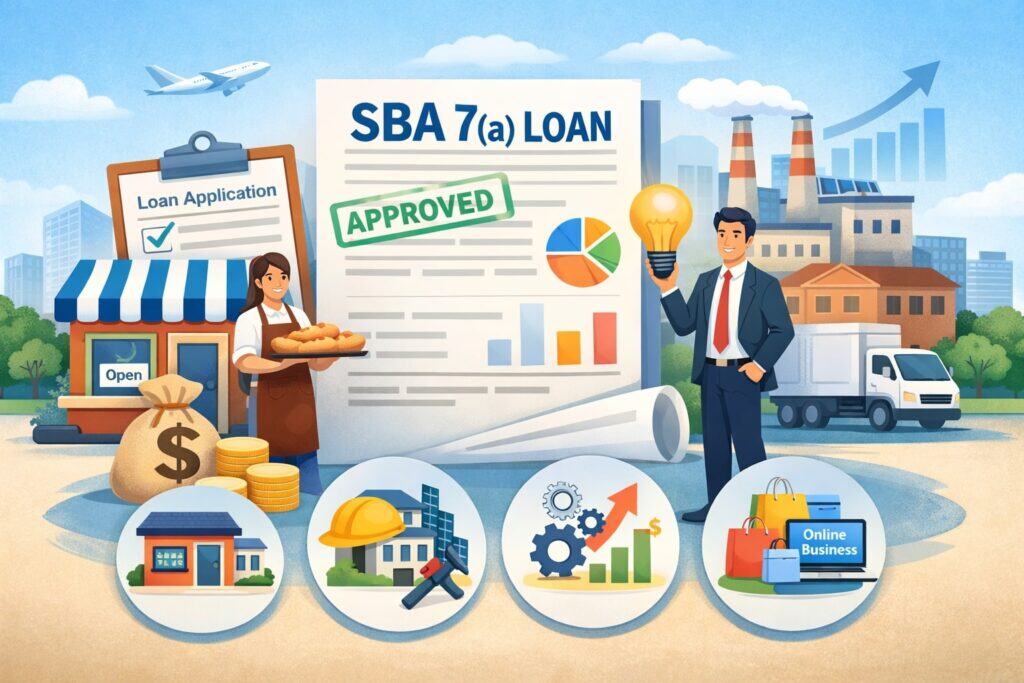
An SBA 7(a) loan is the SBA’s flagship general-purpose business loan program. It’s widely used because it can cover many business needs under one umbrella—making it a common answer when owners ask about SBA 7(a) vs SBA 504 loans and they need flexibility.
How SBA 7(a) loan amounts and guarantees work
Most 7(a) loans have a maximum loan amount of $5 million. SBA’s maximum exposure (the dollar amount it will guarantee) is generally capped, and the guarantee percentage depends on the loan amount.
Under SBA regulations, loans $150,000 or less can receive a higher maximum guarantee percentage than larger loans (unless a special authorization applies).
That guarantee is a big reason lenders can say “yes” when conventional underwriting might say “no.” But it doesn’t mean approval is automatic.
The lender still evaluates cash flow, credit history, experience, collateral (when available), and documentation quality. SBA policies also shape underwriting standards through its operating procedures that lenders must follow.
What SBA 7(a) loans can be used for
What makes the SBA 7(a) loan stand out is its broad list of eligible uses. Depending on the loan type and structure, many borrowers use it for:
- Working capital and operating expenses
- Inventory and supplies
- Equipment purchases
- Leasehold improvements and tenant buildouts
- Business acquisition (including goodwill in many cases)
- Refinance of eligible business debt
- Expansion costs like hiring, marketing, and new locations
That flexibility is the main reason SBA 7(a) loans often win the comparison of SBA 7(a) vs SBA 504 loans when your project isn’t strictly “fixed asset only.”
SBA 7(a) interest rates and terms (what to expect in practice)
Rates on SBA 7(a) loans are commonly variable and tied to a base rate (often Prime) plus an allowable spread, though fixed-rate structures exist in certain situations.
The practical takeaway is: if you want payment stability for 20–25 years on real estate, a 504 often shines. If you can handle the uncertainty of a variable rate—or you need broad-use funding—7(a) can be the better tool.
SBA 7(a) fees you must understand in 2026
Borrower cost is not just the interest rate. There are SBA guarantee fees (upfront) and annual service fees assessed on the guaranteed portion, with rules that change by fiscal year.
For FY 2026, SBA set a lender annual service fee of 0.55% (on the outstanding balance of the guaranteed portion) and published an upfront fee schedule by loan size and maturity.
For many standard 7(a) loans with maturities over 12 months, the FY 2026 upfront fees are based on the guaranteed portion and tier by size (for example, a percentage for smaller loans, higher tiers for larger loans, and a stepped structure above $1,000,000).
SBA also announced targeted relief for certain manufacturers under specified limits, reflecting a strategic policy direction.
SBA 504 loans explained: what they are and why they’re different
An SBA 504 loan is designed for financing major fixed assets—especially owner-occupied commercial real estate and long-term equipment. If you’re comparing SBA 7(a) vs SBA 504 loans for a property purchase or a facility expansion, 504 deserves serious attention.
What the SBA 504 program is built to finance
The SBA describes the 504 program as long-term, fixed-rate financing for major fixed assets that promote business growth and job creation, delivered through Certified Development Companies (CDCs)—community-based nonprofit partners regulated by SBA.
The program is often associated with predictable financing and lower down payments than many conventional real estate loans.
Unlike the SBA 7(a) loan’s wide flexibility, SBA 504 loans typically focus on:
- Purchasing owner-occupied commercial real estate
- Constructing or improving facilities
- Buying long-life machinery and equipment
- Certain refinance structures in specific program categories
If your primary need is working capital, 504 is usually not the right fit. That’s one of the simplest ways to decide SBA 7(a) vs SBA 504 loans.
SBA 504 loan size limits and what “$5.5 million” really means
SBA states the maximum loan amount for a 504 loan is $5.5 million (with program-specific details depending on the project and eligibility category). In practice, the total project cost can be higher because the 504 structure involves multiple layers of financing.
How the SBA 504 structure works (the funding stack)
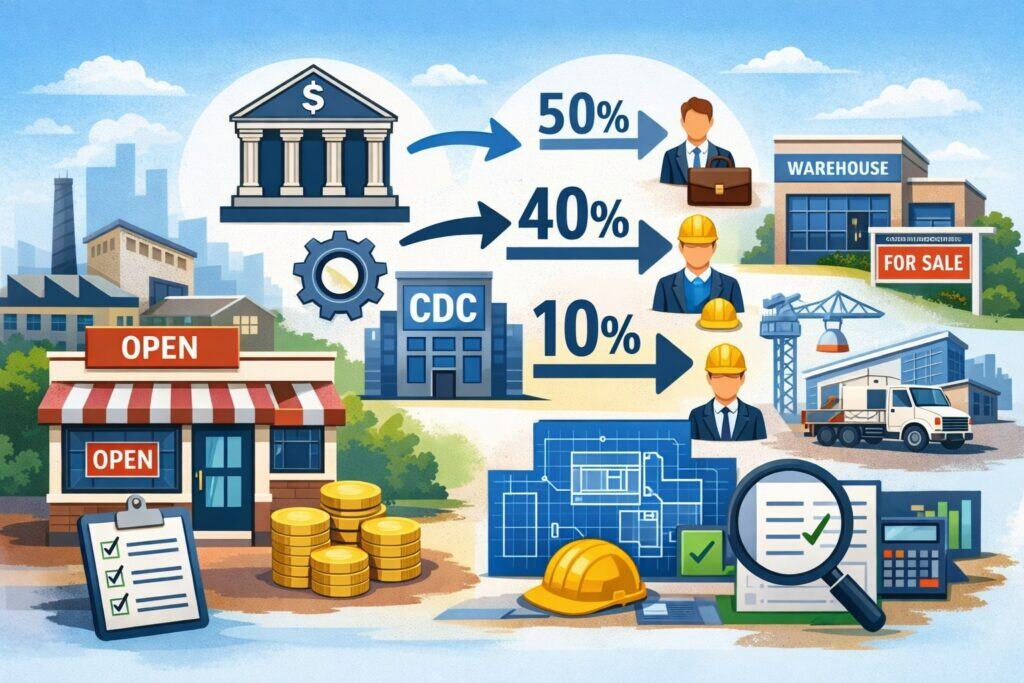
A typical 504 project often involves:
- A bank or lender portion (commonly first lien)
- A CDC/SBA debenture portion (commonly second lien)
- A borrower down payment (equity injection)
This structure is a major reason 504 loans can deliver strong long-term stability. The SBA-backed debenture portion is usually fixed-rate and funded in a monthly debenture sale cycle.
SBA 504 rates and fees: what you pay in 2026
SBA 504 loans are known for fixed rates on the debenture portion, and those effective rates can change monthly based on debenture pricing cycles. For example, published December 2025 effective fixed rates for common terms were in the mid-5% range (exact rates depend on term and cycle).
Fees also matter. For FY 2026, SBA published the 504 fee schedule, including an upfront guarantee fee of 0.50% and an annual service fee of 0.209% for many standard 504 loans (with special rules for specific refinance categories).
SBA also stated that for certain manufacturers (NAICS sectors 31–33), key fees can be waived in FY 2026.
SBA 7(a) vs SBA 504 loans: the decision factors that matter most
When deciding SBA 7(a) vs SBA 504 loans, most borrowers get stuck on rate quotes. That’s understandable—but the real decision usually comes down to five practical factors.
1) What are you buying (or refinancing)?
- If you’re buying a building or heavy equipment: SBA 504 loan is often a strong match.
- If you’re buying a business, financing goodwill, or needing a working capital buffer: SBA 7(a) loan is often more flexible.
2) Do you need working capital included?
This is where SBA 7(a) vs SBA 504 loans splits cleanly. 7(a) is built to include working capital. 504 is typically not.
3) Fixed rate vs variable rate comfort
If you want long-term payment predictability, 504’s fixed-rate debenture portion can be a major advantage. If you can accept variable-rate risk—or if you plan to refinance or sell before long-term rate swings matter—7(a) can still be the better overall tool.
4) Speed and simplicity
A single lender-driven 7(a) structure can sometimes be simpler than coordinating a 504 project that involves a bank and a CDC. But “simpler” depends heavily on lender experience and your documentation readiness.
5) Total cost, not just the interest rate
Both programs can include SBA fees and third-party costs. Fee schedules for FY 2026 are published, and they can shift annually. Comparing SBA 7(a) vs SBA 504 loans without a full cost breakdown is how businesses accidentally overpay.
Real estate, construction, and facility expansion scenarios
If your main goal is real estate—especially buying an owner-occupied building—this section is where SBA 7(a) vs SBA 504 loans becomes crystal clear.
When SBA 504 is often the better real estate tool
The SBA 504 loan is specifically designed for fixed assets and is commonly used for:
- Buying an existing building your business will occupy
- Building a new facility (ground-up construction)
- Major renovations or expansion of an existing facility
Because the SBA-backed debenture portion is typically fixed-rate and long-term, 504 can reduce interest rate uncertainty over a long holding period. It also often aligns well with businesses that want to invest in a facility as a strategic asset rather than staying in leased space indefinitely.
When SBA 7(a) can still make sense for real estate
An SBA 7(a) loan can finance real estate too, and it may be the better choice when you need a blended package that includes:
- Real estate purchase plus tenant improvements
- Equipment and buildout costs
- Working capital for the transition
- Debt refinance tied to the move
If you’re moving locations, you might have a period of overlap—rent + new mortgage + buildout costs + staffing. That working capital cushion is where 7(a) can outperform 504 in real life.
Common real estate “fit” examples
- Buying a building and needing major working capital → SBA 7(a) often fits better.
- Buying a building and keeping cash reserves strong (minimal working capital need) → SBA 504 often fits better.
- Construction projects with phased funding needs → either can work, but the best answer depends on lender/CDC experience and how your draw schedule is structured.
If you’re stuck, focus less on the label “real estate loan” and more on how much of your budget is true fixed assets versus operating needs.
Working capital, inventory, and business acquisition scenarios
This is the section where SBA 7(a) vs SBA 504 loans becomes less of a debate and more of a selection.
Why SBA 7(a) dominates working capital use cases
Working capital is the money that keeps your business moving: payroll, marketing, vendor terms, seasonal inventory builds, slow-paying receivables, and general operating stability. SBA 7(a) loans are commonly used for exactly these reasons because the program is designed for broad business uses and can be structured around cash-flow support.
In practical terms, lenders underwrite a working-capital-heavy SBA 7(a) loan by focusing on cash flow coverage, historical financial statements, and forward-looking projections. Your projections matter more here than in a pure fixed-asset deal because the asset itself doesn’t “guarantee” performance—the cash flow does.
Why SBA 504 is usually not the working capital answer
The SBA 504 loan is primarily for major fixed assets. That focus is intentional: it ties financing to long-lived assets that support expansion and job creation.
So if you need money for inventory, marketing, payroll stabilization, or acquisition goodwill, SBA 504 is usually not the right program.
Business acquisition: the common deciding moment
Many acquisition deals involve goodwill and a “transition cushion.” That’s where SBA 7(a) often wins the SBA 7(a) vs SBA 504 loans comparison.
A typical acquisition funding checklist includes:
- Purchase price (including goodwill)
- Seller note (sometimes required or strongly recommended)
- Working capital injection post-close
- Professional fees (legal, accounting)
- Initial inventory or staffing ramps
Because SBA 7(a) can be structured to fund a broader set of acquisition-related costs, it’s commonly used for business purchases—especially when the buyer needs a buffer to smooth the handoff.
Qualification and underwriting: what lenders look for in 2026
Approval is where SBA 7(a) vs SBA 504 loans stops being theoretical and becomes very practical. The programs have different structures, but lenders generally evaluate similar fundamentals: character, credit, capacity (cash flow), capital (equity), and collateral.
Key underwriting themes across both programs
For both SBA 7(a) loans and SBA 504 loans, lenders want to see:
- Consistent cash flow (historical and projected)
- Reasonable leverage and debt service coverage
- A clear use of funds that matches the program
- Management experience aligned with the business model
- Clean documentation and verifiable financials
SBA also governs the lender process through its Standard Operating Procedures (SOPs). SBA’s SOP 50 10 covers policies and procedures for 7(a) and 504 origination, and SBA issued SOP 50 10 8 as a major updated version effective June 1, 2025 (with related notices).
Why underwriting “tightness” can change over time
SBA programs aren’t static. They evolve in response to economic cycles, loss performance, fraud trends, and policy goals. Recent reporting has highlighted concerns about rising delinquencies and losses in the 7(a) program in prior periods, which can influence how strictly lenders interpret risk—especially for marginal deals.
That doesn’t mean SBA 7(a) loans are “going away.” It means the bar for documentation, cash flow clarity, and borrower readiness can rise when the broader lending environment tightens.
What this means for borrowers comparing SBA 7(a) vs SBA 504 loans
- If your financials are strong but you want fixed-rate stability for real estate → 504 can be attractive.
- If your deal needs flexibility, but your financials are thin → 7(a) can still work, but expect deeper documentation and potentially more conditions.
- If your project is mixed-use and documentation is excellent → 7(a) often moves more smoothly.
Your fastest path to approval is picking the program that naturally matches your use of funds, then presenting a clean, lender-friendly package.
Application process and timeline: what to expect step-by-step
The SBA 7(a) vs SBA 504 loans timeline question is important because both options can involve multiple parties and documentation milestones.
SBA 7(a) loan process (typical flow)
A common SBA 7(a) loan path looks like this:
- Initial lender intake (basic eligibility + high-level financial review)
- Document request (tax returns, financial statements, debt schedule, business plan/projections)
- Term sheet or conditional approval
- Underwriting and SBA submission (varies by lender authority)
- Closing, funding, and disbursement
In many cases, the speed depends more on lender experience and borrower responsiveness than on the SBA itself. If your file is incomplete, the timeline stretches quickly.
SBA 504 loan process (typical flow)
Because SBA 504 loans involve a CDC and a bank, the process often includes:
- Bank term sheet (first-lien portion)
- CDC application and project packaging
- SBA review/authorization through the 504 channel
- Interim financing (in many construction or purchase situations)
- Debenture funding cycle and final takeout
This structure can mean extra coordination, but it also creates long-term fixed-rate advantages that can be worth it.
Documentation that speeds up both programs
To reduce delays, prepare these early:
- Year-to-date financials and trailing 12-month P&L
- Business and personal tax returns
- A clean debt schedule (terms, rates, maturities)
- Ownership documents and resumes
- A written use-of-funds breakdown that matches SBA rules
If you treat SBA lending like a compliance-heavy transaction (because it is), you’ll move faster in both SBA 7(a) loans and SBA 504 loans.
Costs, fees, and “true price”: how to compare the numbers correctly
Comparing SBA 7(a) vs SBA 504 loans using only interest rate is one of the most expensive mistakes borrowers make. The better approach is to compare:
- Interest rate type (fixed vs variable)
- Total financed amount
- SBA guaranty fees and annual service fees
- Closing costs, legal, appraisal, environmental reports (often for real estate)
- Packaging and CDC fees (commonly in 504 deals)
- Prepayment expectations and refinance flexibility
SBA 7(a) fees in FY 2026 (what the SBA published)
For FY 2026, SBA published an annual service fee of 0.55% (on the outstanding balance of the guaranteed portion) and a tiered upfront guaranty fee schedule for loans over 12 months, plus a short-term schedule for 12 months or less.
The upfront fee tiers matter because they scale with the guaranteed portion and loan size. SBA also clarified rules around multiple loans approved within 90 days and how fees are calculated to prevent fee avoidance through splitting.
SBA 504 fees in FY 2026 (what the SBA published)
For FY 2026, SBA published a 0.50% upfront guarantee fee and a 0.209% annual service fee for many standard 504 loans (with additional detail for refinance categories). SBA also published fee waivers for certain manufacturers (NAICS 31–33) in FY 2026.
How to “price” SBA 7(a) vs SBA 504 loans like a pro
A strong comparison includes:
- Scenario A: “I keep this loan for 7+ years”
- Scenario B: “I sell or refinance in 3–5 years”
- Scenario C: “Rates drop (or rise) meaningfully”
Because SBA 7(a) loans are often variable-rate, the long-run cost can be highly rate-sensitive. SBA 504 loans can reduce that variability on the debenture portion by locking in a fixed rate, which is valuable if you plan to hold the building long-term.
If you want the cleanest comparison, ask your lender (and CDC, if applicable) for a full payment schedule and a line-item list of fees—then compare totals, not marketing headlines.
Common mistakes borrowers make (and how to improve approval odds)
Most SBA denials and delays happen for predictable reasons. Fixing them is one of the best ways to improve your chances—whether you choose an SBA 7(a) loan or an SBA 504 loan.
Mistake 1: Picking the wrong program for the use of funds
If you apply for an SBA 504 loan but your project is really 40% working capital, you’ve built friction into your file. When the project doesn’t match program intent, you create confusion, extra conditions, or rejection. Start by mapping your budget: fixed assets vs soft costs vs working capital.
Mistake 2: Weak or inconsistent financial documentation
Lenders need to reconcile tax returns, financial statements, and bank statements. Inconsistencies raise risk flags. If you’re using add-backs, be prepared to document them clearly and conservatively.
Mistake 3: Underestimating timeline and third-party reports
Real estate deals can require appraisals, environmental reports, and construction documentation. These can become the slowest moving pieces. Start them early.
Mistake 4: Ignoring cash flow reality
SBA lending is still cash-flow lending. The SBA guarantee helps the lender, but repayment still comes from business performance. If projections are too optimistic or unsupported, underwriters will discount them.
Mistake 5: Not preparing a “story” that makes sense
Underwriting is numbers + narrative. Your file should clearly explain:
- what you do,
- why you’ll succeed,
- how the money will be used, and
- how repayment will work.
When you package the deal cleanly, the SBA 7(a) vs SBA 504 loans decision becomes much easier for the underwriter to support.
Future outlook: what may change for SBA 7(a) loans and SBA 504 loans
Any “latest guide” on SBA 7(a) vs SBA 504 loans should acknowledge that policies evolve. Here’s what the current direction signals going into 2026.
1) Fees can shift annually—and strategic incentives may expand
SBA issued FY 2026 fee notices for both programs, including targeted fee relief for certain manufacturers in both 7(a) and 504 contexts. That type of targeted incentive suggests SBA may continue using fee policy to encourage specific economic priorities.
Prediction: Expect future fee relief to remain targeted rather than universal, focused on industries or goals policymakers want to accelerate (for example, manufacturing capacity, supply chain resilience, or other strategic sectors).
2) Underwriting expectations may continue tightening in response to losses
Public reporting has pointed to increased delinquencies and losses in the 7(a) program in recent periods. When program performance worsens, the typical response is more emphasis on documentation, verification, and credit discipline across lenders.
Prediction: Borrowers may see stricter documentation requests and more conservative cash-flow stress testing, especially for highly leveraged deals, startups, or acquisitions with thin margins.
3) The SBA operating procedures are actively updated
SBA’s SOP framework and notices (including SOP 50 10 8 and technical updates) show that rules can change and then get clarified.
Prediction: Expect continuing “technical updates” and clarifications, particularly around eligibility, documentation standards, and fee calculations—especially as the SBA responds to lender behavior and market conditions.
FAQs
Q.1: What is the biggest difference between an SBA 7(a) loan and an SBA 504 loan?
Answer: The biggest difference in SBA 7(a) vs SBA 504 loans is what they’re designed to finance. An SBA 7(a) loan is flexible and can fund working capital, inventory, acquisitions, and many business needs.
An SBA 504 loan is focused on fixed assets like owner-occupied commercial real estate and major equipment, typically with fixed-rate financing on the debenture portion.
From a borrower’s point of view, that translates into a simple decision rule: if your project includes meaningful working capital or an acquisition, the SBA 7(a) loan is often the natural fit. If your goal is buying a building you’ll occupy long-term or financing equipment that supports expansion, the SBA 504 loan is often the cleaner match.
Also, the structure differs. A 7(a) loan is usually one lender and one loan. A 504 loan is typically a coordinated project with a bank and a CDC. That coordination can feel more complex, but the tradeoff is long-term stability and a purpose-built fixed asset structure.
Q.2: Can I use an SBA 504 loan for working capital?
Answer: In most situations, SBA 504 loans are not intended for general working capital. The 504 program is designed to finance major fixed assets that support growth and job creation, such as owner-occupied commercial real estate or long-life machinery and equipment.
If your project includes working capital needs—like payroll coverage, inventory ramp, marketing, or operating reserves—an SBA 7(a) loan is typically the better fit in the SBA 7(a) vs SBA 504 loans comparison.
Many borrowers who want a building purchase and working capital choose 7(a) to avoid splitting the financing into multiple products. Another strategy some businesses use is pairing a 504 for the building with a separate line of credit for working capital, but that adds complexity and depends on lender appetite and your credit profile.
So if working capital is a core need, treat that as a strong signal toward SBA 7(a).
Q.3: Which one is cheaper: SBA 7(a) or SBA 504?
Answer: “Cheaper” depends on how long you keep the loan and how you value rate stability. SBA 504 loans often look attractive because the SBA-backed debenture portion is fixed-rate and long-term, which can reduce interest rate risk. Meanwhile, SBA 7(a) loans are frequently variable-rate, so the total cost can rise if base rates rise.
Fees also matter. For FY 2026, SBA published specific fee schedules for both programs, including annual service fees and upfront guarantee fees that can shift by year and by borrower category.
A good way to compare SBA 7(a) vs SBA 504 loans is to request a side-by-side payment schedule under realistic assumptions:
- If you hold the loan for 10+ years, fixed-rate stability can be valuable.
- If you expect to refinance or sell in 3–5 years, the “cheapest” option might be the one with lower total upfront + early-life costs, not necessarily the lowest long-term rate.
In other words: ask for a full-cost breakdown, not just a rate quote.
Q.4: What are the maximum loan amounts for SBA 7(a) and SBA 504 loans?
Answer: For SBA 7(a) loans, SBA states that most 7(a) loans have a maximum loan amount of $5 million, with some subprogram limits (like SBA Express) lower. For SBA 504 loans, SBA states the maximum loan amount is $5.5 million (with program details that can vary by category and project type).
In real life, the 504 project total can exceed the SBA portion because of the multi-part structure involving the bank portion and borrower equity. That’s why it’s common to see large real estate projects completed with 504 even though the SBA portion itself has a stated maximum.
Q.5: Which is easier to qualify for: SBA 7(a) or SBA 504?
Answer: Neither is universally “easier,” but they can be easier in different scenarios. SBA 504 loans can be straightforward when you have a clean fixed-asset project (like buying an owner-occupied building), stable cash flow, and clear documentation.
SBA 7(a) loans can be more straightforward when your project is mixed-use and you want one flexible loan that covers working capital, improvements, and other needs.
SBA’s SOP framework governs origination policies for both programs, and SBA published significant updates effective June 1, 2025 (with notices and technical updates), which means documentation and underwriting discipline matter more than ever.
To improve approval odds in either program, focus on:
- strong, well-documented cash flow,
- clean tax returns and financial statements,
- a clear and program-aligned use of funds,
- realistic projections backed by evidence.
When your deal fits the program naturally, qualification gets easier—regardless of whether you choose SBA 7(a) vs SBA 504 loans.
Conclusion
The best way to decide SBA 7(a) vs SBA 504 loans is to start with your use of funds and work outward.
Choose an SBA 7(a) loan when you need flexibility—especially if your project includes working capital, inventory, a business acquisition, or a mix of costs that don’t fit neatly into a fixed-asset-only structure. SBA 7(a) loans are built to fund business transitions and growth where liquidity matters as much as the asset you’re buying.
Choose an SBA 504 loan when your project is primarily fixed assets—owner-occupied real estate, construction, or major equipment—and you want long-term fixed-rate stability on the debenture portion. The 504 structure can be powerful for businesses that plan to hold property long-term and want predictable payments.
Finally, remember that SBA programs evolve. Fee schedules and underwriting expectations can change by fiscal year, and SBA has published FY 2026 fee guidance for both 7(a) and 504. Treat “latest” as something you verify at the time you apply.