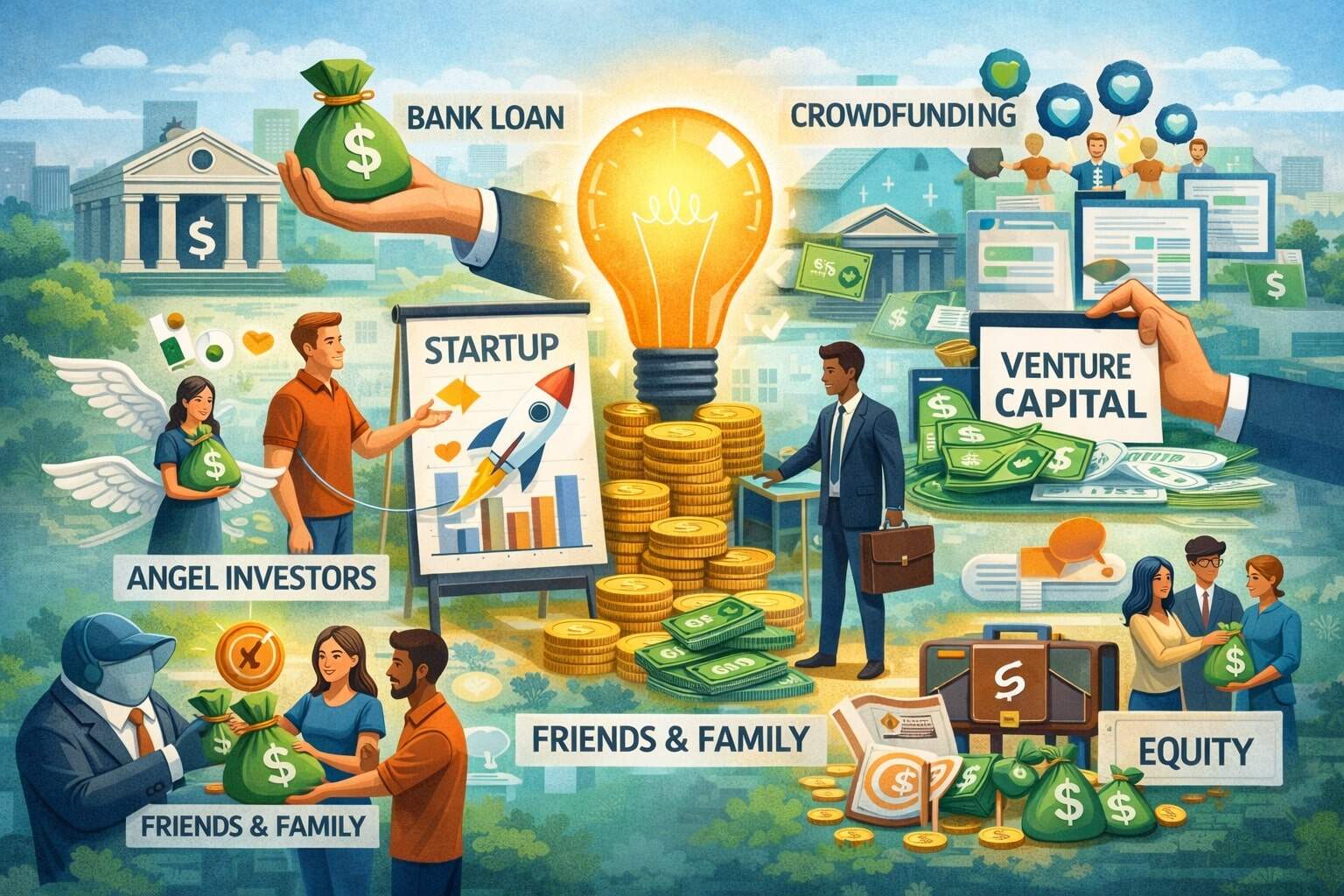
Startup Funding Options Explained
Startup funding options can feel endless, but most founders only need a clear map: what you’re building, how fast you need to grow, and what you’re willing to trade (cash flow, ownership, control, or time).
The best startup funding options aren’t the ones with the biggest checks—they’re the ones that match your stage, margins, risk profile, and distribution strategy.
In practice, startup funding options fall into a few buckets: self-funding (bootstrapping), equity (angels, venture capital), debt (loans, venture debt), and non-dilutive capital (grants, credits, partnerships, customer prepayments).
Each bucket has different “hidden costs.” Equity can be expensive if you give away too much ownership too early. Debt can choke cash flow if revenue is uneven. Crowdfunding can create a large shareholder base that complicates future rounds. Grants can be slow and restrictive.
A modern fundraising plan usually blends multiple startup funding options over time. A founder might bootstrap to validate demand, then raise an angel round to hire a small team, then pursue venture capital to scale distribution, then add venture debt to extend runway, and later consider secondary sales for liquidity.
Another founder might skip venture capital entirely and lean on revenue-based financing plus customer prepayments.
This guide breaks down startup funding options in a practical way—how they work, when they fit, what investors and lenders expect, and what to watch out for. You’ll also get future-facing predictions so you can plan your next 12–36 months with fewer surprises.
How to Choose Among Startup Funding Options

The fastest way to narrow startup funding options is to treat capital like a product decision. Different startup funding options “price” risk differently.
Equity investors want outsized outcomes, so they prefer markets that can become very large, with scalable distribution and defensible differentiation. Lenders want predictable repayment, so they prefer stable margins, repeatable revenue, and collateral or strong guarantees.
Start by defining your funding purpose in one sentence: “We need $X to achieve Y milestone by Z date.” If you can’t define the milestone, you’ll drift into raising money as a goal instead of using money as a tool.
Good milestones are measurable: shipping v1, reaching $25k MRR, signing 10 pilots, achieving a specific gross margin, hitting a compliance step, or expanding into a new channel.
Next, decide your tolerance for dilution and control. Some startup funding options require giving up board seats, veto rights, or protective provisions. Others require personal guarantees. Your personal goals matter here: do you want to optimize for maximum scale, or for steady profitability and control?
Finally, build a “capital stack” that matches your timeline. If your sales cycle is long or regulated, you may need more runway and may lean toward equity-based startup funding options. If your business has strong margins and fast payback, you can often use debt or revenue-based startup funding options without giving up much ownership.
Stage-by-Stage Map of Startup Funding Options
Most startup funding options fit best at specific stages because risk changes dramatically as you prove the business. At the idea and prototype stage, funding is usually personal savings, a small friends-and-family round, or grants—because you have limited proof.
At the validation stage (early traction, pilots, small revenue), angel investors and accelerators become realistic startup funding options because you can show early demand signals.
At the early scale stage (repeatable sales motion, improving retention, clear unit economics), venture capital becomes a stronger fit among startup funding options—especially if the market is large and growth can be accelerated with hiring and marketing.
At the growth stage (strong revenue base, forecasting), you can add venture debt, bank lines, and structured financing as startup funding options to extend runway without massive dilution.
This staging matters because it impacts pricing. Early capital is the most expensive because risk is highest. That’s why many founders bootstrap longer—to raise later at better terms. But bootstrapping too long can also be risky if a competitor captures distribution.
A useful rule: choose startup funding options that match your proof level. If you only have a concept, avoid complex financing structures. If you have predictable revenue, don’t overpay with equity.
The Real Cost of Startup Funding Options: Dilution, Cash Flow, and Constraints
Founders often compare startup funding options based on headline numbers—valuation, interest rate, or check size—but the “real cost” is usually in terms and constraints.
Equity funding can include liquidation preferences, participation rights, anti-dilution clauses, board control, and investor approval rights. Those can affect outcomes even if the valuation looks great.
Debt-based startup funding options can be cheaper on paper, but repayment schedules can force you to prioritize short-term cash flow over long-term growth. Covenants can restrict spending, hiring, or additional fundraising. Personal guarantees can put personal assets at risk.
Crowdfunding as a startup funding option can bring marketing value and customer loyalty, but it can also create investor-relations overhead and future cap table complexity. Meanwhile, non-dilutive startup funding options like grants can protect ownership, but may require strict use-of-funds rules and long timelines.
The key is to model scenarios. Build a simple spreadsheet: expected revenue, burn, runway, dilution at each round, and repayment obligations. Compare three funding paths. The best startup funding options are the ones that keep your company solvent and strategically flexible.
Bootstrapping and Revenue-Based Funding

Bootstrapping is one of the most underestimated startup funding options because it compounds two advantages: you learn faster (because customers decide what matters) and you keep ownership.
Bootstrapping isn’t “no funding”—it’s funding your startup through savings, consulting income, early sales, or lean operations. The discipline you build while bootstrapping often improves unit economics, which later makes every other startup funding option easier and cheaper.
Bootstrapping works best when you can launch an MVP quickly, sell early, and reinvest profit. It’s especially powerful for service-to-software transitions, niche vertical products, or businesses with clear buyer pain. The main risk is speed: if the market is winner-take-most or distribution advantages compound, bootstrapping may be too slow.
Revenue-based financing (RBF) is the bridge between pure bootstrapping and traditional debt. It’s a startup funding option where repayments flex with revenue—often a percentage of monthly receipts until a cap is reached. That flexibility can be a lifesaver for seasonal businesses or startups with uneven cash flow.
Bootstrapping Tactics That Expand Your Startup Funding Options Later
If you bootstrap strategically, you’re not “avoiding” startup funding options—you’re improving future leverage. Start with a tight scope: one customer segment, one core use case, one distribution channel. Build a product that solves a painful, urgent problem that people already budget for.
Use pre-sales and pilots to fund development. A paid pilot is both capital and proof. If you can collect annual contracts upfront—even at a discount—you create non-dilutive startup funding options through working capital.
You can also use professional services as a “cash engine” while building product IP, but keep boundaries: define a services menu, avoid bespoke complexity, and reinvest into reusable product features.
Also, get serious about cash management. Shorten billing cycles, require deposits, and reduce payment delays with automation. Bootstrapping success is often about time-to-cash, not just revenue.
Bootstrapping also improves your story for angels and venture capital. A founder who is bootstrapped to real traction often earns better terms because risk is lower. Among startup funding options, bootstrapping is the one that can actually increase your valuation before you raise.
Revenue-Based Financing as a Flexible Startup Funding Option
Revenue-based financing is often positioned as a founder-friendly startup funding option because it doesn’t require giving up equity. Instead, you agree to repay a multiple of the capital (for example, 1.3x to 2.0x) using a fixed percentage of monthly revenue. When revenue dips, payments dip. When revenue rises, you repay faster.
RBF fits best when you have consistent gross margins, a stable or growing revenue base, and a clear use of funds—like marketing spend with measurable payback, inventory purchases, or hiring for a proven sales motion. It’s less suitable for deep R&D startups with long timelines and uncertain revenue.
The tradeoff is cost. RBF can be more expensive than a traditional loan, especially if you repay quickly. Also, some providers effectively underwrite your business like a lender, meaning they may require access to bank accounts, revenue data, and ongoing monitoring.
Still, as startup funding options go, RBF can be a smart “middle path” when you want growth capital without heavy dilution—and when your revenue is real enough to support repayment without starving operations.
Friends, Family and Angel Investors

Friends-and-family funding is often the first outside money founders raise, and it’s one of the most sensitive startup funding options because relationships are involved. Done well, it can buy time to reach traction milestones.
Done poorly, it can create confusion, resentment, or legal problems. The goal should be clarity and fairness: everyone understands the risk, and the paperwork matches the reality.
Angel investors are the next step among startup funding options. Angels invest personal capital, often early, and can add strategic value: introductions, hiring help, and go-to-market advice. Angel rounds can be informal or organized through syndicates and angel groups. Many founders prefer angels because decision cycles can be faster than institutional venture capital.
Friends-and-Family as a Startup Funding Option Without Regret
If you use friends-and-family as a startup funding option, protect everyone with structure. Use standardized documents (like a SAFE or a convertible note) rather than casual IOUs. Explain that startups are high-risk and illiquid—investors may lose everything, and there may be no ability to sell for years.
Set minimum checks to reduce administrative overhead. Keep the round small and purposeful. Communicate how you’ll provide updates (monthly or quarterly), what metrics you’ll share, and what you won’t promise.
Avoid suggesting guaranteed returns. Keep the cap table clean by using a special purpose vehicle (SPV) when appropriate, so you don’t end up with dozens of tiny shareholders.
Also, consider whether this startup funding option truly helps. If the amount raised won’t meaningfully extend runway or reach a milestone, it may not be worth the relationship risk. A small round that doesn’t change outcomes can create long-term pressure.
When founders treat friends-and-family funding like professional financing—clear docs, clear risk disclosure, clear updates—it can be one of the healthiest startup funding options. When it’s treated casually, it’s often the one that creates the most emotional debt.
Angel Investors, Syndicates, and What They Look For
Angel investors evaluate startup funding options through a simple lens: team quality, market size, and early evidence. Even at early stages, they want signals that you can execute. Those signals include founder-market fit, speed of iteration, customer discovery depth, early traction, and clarity of the business model.
Syndicates can make angel investing easier because a lead investor does diligence and others follow. For founders, syndicates can be efficient startup funding options because one lead relationship unlocks multiple checks. But syndicates also increase expectations: the lead will want reporting, and the group will watch metrics.
Angels often invest through SAFEs or convertible notes early, delaying valuation negotiations. They may also ask for pro rata rights (the right to invest in future rounds). Strong angels can be invaluable—especially if they help you hire your first key roles or land your first major customers.
To attract angels among startup funding options, build a crisp narrative: problem, solution, why now, why you, traction, business model, and next milestone. Angels don’t need perfection, but they do need momentum and credibility.
Venture Capital and Growth Equity

Venture capital is one of the most discussed startup funding options, and also one of the most misunderstood. VC is designed for a specific profile: companies that can grow very fast, reach large markets, and achieve outcomes big enough to return the fund. That usually means scalable distribution, strong retention, and a path to significant revenue scale.
VC can be transformative when it matches the business. It enables rapid hiring, accelerated product development, and aggressive go-to-market expansion.
But VC also introduces expectations: growth targets, board oversight, and follow-on fundraising pressure. If your business can’t or shouldn’t grow at VC pace, venture capital may be the wrong startup funding option—even if you can raise it.
Growth equity is later-stage equity capital, usually when revenue is meaningful and the business model is clearer. It often focuses more on scaling efficiently and may be less tolerant of heavy losses than early VC.
VC Term Sheets: How Startup Funding Options Change Your Control
A venture term sheet doesn’t just price your company—it defines power and outcomes. Key terms to understand include liquidation preference (who gets paid first in an exit), participation rights (whether investors get additional upside beyond preference), anti-dilution protections (what happens if a later round is down), and board composition (who controls governance).
Protective provisions can require investor approval for major decisions: issuing new shares, taking debt, selling the company, or changing the option pool. These can be reasonable, but they can also reduce founder flexibility. That’s why comparing startup funding options requires looking beyond valuation.
Also, pay attention to option pool expectations. Investors may require the option pool to be “topped up” before investment, effectively reducing founder ownership. Understand the fully diluted cap table after the round, not just headline ownership.
The best approach is alignment. Choose investors who understand your market and agree on strategy and pace. Among startup funding options, VC is powerful—but only when expectations fit your business reality.
When VC Is the Right—or Wrong—Startup Funding Option
VC is often right when you have a repeatable growth engine: strong product-market fit, clear unit economics, and the ability to deploy capital into growth with predictable returns. It’s also right when speed matters: network effects, land-grab markets, or winner-take-most dynamics.
VC is often wrong when margins are thin, sales cycles are long and unpredictable, the market is too small, or the business is better suited to steady profitability. It can also be wrong when founders want long-term control and lifestyle flexibility. VC-backed companies usually optimize for large exits within a fund’s time horizon.
A practical test: ask, “If we raised nothing, could we still build a healthy business?” If yes, you might have more startup funding options than you think—and you can negotiate from strength. If no, and your path requires heavy upfront investment, VC may be the best match.
The goal isn’t to “get venture-backed.” The goal is to choose startup funding options that maximize your chance of building the company you actually want.
Debt-Based Startup Funding Options
Debt is a critical category of startup funding options because it can reduce dilution. But debt is also unforgiving: it must be repaid on schedule, regardless of whether growth goals are met. That’s why lenders are conservative—unless you have assets, predictable revenue, or strong guarantees.
Debt-based startup funding options include traditional bank loans, government-backed programs, lines of credit, equipment financing, and venture debt. The right choice depends on revenue stability, collateral, and how quickly the borrowed funds generate cash.
Debt is most useful when it’s used for specific, ROI-linked purposes: financing receivables, purchasing equipment, funding inventory, or extending runway after a strong equity round. Debt is least useful when it funds experimentation with uncertain timelines.
Bank and SBA-Style Loans as Startup Funding Options
Traditional bank loans are among the hardest startup funding options to access early because banks prefer operating history and collateral. Government-backed programs can expand access by reducing lender risk through guarantees and program rules. Some programs also publish changing fee schedules by fiscal year, which can affect cost.
If you pursue this startup funding option, prepare for underwriting: personal credit, business financials, projections, tax filings, and sometimes collateral and personal guarantees. You may also see policy shifts that tighten or loosen access.
Recent reporting has highlighted increased scrutiny and rule changes in lending standards, which can affect approvals and requirements.
To increase approval odds, strengthen fundamentals: document cash flow, reduce “messy” bank statements, separate personal and business finances, and show a clear use of funds tied to revenue. Lenders want to understand repayment sources—how the loan gets paid back.
Debt-based startup funding options like these are often best for founders who already have traction and want to scale without giving up much ownership. But they are rarely the first startup funding options for zero-revenue startups.
Venture Debt as a Startup Funding Option for VC-Backed Companies
Venture debt is a specialized startup funding option typically used by VC-backed companies. It’s designed to extend the runway without raising an immediate equity round.
Venture debt providers underwrite the quality of your investors, your revenue trajectory, and your cash position. They may also require warrants (a small equity kicker), meaning it’s not purely non-dilutive.
Venture debt works best when you’ve recently raised equity, have a strong cash buffer, and are using debt to reach the next valuation milestone. It can be used to finance working capital, bridge to profitability, or fund growth initiatives with measurable payback.
The risks are real. Repayment schedules can become stressful if growth slows. Covenants or minimum cash requirements can limit flexibility. If a company runs into trouble, debt holders often have priority claims over assets.
Still, in the landscape of startup funding options, venture debt can be a smart tool when used conservatively—especially when it avoids a rushed equity round at a weak valuation.
Alternative Startup Funding Options: Crowdfunding and Public-Style Raises
Alternative startup funding options have expanded dramatically with online platforms and regulatory pathways. The advantage is access: you can reach customers, fans, and smaller investors, often while building brand awareness. The tradeoff is complexity: legal compliance, disclosures, investor communications, and cap table management.
Two major pathways are Regulation Crowdfunding (Reg CF) and Regulation A. These are structured exemptions that allow companies to raise from the public under specific rules and limits.
They’re not “easy money,” but they can be powerful startup funding options for consumer brands, community-driven products, and startups with strong storytelling and loyal users.
Regulation Crowdfunding (Reg CF) as a Startup Funding Option
Regulation Crowdfunding is a startup funding option that allows eligible companies to raise capital online through registered intermediaries.
It comes with a defined maximum amount that can be raised in a 12-month period, along with disclosure requirements and resale restrictions. The SEC’s guidance describes a maximum aggregate raise of $5 million in a 12-month period under Reg CF.
Reg CF can be attractive because it opens startup funding options to a wider investor base. It can also double as marketing: investors often become evangelists. But founders should plan for the operational burden.
You’ll need clear financials, a compelling narrative, and systems for investor updates. Securities purchased in these offerings generally have limits on resale for a period, and there are rules around what you must disclose.
To make this startup funding option work, focus on campaign fundamentals: a crisp product story, real traction evidence (even small), strong visuals, and a plan to keep momentum throughout the raise.
Also plan for cap table strategy—many founders use vehicles or specialized structures to avoid having hundreds of tiny direct shareholders.
Regulation A (Tier 1 and Tier 2) for Larger Startup Funding Options
Regulation A is another startup funding option that can support larger raises than Reg CF, with two tiers and different requirements. The SEC describes Tier 1 offerings of up to $20 million and Tier 2 offerings of up to $75 million in a 12-month period.
This pathway can resemble a “mini public offering,” with heavier compliance and preparation than a typical startup seed round. It can be a fit for later-stage startups that want broad investor access without a full traditional public offering process.
Tier 2 typically requires more ongoing reporting than Tier 1, and founders should budget for legal, accounting, and marketing costs.
As startup funding options go, Regulation A can be compelling when you have strong brand demand, a clear business model, and enough scale to justify the costs. It can also support liquidity and broaden ownership, but it adds ongoing obligations—so it’s best used intentionally, not as a last resort.
Non-Dilutive Startup Funding Options
Non-dilutive startup funding options are especially valuable because they preserve ownership. These include grants, innovation programs, tax incentives, partner funding, and customer-based financing like prepayments. The challenge is that many non-dilutive startup funding options are slower, more competitive, and more restrictive than equity.
But the upside is strategic. Non-dilutive capital can fund R&D, validate credibility, and reduce how much equity you must sell. It can also create leverage in negotiations—when you don’t “need” the round, you can choose better terms.
Grants, Credits, and Competitions as Startup Funding Options
Grants and innovation programs can fund research, workforce development, or market expansion. Many require detailed proposals and strict reporting. Even if the money is smaller, the signaling value can be big—winning a credible program can make angels and lenders take you more seriously.
Another angle is tax planning that supports investment attractiveness. For example, Qualified Small Business Stock (QSBS) rules under IRC Section 1202 can significantly influence investor and founder outcomes when structured correctly, and reputable tax analysis has highlighted recent legislative changes expanding benefits in specific ways.
Because rules and eligibility can be nuanced, treat this as a finance-and-legal collaboration. The “best” non-dilutive startup funding options often combine: grants for R&D, credits for payroll or innovation spend, and strategic partnerships that add distribution.
Most importantly, don’t let grants distract from customers. The best founders use grants to accelerate traction—not replace it.
Strategic Partnerships and Customer Pre-Sales as Startup Funding Options
Strategic partnerships are underrated startup funding options because they can include cash, distribution, and credibility. A partner might fund joint development, commit to minimum purchases, or pay for integration. In some cases, partnerships act like non-dilutive capital because the partner is prepaying for value.
Customer pre-sales are one of the cleanest startup funding options when possible. Annual upfront contracts or deposits can fund growth. The discipline here is delivery: you must ensure you can fulfill promises without overcustomizing the product.
To make these startup funding options work, build offers with tight scope. Define what’s included, timelines, success criteria, and what happens if requirements change. Protect margins and avoid becoming a services shop unless that’s your strategy.
When executed well, partnerships and pre-sales not only fund the business—they also reduce market risk, making every other startup funding option easier.
Preparing to Raise: Make Startup Funding Options Compete for You
Founders often think fundraising is about pitch skills. In reality, startup funding options become abundant when your fundamentals are strong: clear market, clear traction, clear economics, and clean documentation. Preparation increases your speed, your terms, and your negotiating leverage.
Your goal is to remove perceived risk. Investors and lenders price uncertainty. The more you can prove—demand, retention, payback, compliance readiness—the better your startup funding options will be.
Pitch Deck, Metrics, and Narrative That Unlock Startup Funding Options
A high-performing deck is clear, not clever. It shows: problem, solution, why now, market size, traction, business model, go-to-market, competition, team, and the ask. Then it connects the ask to milestones. “We’re raising $1.5M to achieve $80k MRR with 70% gross margin and a repeatable outbound motion by Q4.”
Metrics matter. Even early, show leading indicators: pipeline, conversion, retention, usage, CAC payback, churn, and gross margin. If you’re pre-revenue, show validation signals: pilot LOIs, waitlists with engagement, willingness-to-pay interviews, and prototype results.
Different startup funding options require different metrics. Lenders care about repayment ability and cash coverage. Equity investors care about growth potential and defensibility. Crowdfunding audiences care about story, product, and community.
When your narrative and metrics align, you don’t “ask for money.” You present a compelling opportunity—and startup funding options start chasing you.
Legal Readiness, Cap Table Hygiene, and Compliance
Legal readiness is a multiplier for startup funding options. Clean incorporation, IP assignments, contractor agreements, and a clear cap table prevent delays and reduce risk. Investors hate surprises: unclear ownership, missing IP assignments, messy convertible instruments, or undocumented promises.
Cap table hygiene matters because it affects future rounds. Too many small holders, unclear SAFE terms, or poorly designed option pools can scare off institutional capital. Crowdfunding in particular can complicate cap tables if not structured thoughtfully.
Compliance readiness also matters when you use regulated startup funding options like Reg CF or Reg A. These routes have disclosure obligations and platform requirements, and official guidance emphasizes structured processes through registered intermediaries for certain offerings.
Treat legal work as strategic. It’s not just paperwork—it’s what keeps your startup funding options open when timing matters.
Future Predictions for Startup Funding Options
Startup funding options are evolving quickly due to technology, policy shifts, and changing investor behavior. Founders who plan for these shifts can raise more efficiently and avoid dead ends. The biggest changes are happening in underwriting, liquidity, and the blending of private and public-style fundraising.
One major trend is data-driven underwriting. Lenders and alternative financiers increasingly evaluate real-time revenue, churn, and transaction data. Another is greater emphasis on capital efficiency. After periods of “growth at all costs,” many investors have leaned toward durable margins and clearer paths to profitability.
Policy changes can also reshape startup funding options. For instance, changes in tax incentives like QSBS can affect how founders and investors think about long-term outcomes and holding periods, and recent analysis highlights updated structures and benefits under newer rules.
AI Underwriting, Embedded Finance, and New Liquidity Paths
Expect more startup funding options that feel “embedded” inside your tools. Payment providers, payroll platforms, and commerce systems can offer financing based on your live data. This reduces application friction and speeds decisions—but it also increases monitoring and can introduce automated repayment that hits cash flow quickly.
AI underwriting will likely expand approvals for businesses that traditional lenders struggle to model, but it may also create new risk controls and dynamic pricing. In other words: you may get faster access to capital, but terms could adjust based on performance signals.
Liquidity is another frontier. Secondary markets for private shares and structured employee liquidity programs are becoming more common. This can change how founders think about venture capital—if you can create partial liquidity earlier, you may be less pressured to optimize solely for a giant exit.
Overall, startup funding options will become more diverse—but also more data-driven and more conditional.
Regulatory and Macro Trends That Could Shape Startup Funding Options
Regulatory frameworks for crowdfunding and public-style raises remain central to alternative startup funding options. Official limits and tier structures define what’s possible under different exemptions. If these limits evolve over time, they can open (or restrict) access for certain founders.
Macro conditions also matter. Interest rate environments affect debt-based startup funding options directly—higher rates raise the cost of capital and often tighten underwriting. Meanwhile, increased scrutiny in certain lending programs can change requirements and fees from year to year.
A practical prediction: founders will increasingly blend startup funding options. Rather than “all equity” or “all debt,” expect more hybrid stacks: equity for risk, debt for efficiency, and non-dilutive capital for strategic acceleration. The winners will be founders who treat capital strategy as a core competency, not a one-time event.
FAQs
Q.1: What are the best startup funding options for a first-time founder?
Answer: The best startup funding options for a first-time founder usually prioritize simplicity and learning speed. Bootstrapping is often ideal because it forces customer-driven execution and preserves ownership.
If you need outside capital, friends-and-family or a small angel round can provide a runway to reach a concrete milestone—like shipping the product, securing paid pilots, or proving retention.
The key is not the label of the startup funding option—it’s the milestone math. If $150k gets you to a revenue milestone that makes a larger round easier, it’s useful. If $150k only delays hard decisions, it’s not.
First-time founders should also be careful with complex instruments and excessive dilution early. Clean structures keep future startup funding options open.
If you have early revenue, consider revenue-based financing or small lines of credit, but only if repayments won’t starve growth. Debt is a tool, not a lifeline. Choose startup funding options that reduce stress and increase focus.
Q.2: How much money should I raise when comparing startup funding options?
Answer: When comparing startup funding options, raise enough to reach your next value-inflection milestone with a buffer. A common planning range is 12–18 months of runway, but the “right” number depends on your cycle time: product build, sales cycle length, and hiring speed.
Fundraising itself takes time and attention. If you raise too little, you may spend half your runway raising again. If you raise too much too early, you might over-dilute or overbuild. The best approach is milestone-based: calculate burn, add a contingency buffer, and align your raise with clear deliverables.
Different startup funding options also change this math. Equity gives flexibility but adds dilution. Debt requires repayment, so you need more confidence in cash flow. Crowdfunding requires campaign effort, so you need marketing capacity. Raise to remove your biggest constraint—not to maximize the headline amount.
Q.3: Are crowdfunding startup funding options actually worth it?
Answer: Crowdfunding startup funding options can be worth it when the campaign doubles as customer acquisition and brand building. If you have a product with a strong story and a community-driven audience, crowdfunding can provide both capital and momentum. It can also expand who can participate, under defined rules and limits.
But crowdfunding isn’t “easy.” You’ll need compelling content, strong conversion, and a plan to sustain attention. There are also disclosure obligations and platform requirements depending on the route you choose.
It may not be worth it if you don’t have marketing bandwidth, if your product isn’t easily communicated, or if your future funding path depends on a very clean cap table. The best founders treat crowdfunding as a go-to-market event—not just a financing event.
Q.4: What’s the safest startup funding option that avoids giving up equity?
Answer: No startup funding option is completely “safe,” but if your business has revenue, the least dilutive paths often include customer prepayments, strategic partnerships, and revenue-based financing—because they tie capital to real demand. Grants can also be strong non-dilutive startup funding options, but timelines and restrictions can be challenging.
Traditional loans can avoid equity, but they introduce repayment risk and may require guarantees or strict underwriting. Some government-backed programs publish changing fee structures and requirements, which can affect total cost.
The safest approach is usually a blend: reduce burn, improve cash collection, use customer-funded growth, and add financing only when repayment is clearly supported. Equity-free startup funding options are best when your business fundamentals are already strong.
Q.5: How do I know if venture capital is the wrong startup funding option for my business?
Answer: Venture capital is often the wrong startup funding option if your market is too small, your margins are thin, your growth can’t scale predictably, or your business is better suited to steady profitability.
VC requires a growth profile that can produce very large outcomes. If your business model doesn’t fit, VC can push you into unhealthy decisions—overspending, premature scaling, or endless fundraising.
Ask: Do we have a scalable acquisition channel? Do we retain customers strongly? Can we grow fast without quality collapsing? Are we building something defensible?
If the honest answer is “not really,” consider other startup funding options: angels aligned with sustainable growth, revenue-based financing, strategic partners, or bootstrapping.
Also consider your personal goals. If you want long-term control or a lifestyle-compatible pace, VC may create misalignment. The right startup funding option is the one that supports the company you’re actually building.
Conclusion
Startup funding options aren’t about finding money—they’re about choosing the right tradeoffs for your stage and strategy. Bootstrapping and customer-funded growth protect ownership and sharpen execution. Angels and venture capital can accelerate hiring and distribution when the market opportunity is large and the model scales.
Debt-based startup funding options reduce dilution but demand predictable repayment. Crowdfunding and public-style raises expand access, but add compliance and operational complexity.
The highest-leverage move is to treat startup funding options as a roadmap, not a single decision. Raise to specific milestones. Keep your cap table clean. Build a narrative backed by metrics. And choose investors and lenders who align with your pace and priorities.
Looking ahead, startup funding options will become more data-driven, more embedded in software platforms, and more hybrid in structure. Founders who master capital strategy—alongside product and go-to-market—will have more choices, better terms, and a higher chance of building a durable company.