
What Is a DSCR (Debt Service Coverage Ratio) and Why Does It Matters?
When a business applies for financing, lenders want a clear answer to one basic question: can this business realistically afford to repay the debt?
That is where the debt service coverage ratio (DSCR) becomes so important. It gives lenders, owners, and financial decision-makers a quick way to measure whether a company’s cash flow is strong enough to cover its loan payments.
For business owners, DSCR is more than a number on a loan application. It is a practical health check that shows whether current income can support existing debt and any new financing.
A strong ratio can improve approval odds, expand borrowing options, and support smarter growth decisions. A weak ratio can signal cash flow pressure, over-borrowing, or the need to tighten operations before taking on more obligations.
Understanding DSCR in business finance can help you make better decisions long before you sit down with a lender. It can guide budgeting, refinancing plans, expansion timing, and even day-to-day expense management.
Whether you are looking at a term loan, commercial real estate loan, equipment financing, or another form of credit, knowing how to calculate debt service coverage ratio and improve it can make a meaningful difference.
This guide breaks down what DSCR means, how the DSCR formula explained actually works, what lenders usually look for, and what steps can help strengthen your position if the number is too low.
What debt service coverage ratio means in business finance

The debt service coverage ratio (DSCR) measures how much income a business has available to pay its debt obligations. In simple terms, it compares cash available for debt payments to the total amount of debt due during a specific period. That is why it is often treated as one of the most practical loan qualification metrics.
A lender does not just want to know that your business generates revenue. Revenue alone does not show whether enough money is left after normal operating costs to make loan payments comfortably. DSCR helps bridge that gap by focusing on available cash flow versus required debt service.
If your DSCR is above 1.00, your business is generating more cash than it needs to cover debt payments. If it is exactly 1.00, you are earning just enough to pay debt, with no cushion. If it is below 1.00, the business is not producing enough cash flow to fully cover debt service from operations alone.
That is why DSCR for business loans matters so much. It tells lenders whether repayment looks manageable or risky. It also helps business owners see whether they are operating with breathing room or running too close to the edge.
In everyday business finance, DSCR acts like a pressure gauge. It can show whether growth is being funded responsibly, whether refinancing makes sense, and whether the business may need to improve profitability before adding another loan.
It is often discussed alongside other business cash flow ratio measures, but it remains one of the clearest indicators of debt repayment ability.
Why DSCR is so important to lenders
Lenders care about repayment first. Even when collateral is available, most lenders would rather approve borrowers that show strong ongoing cash flow than rely on repossessing assets later. DSCR gives them a direct way to assess that repayment capacity.
A lender reviewing your application may ask questions like these:
- Does the business have enough operating income to cover its current debt?
- If we add this new loan payment, will cash flow still look healthy?
- Is there enough cushion for slower months, delayed receivables, or unexpected expenses?
- Does this borrower appear overextended already?
The debt service coverage ratio helps answer all of those questions in one calculation. That is why DSCR requirements for lenders are often built into underwriting standards. Some lenders may also use DSCR as an ongoing covenant after approval, especially on larger or longer-term loans.
From the lender’s side, a strong DSCR lowers perceived risk. It suggests the business has a reasonable margin of safety and may be better positioned to handle disruptions. A weak ratio does the opposite.
It can trigger a denial, a smaller approved amount, a higher rate, extra collateral requirements, or a request for a co-signer or guarantee.
For borrowers, understanding this lens is useful because it explains why lenders may reject an application even when sales look solid. If operating cash flow is too thin compared with debt obligations, approval becomes harder.
Why DSCR matters to business owners too
It is easy to think of DSCR as just a lender ratio, but it is equally valuable for owners and managers. A business that tracks DSCR regularly can spot trouble earlier and make decisions with more confidence.
For example, a company planning to buy equipment, hire staff, expand locations, or refinance debt should know how those moves affect debt service coverage. A decision that looks affordable based on sales projections may not look nearly as comfortable once debt payments are added to the picture.
DSCR in business finance also helps owners avoid a common mistake: borrowing based on optimism rather than sustainable cash flow.
When DSCR is monitored consistently, it becomes easier to answer practical questions such as whether the business is ready for growth financing, whether debt payments are consuming too much cash, or whether a temporary slowdown could create repayment stress.
This ratio can also improve communication with advisors, lenders, and investors. Instead of saying, “We think we can handle it,” owners can point to a concrete measure of repayment capacity. That leads to better planning and more disciplined financial management.
DSCR formula explained in a simple, usable way
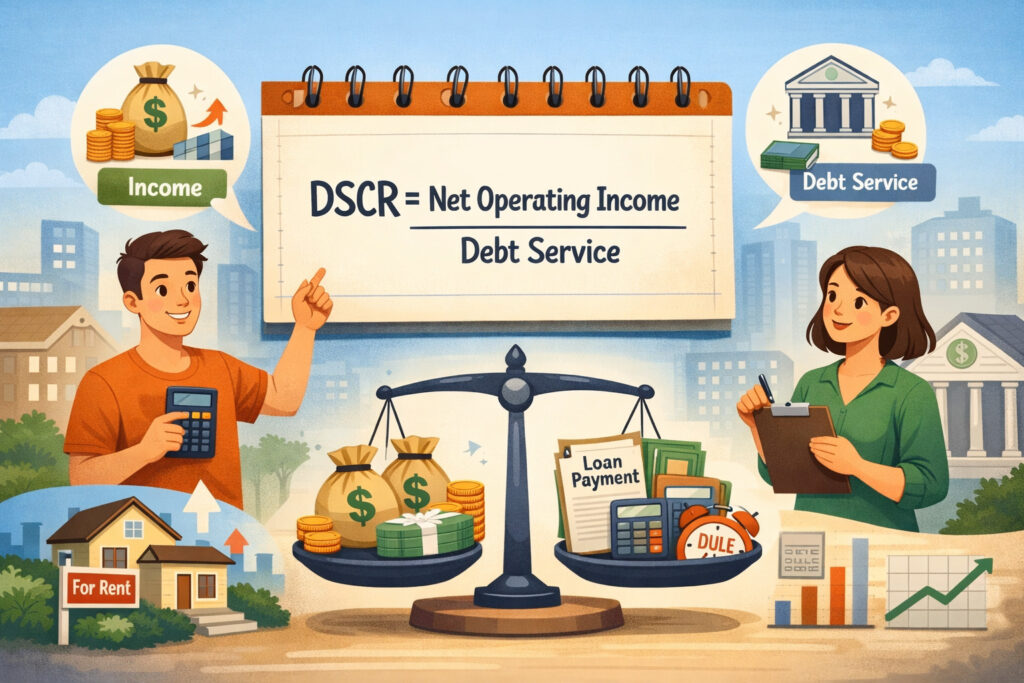
At its core, the DSCR formula explained is straightforward:
DSCR = Net Operating Income ÷ Total Debt Service
That single formula tells you how many dollars of qualifying income are available for every dollar of debt payment due. It sounds simple, but the real confusion usually comes from what belongs in “net operating income” and what belongs in “total debt service.”
If a business has $150,000 in qualifying operating income and $100,000 in total annual debt service, the DSCR is 1.50. That means the business generates $1.50 of income for every $1.00 of required debt payments.
If the same business had only $90,000 in qualifying income against $100,000 in debt service, the DSCR would be 0.90. In that case, it would not be generating enough to fully cover debt obligations from operations.
This is why DSCR is often considered one of the most practical business loan DSCR requirements. It does not just measure profitability in a broad sense. It focuses on whether debt can actually be paid.
Here is a simple breakdown:
| Component | What it generally means | Example |
| Net operating income | Income available from operations before debt payments | $180,000 |
| Total debt service | Principal + interest due on loans during the period | $120,000 |
| DSCR calculation | Net operating income ÷ total debt service | 1.50 |
A ratio above 1.00 means income exceeds required debt payments. The higher the ratio, the stronger the cushion. A ratio below 1.00 means the business would need to use reserves, owner contributions, or some other source to cover the gap.
What usually counts as net operating income or available cash flow
Net operating income is the most misunderstood part of the calculation. Different lenders may define it somewhat differently, but the idea is usually the same: how much income is truly available to service debt after normal operating expenses are paid.
In many business lending situations, lenders start with operating profit and then make adjustments. They may look at earnings before interest, taxes, depreciation, and amortization, or a related cash flow measure, depending on the loan type and underwriting method. The goal is to estimate recurring cash flow that can reasonably support repayment.
Items that often count toward available cash flow include:
- Revenue from normal business operations
- Less ordinary operating expenses such as payroll, rent, utilities, supplies, and insurance
- Sometimes non-cash expenses like depreciation and amortization are added back
- Sometimes certain one-time or owner-specific adjustments are reviewed
What generally does not count favorably is income that is unusual, non-recurring, or hard to rely on. A one-time asset sale, irregular legal settlement, or temporary spike in sales may not be treated as dependable support for debt repayment.
This matters because many borrowers accidentally overstate their DSCR by using income figures that look good on paper but do not reflect normal operating performance. Lenders usually want consistency, not best-case scenarios.
If your finances are messy, it becomes harder to present a strong DSCR clearly. That is one reason articles on getting approved for a small business loan often emphasize clean records and organized financial statements.
What counts as total debt service
Total debt service is the other side of the formula. It refers to the debt payments due during the measurement period, usually over a year. In most cases, that means both principal and interest payments on relevant business debt.
This can include:
- Existing term loan payments
- Commercial mortgage payments
- Equipment loan payments
- Vehicle loan payments
- Some recurring lease-like obligations, depending on underwriting
- The projected payment on the new loan being requested, if the lender is testing post-closing affordability
One common borrower mistake is counting only interest or only current debt, while ignoring the payment for the new financing request. Lenders usually want to know whether the business can handle the full debt picture, not just the obligations already on the books.
Another mistake is mixing monthly income with annual debt service, or annual income with monthly debt service. The time periods must match. If you use annual cash flow, use annual debt payments too. If you use monthly figures, keep the whole formula monthly.
How to calculate debt service coverage ratio step by step

To calculate debt service coverage ratio correctly, you need clean numbers and a consistent time period. The good news is that once you understand the inputs, the math itself is simple. The challenge is making sure you are using realistic figures rather than overly optimistic ones.
The safest way to approach the calculation is to build it in steps. That makes it easier to explain to a lender, accountant, or business partner, and it also reduces the risk of accidentally leaving out a debt payment or inflating cash flow.
Step 1: Identify the time period you are measuring
Start by deciding whether you are calculating DSCR on an annual or monthly basis. Annual calculations are more common because many lenders review business performance using annual financial statements or trailing twelve-month data. Monthly analysis can also be useful for internal planning, especially if your business has strong seasonality.
The key is consistency. If your income number covers twelve months, your debt service number must also cover twelve months. If you use one month of income, then use one month of debt obligations.
Annual measurement usually gives a fuller picture because it smooths out short-term highs and lows. That said, a lender may still look at recent monthly performance to confirm that current cash flow supports the annual story. A business that had a strong year but is weakening sharply in recent months may still face questions.
This first step sounds basic, but it matters because inconsistent timing can create a misleading ratio. A business may appear stronger or weaker than it really is if monthly and annual figures get mixed together.
Step 2: Calculate net operating income or qualifying cash flow
Next, determine the income available to cover debt service. This usually starts with revenue and subtracts ordinary operating expenses. Depending on the lender and the type of financial statements, certain non-cash expenses may be added back.
Suppose a business has these annual figures:
- Gross revenue: $900,000
- Operating expenses: $690,000
- Net operating income: $210,000
If this lender accepts that $210,000 as the qualifying income figure, that becomes the numerator in the DSCR formula. In other cases, the lender may adjust the number upward or downward based on tax returns, owner compensation, non-recurring expenses, or debt-related items.
This is why a borrower should not assume that the number on one line of the profit and loss statement will automatically become the official DSCR income figure. The more clearly you understand your lender’s method, the more accurately you can estimate your true ratio.
When preparing for financing, it can also help to review your credit profile and supporting documents. Resources on improving your business credit score before applying for a loan can complement DSCR preparation because lenders often review both repayment capacity and credit behavior together.
Step 3: Add up all required debt payments
Now total the debt payments due during the same period. This should usually include principal and interest on all relevant business debt. If you are applying for a new loan, include the expected payment for that loan as well if you want a realistic approval estimate.
Suppose the same business has:
- Existing equipment loan payments: $24,000 per year
- Existing term loan payments: $36,000 per year
- Proposed new loan payment: $40,000 per year
Total debt service would be $100,000.
Then the DSCR would be:
$210,000 ÷ $100,000 = 2.10
That is a strong result. It means the business generates $2.10 in qualifying income for every $1.00 of debt service. A lender would generally view that much more favorably than a ratio close to 1.00.
Be careful not to skip debts simply because they are manageable. DSCR is about the full repayment obligation, not just the debt you are worried about most.
Step 4: Interpret the result realistically
Once you have the ratio, the last step is interpretation. A ratio above 1.00 means the business can technically cover debt obligations. But lenders usually want more than bare minimum coverage. They want to see a cushion.
As a rough guide:
- Below 1.00: weak, not enough cash flow to cover debt fully
- Around 1.00 to 1.15: thin coverage, often risky
- Around 1.20 to 1.35: commonly acceptable range for many business loans
- Above 1.35: stronger coverage and more flexibility
- Above 1.50: often viewed as comfortably strong
These are general benchmarks, not hard rules. Business loan DSCR requirements vary by loan type, industry risk, collateral strength, borrower history, and lender policy.
Pro Tip: Run your DSCR using both current debt and projected debt after the new loan. That gives you a much clearer picture of whether the financing will still feel manageable after closing.
What is considered a good, average, or weak DSCR
Not all DSCR numbers are viewed the same way. Lenders typically interpret the ratio in ranges rather than as a simple pass-or-fail result. That is why understanding what is considered strong, average, or weak can help you plan before you apply.
A business with a DSCR of 1.05 may technically cover debt, but it has very little room for error. A small drop in sales, delayed customer payments, or increase in costs could quickly create repayment pressure. On the other hand, a business with a DSCR of 1.50 has a much larger cushion and usually presents less risk.
General DSCR benchmarks lenders often use
Here is a practical way to think about common lender expectations:
| DSCR Range | General interpretation | Likely lender reaction |
| Below 1.00 | Insufficient cash flow | High risk, often declined |
| 1.00–1.14 | Very thin coverage | May require strong compensating factors |
| 1.15–1.24 | Borderline to acceptable | Possible approval depending on the full file |
| 1.25–1.39 | Solid | Often meets common underwriting expectations |
| 1.40+ | Strong | More comfortable approval profile |
These ranges are not universal, but they reflect how many lenders think about DSCR for business loans. Some lenders may approve slightly lower ratios if the borrower has strong credit, significant collateral, a long profitable track record, or large cash reserves. Others may demand a stronger ratio for riskier industries or more complex loan structures.
In practice, many businesses hear that 1.25 is a meaningful target. That level suggests the company has a modest but real repayment cushion. It is one of the most common reference points in conversations about business loan DSCR requirements.
Why “good” DSCR depends on the borrowing situation
A good DSCR is not the same in every scenario. A lender financing owner-occupied commercial property may think differently than a lender making a short-term working capital loan. Equipment financing, real estate lending, acquisition financing, and refinancing can all involve different underwriting priorities.
For example, a business with highly predictable recurring revenue may be viewed more favorably at a lower ratio than a seasonal business with volatile cash flow. Likewise, a business with strong liquidity and little other debt may have more flexibility than one already carrying several loans.
That is why business owners should avoid chasing one magic number without context. Instead, ask what level would make the application comfortable for the specific lender and loan type involved.
If you are trying to improve your profile before applying, it can also help to strengthen the surrounding financial picture. Reviewing strategies for building an emergency fund for your business may support your overall lender readiness because cash reserves can help offset repayment risk.
How lenders use DSCR for business loans and loan approval
When lenders review financing requests, DSCR is often one of the first ratios they examine because it speaks directly to repayment ability. It is especially important in underwriting for established businesses, commercial real estate, and larger loan requests where cash flow analysis carries significant weight.
A lender may use DSCR at multiple points in the process. First, it can serve as an initial screening tool. If the ratio is clearly too low, the application may never move far in underwriting. Second, it can influence the loan amount, pricing, required collateral, and repayment terms. Third, it may continue to matter after approval if the loan agreement includes financial covenants.
In that sense, DSCR is not just a loan approval metric. It can affect the entire structure of the financing.
How DSCR affects approval, terms, and borrowing capacity
A strong DSCR can improve your overall financing profile in several ways. It may help support a larger approved amount, better rates, longer repayment periods, or fewer extra conditions. That is because the lender sees a more comfortable repayment cushion.
A weaker ratio can shrink borrowing capacity even if the business otherwise looks promising. The lender may conclude that the company can manage some debt, but not as much as requested. In that case, the loan amount may be reduced to keep the payment within acceptable DSCR limits.
This is a major reason borrowers should understand how to improve DSCR for loan approval before applying. Small changes to cash flow or debt structure can sometimes shift the result enough to move an application from borderline to workable.
Imagine two businesses with similar revenue. One has a DSCR of 1.45 and the other has 1.08. Even if both are profitable, the first one usually looks safer because it has much more room to absorb surprises without missing payments.
How DSCR is used in refinancing and financial planning
DSCR also matters beyond new loan applications. It plays an important role in refinancing because the lender wants to know whether the new structure improves or at least supports repayment. If refinancing lowers the payment and improves DSCR, that can strengthen the application. If the refinance increases payments too much, it may create problems.
For internal planning, DSCR can help answer questions like:
- Can the business afford a second location?
- Is it safe to add equipment financing this quarter?
- Would consolidating debt improve cash flow?
- Is the business carrying too much debt relative to earnings?
This is why monitoring debt service coverage ratio regularly supports long-term business health. It turns the ratio into a decision-making tool rather than just a bank requirement.
If a business is trying to free up more cash to strengthen its ratio, practical steps such as cutting costs without hurting growth can be especially relevant. Reducing waste while protecting revenue can improve DSCR without forcing the business to slow down unnecessarily.
Pro Tip: If your DSCR is borderline, ask whether changing the loan term would improve the ratio enough to qualify. Spreading payments over a longer period can sometimes help, though total borrowing cost may rise.
Practical DSCR examples for real-world business situations
Many business owners understand DSCR better once they see it in action. The formula is simple, but its impact becomes clearer when you compare strong and weak scenarios. The examples below show how the same business can produce very different borrowing outcomes depending on cash flow and debt structure.
Example 1: A strong DSCR for an expansion loan
Suppose a service business wants financing to open a second location. Its trailing annual financials show:
- Qualifying operating income: $240,000
- Existing annual debt service: $60,000
- Proposed annual payment on the new loan: $80,000
Total debt service after the new loan would be $140,000.
Now calculate DSCR:
$240,000 ÷ $140,000 = 1.71
A DSCR of 1.71 is strong. This suggests the business has substantial cash flow relative to its debt obligations. A lender would likely view this as a positive sign, assuming the rest of the file also looks stable.
Why this matters: the business is not just scraping by. It appears to have room for slower months, operational surprises, or a ramp-up period at the new location. That cushion can improve approval chances and may even strengthen the borrower’s negotiating position.
Example 2: A borderline DSCR for working capital financing
Now imagine a retail business applying for working capital. Its annual numbers are:
- Qualifying operating income: $110,000
- Existing annual debt service: $45,000
- Proposed annual payment on new financing: $50,000
Total debt service becomes $95,000.
DSCR:
$110,000 ÷ $95,000 = 1.16
A DSCR of 1.16 is not disastrous, but it is thin. The lender may worry that the business has only a small margin above its debt obligations. If revenue dips, if inventory costs rise, or if a slow season lasts longer than expected, repayment could become tight.
This borrower might still get approved, but the lender may ask for stronger compensating factors such as better collateral, stronger credit, more reserves, or a reduced loan amount.
Example 3: A weak DSCR that signals over-borrowing risk
Consider a business with:
- Qualifying operating income: $90,000
- Existing annual debt service: $55,000
- Proposed annual payment on new loan: $45,000
Total debt service: $100,000
DSCR:
$90,000 ÷ $100,000 = 0.90
This is a weak result. The business is not generating enough qualifying cash flow to cover total debt service. That does not necessarily mean the company is failing, but it does mean the requested financing likely adds too much payment burden for current performance.
In this case, the business may need to lower the requested amount, improve profitability, refinance existing debt, or wait until cash flow strengthens.
Pro Tip: When modeling financing options, run several DSCR scenarios. Compare the ratio under your best case, normal case, and slower-sales case. That gives a much more realistic picture than one optimistic forecast.
Common mistakes businesses make when calculating DSCR
A surprising number of businesses miscalculate DSCR, even when they understand the formula. The problem is usually not the math. It is the assumptions. Small errors in the inputs can produce a ratio that looks much stronger than the lender’s version, leading to confusion and disappointment during underwriting.
Mistake 1: Using revenue instead of true operating income
One of the biggest errors is starting with top-line revenue rather than income available after operating expenses. High sales do not automatically mean strong debt repayment ability. If payroll, rent, materials, and overhead consume most of that revenue, the business may have far less cash available than expected.
DSCR is not a sales ratio. It is a repayment capacity ratio. That means the number should reflect what remains after normal operating costs are accounted for.
Another version of this mistake is using a net income figure that has not been adjusted properly for the lender’s method. Some borrowers pull a number from the profit and loss statement and assume that is the final answer. In reality, the lender may make additions or subtractions based on non-cash expenses, owner compensation, unusual transactions, or one-time events.
Mistake 2: Leaving out debt obligations
A business may calculate current debt service correctly but forget to include the payment on the new financing request. That can make the pre-application ratio look strong while the lender’s post-closing ratio looks weak.
Other borrowers leave out smaller obligations because they seem manageable. But lenders often look at the full debt load, not just the largest loan. A vehicle payment, equipment lease, or existing line-related obligation can still affect the final ratio.
To calculate debt service coverage ratio accurately, include the debts that the lender is likely to consider relevant. If you are unsure, ask directly. A small omission can change the outcome.
Mistake 3: Mixing time periods and inconsistent data
Another common issue is mixing annual and monthly figures. A borrower may use annual cash flow but only one month of debt payments, or vice versa. That creates a misleading ratio that does not reflect real repayment capacity.
It is also risky to mix outdated income figures with current debt obligations. If your financials reflect an earlier performance level but your debt has recently increased, the ratio may overstate your current strength.
The cleanest method is to use a consistent measurement period and up-to-date records. That is especially important if your business has experienced recent changes in sales, costs, or debt load.
Mistake 4: Ignoring seasonality and one-time events
Seasonal businesses often run into trouble when they calculate DSCR based on a short strong period that does not reflect the full year. A great quarter does not always mean the annual debt burden is comfortable. Likewise, one-time cost savings or temporary sales spikes can make cash flow look stronger than normal.
Lenders usually prefer recurring, stable performance. That is why they may normalize income rather than simply accept the best recent month or quarter. Businesses should do the same when evaluating affordability internally.
DSCR vs other financial ratios: where it fits and why it stands out
DSCR is important, but it is not the only ratio lenders review. Business owners often hear about debt-to-income, current ratio, quick ratio, leverage ratios, and profitability ratios as well. Each one shows a different part of the financial picture.
What makes DSCR stand out is that it is directly tied to repayment ability. Many other ratios are useful, but they do not answer the debt-payment question as directly.
DSCR vs debt-to-income and leverage ratios
Debt-to-income ratios are commonly discussed in consumer lending, while leverage ratios look at how much debt a business carries compared with equity, assets, or earnings. These measures can show whether a company is heavily indebted, but they do not always show whether debt payments are manageable in practice.
A business could have a moderate overall debt load and still struggle with monthly payments if cash flow is inconsistent. On the other hand, a company with higher leverage might still perform well if cash flow is strong and predictable.
That is why lenders often view DSCR as more useful than a simple leverage snapshot when they are focused on repayment. The ratio connects income and debt service in a way that mirrors the real-world question: can this business make its payments from operations?
DSCR vs liquidity ratios like current ratio
Liquidity ratios such as the current ratio or quick ratio measure whether a business has enough short-term assets to cover short-term liabilities. These ratios are valuable because they show near-term financial flexibility. However, they do not fully capture ongoing loan affordability.
A business could have solid liquidity because it is holding cash temporarily, yet still have weak operating performance. Conversely, a business may have modest liquidity but strong steady cash flow that supports debt service well.
DSCR and liquidity ratios work best together. Liquidity shows short-term flexibility. DSCR shows debt repayment strength from operations. Lenders often like to see both, especially for larger financing requests.
Why lenders still come back to DSCR
Among all the available loan qualification metrics, DSCR remains one of the clearest because it is practical. It does not just describe financial structure. It connects earnings to required payments in a direct and understandable way.
For business owners, that makes it especially useful for planning. It helps answer not only whether a loan may be approved, but whether the loan is likely to feel sustainable after funding.
How to improve DSCR for loan approval and stronger financial health
If your ratio is lower than you want, the good news is that DSCR can often be improved. In fact, many businesses that struggle with loan approval are not far off. A few targeted changes to cash flow, expenses, or debt structure can make a meaningful difference.
When people search for ways to improve DSCR for loan approval, they often focus only on increasing sales. More revenue can help, but it is not the only path. Sometimes the fastest gains come from improving margins, lowering debt service, or restructuring obligations more intelligently.
Increase operating income without adding unnecessary strain
One clear way to improve debt service coverage ratio is to raise the amount of income available to cover debt. That can happen through revenue growth, higher margins, or both.
Practical ways to strengthen operating income include:
- Increase prices where the market allows
- Improve collections so receivables turn into cash faster
- Cut low-margin products or services that drain resources
- Focus sales efforts on your most profitable offerings
- Reduce waste, shrinkage, and inefficient spending
- Negotiate better vendor pricing
- Streamline staffing schedules or operating processes
The key is quality of earnings, not just bigger gross sales. If new revenue comes with heavy costs, the impact on DSCR may be limited. Stronger margins usually help more than growth that is expensive to produce.
Lower debt service or restructure existing obligations
The other side of the ratio is debt service. Reducing that burden can improve DSCR quickly, especially if existing payments are squeezing cash flow.
Possible strategies include:
- Refinance high-payment debt into longer-term financing
- Consolidate multiple obligations into one lower payment
- Pay down smaller balances before applying for new financing
- Delay non-essential borrowing until income improves
- Replace short-term expensive debt with more affordable structures
These steps can improve business loan DSCR requirements by lowering the denominator in the formula. Even if total debt remains similar, a more manageable payment schedule can strengthen the ratio enough to improve approval odds.
Just be careful not to focus only on the monthly payment while ignoring total borrowing cost. A longer term may improve DSCR, but it may also increase total interest paid.
Strengthen reserves and financial discipline
Although reserves do not directly enter the DSCR formula in every case, they still matter. A business with cash reserves, better budgeting discipline, and fewer emergency financing needs is often more stable overall.
That is one reason regular cash flow management matters so much. Businesses that prepare ahead can avoid expensive short-term debt that damages DSCR later.
Ways to support financial discipline include:
- Build a dedicated operating reserve
- Forecast debt payments well in advance
- Review recurring expenses quarterly
- Separate essential spending from nice-to-have spending
- Monitor profitability by product line or service category
- Revisit pricing and vendor contracts regularly
A stronger DSCR usually reflects stronger habits, not just one-time adjustments.
Why monitoring DSCR regularly supports long-term business success
Many businesses only think about DSCR when a lender asks for it. That is understandable, but it is not ideal. Monitoring debt service coverage ratio on a regular basis can improve financial decision-making even when no immediate loan application is planned.
When owners track DSCR consistently, they gain an early warning system. A declining ratio may reveal that expenses are rising faster than income, that debt is piling up, or that margins are getting squeezed. A rising ratio can signal that the business is becoming more financeable and more resilient.
Regular monitoring also helps with timing. Instead of applying for financing when cash flow is weak and hoping for the best, owners can choose a stronger moment when the ratio better supports approval. That can lead to better terms, more options, and less stress in the application process.
How often businesses should review DSCR
For many businesses, quarterly review is a practical starting point. That gives enough frequency to catch trends without becoming excessive. Businesses with thin margins, seasonal swings, or active growth plans may benefit from monthly review.
A regular DSCR review should look at:
- Current ratio based on trailing performance
- Projected ratio after any planned borrowing
- Trend compared with previous quarters
- Sensitivity to slower sales or higher expenses
- Debt maturity schedule and refinancing needs
This turns DSCR from a one-time underwriting number into a management tool. It helps the business stay proactive rather than reactive.
Using DSCR to guide growth decisions
Growth often requires borrowing, but not every business is ready for debt at the same time. Monitoring DSCR helps owners decide when growth is supportable and when it might create unnecessary strain.
For example, a business considering expansion can test whether projected income supports the new debt comfortably. If the ratio would fall too close to the edge, management might decide to wait, reduce the project size, or strengthen cash flow first.
This same approach applies to refinancing, hiring, equipment purchases, and large inventory commitments. DSCR helps answer a simple but crucial question: can the business take on this obligation without weakening financial stability too much?
Is debt service coverage ratio the same as profit margin?
No. Profit margin shows how much profit a business keeps from revenue, while debt service coverage ratio shows whether the business has enough qualifying income to cover debt payments. A company can have a decent profit margin and still have weak DSCR if debt obligations are too high. DSCR is more directly tied to loan affordability, which is why lenders rely on it so heavily.
Can a startup have a strong DSCR?
Yes, but it is less common because many startups do not yet have stable operating income. DSCR works best when a business has an established record of dependable cash flow. Newer businesses may still qualify for financing, but lenders often look more closely at credit, collateral, guarantees, and business plans when operating history is limited.
Do all lenders use the same DSCR requirements?
No. DSCR requirements vary by lender, loan type, industry, collateral, and risk level. One lender may be comfortable with a lower ratio, while another may want a stronger cushion. The way lenders define qualifying income and debt service can also differ, which is why it helps to ask how they calculate DSCR before applying.
Does a higher DSCR always mean a business should borrow more?
Not necessarily. A higher DSCR usually means the business has a stronger repayment cushion, which is a positive sign. However, taking on more debt should still match the business’s goals, cash flow stability, and return on investment. Just because a business can borrow more does not always mean it should.
Can DSCR improve without increasing sales?
Yes. Many businesses improve DSCR by reducing operating expenses, improving margins, refinancing debt into lower payments, or paying down existing balances. Sales growth can help, but it is not the only way to strengthen the ratio. Better cost control and smarter debt management can make a big difference.
Why does a lender’s DSCR calculation sometimes differ from mine?
Lenders often use their own method for calculating qualifying income and total debt service. They may remove one-time income, add back certain expenses, or include the payment for the new loan being requested. That can make their final DSCR different from a borrower’s estimate. Asking about their calculation method early can help avoid surprises.
Conclusion
The debt service coverage ratio (DSCR) is one of the most important numbers in business lending because it answers a practical question that matters to both lenders and owners: is there enough cash flow to cover debt payments with confidence?
That is why it plays such a central role in loan approval, refinancing decisions, borrowing capacity, and long-term financial planning.
A strong DSCR can open doors to better financing opportunities and give your business more room to grow responsibly. A weak DSCR can be a warning sign that debt is too heavy for current cash flow or that operations need attention before more borrowing makes sense. Either way, the ratio gives you useful insight.
If you understand the DSCR formula explained, know how to calculate debt service coverage ratio correctly, and review it regularly, you will be in a much stronger position to make smart borrowing decisions.
More importantly, you will be using DSCR not just as a lender requirement, but as a practical tool for protecting your business and planning its next move wisely.